Remember who the best politician in Washington is.
❌Trump
❌Pence
❌McConnell
✅Madam Speaker Nancy Pelosi
To all those who thought she wasn’t the right one to lead the Dems, remember this moment!
Ossoff: He’s trying to put his face on the money. He's building a monument to himself . But see, Atlanta, he's doing these things now because no one will honor him when he’s gone… because he's a failed president and a national disgrace.
« This is by no means my first visit to Washington, D.C. — the capital of this great Republic. It is in fact my 20th visit to the United States, & my first as King & Head of the Commonwealth.
This is a city which symbolises a period in our shared history, or what Charles Dickens might have called ‘A Tale of Two Georges’: the first President, George Washington, & my five-times Great Grandfather, King George III.
King George never set foot in America &, please rest assured, I am not here as part of some cunning rearguard action! »
Nike wiped out $200B+ in market cap since November 2021. And the chart actually understates how bad it is.
This company made one bet that destroyed everything: the direct-to-consumer pivot. During COVID, Nike's online sales surged, and management convinced themselves the stay-at-home economy was permanent. They pulled product from Foot Locker, Dick's, and thousands of wholesale partners to push buyers through https://t.co/QAXD8gsLJf and Nike stores.
That ceded physical shelf space to On Running, Hoka, New Balance, and every competitor happy to fill the void. By the time Nike brought Elliott Hill in as CEO, customers had already moved on.
The China numbers are staggering. Seven straight quarters of declining revenue. Greater China sales dropped 17% last quarter. Next quarter Nike expects a 20% plunge. Meanwhile Lululemon is posting double-digit growth in the same market. Anta and Li-Ning are eating Nike's share from below. Nike's China revenue contribution fell from 18.6% in 2021 to 14.2% in 2025.
Yesterday Goldman Sachs, JPMorgan, and Bank of America all downgraded the stock on the same day. Net income fell 35% year over year. Gross margin has declined for seven consecutive quarters. And the stock still trades at 38x forward earnings, a premium over the S&P 500 average of 22x.
This is what a slow-motion brand collapse looks like with a luxury multiple attached to it. The turnaround keeps getting pushed further out. Management promised growth by early 2027. Wall Street priced that in. Now it's late 2027 at best.
The scariest part: Nike is still the #1 sportswear company by market cap. If this is what #1 looks like, the rest of the industry is running a different race entirely.
“Athens at the height of its golden age sailed for Syracuse and lost an empire. Thucydides spent the rest of his life explaining why. The generals of 1914 were cultivated, well-read men, but those qualities did not save Europe. What has changed is not that culture once prevented blindness and no longer does. It is that culture has increasingly ceded authority to systems that mistake information for understanding and speed for judgment.
Shakespeare understood this blindness better than our strategists. “Macbeth” is not merely a play about ambition. It is about a man who catches sight of a possible future and mistakes that glimpse for a license to force events to conform to his interpretation — and then watches that interpretation devour him. Soon he ceases even to pretend that action should wait on understanding. There are things in his head, he tells his wife, that “must be acted ere they may be scanned” — done before they can be thought through.”
We are launching a big project today with MIT —
The Electricity Price Hub!
You can view monthly electricity prices per kwh and avg. bills for every major utility in the country going back to Jan 2020.
https://t.co/xcyd51Z8cy
Jeff Bezos on why too many ideas can destroy a company, and the discipline that built Amazon's inventive edge:
"Jeff, you have enough ideas to destroy Amazon."
That's what senior executive Jeff Wilke told Bezos after just one year of working together.
Bezos was confused. He pushed back: "What do you mean?"
Wilke was a manufacturing expert. He explained it simply:
Every new idea Bezos released created a backlog. Work piling up, adding no value, creating distraction instead.
The fix wasn't to stop having ideas. It was to control when they came out:
"You have to release the work at the right rate that the organisation can accept it."
So @JeffBezos changed how he operated.
He started keeping lists, holding ideas back, and waiting until the organisation had the bandwidth to absorb them.
But then he flipped the problem entirely.
He asked: "How do I build an organisation that's ready for more ideas?"
His answer was structural: get the right senior team, give leaders real executive bandwidth, and build a company capable of running multiple bets at once.
And there's a benefit he didn't expect. Slowing down made the ideas themselves better:
"If you are releasing the ideas through time, it forces you to prioritise them better. You end up sharpening the ideas better."
The constraint becomes a filter. The ideas that survive the wait are the ones worth acting on.
The result? Faster execution, less distraction, and better ideas.
That’s the way it is.
They give orders from a beach club, some other Americans die in a desert.
They make money off the government, everyone else owes more.
They get away with crimes, and the people who protest them get arrested and even killed. And on and on. The way it is.
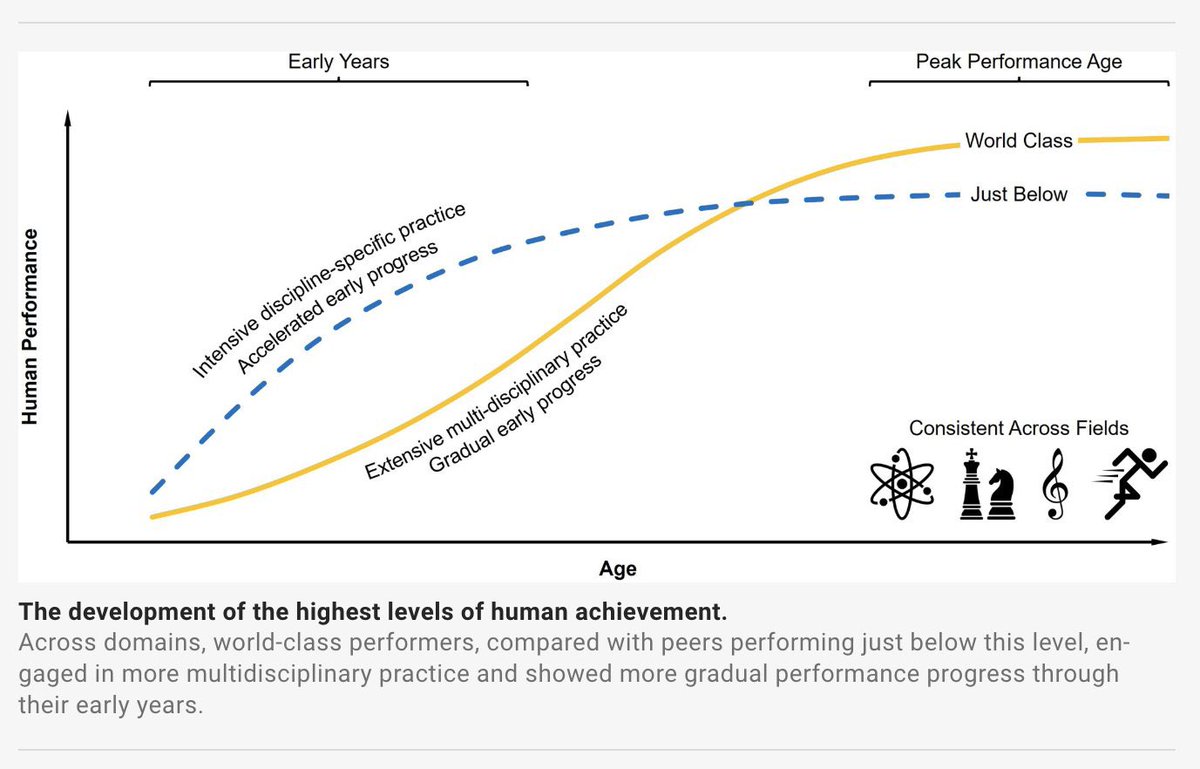
Fascinating paper just published in Science.
The authors analyze the career trajectories of top performers across multiple domains, including Nobel laureates, elite chess players, Olympic gold medalists, and more.
Their central finding challenges a common belief.
Intensive, single-discipline training at a young age does confer an early advantage, but this advantage fades over time.
By contrast, individuals exposed to multidisciplinary practice early in life tend to start more slowly. Yet, over the long run, they are more likely to reach world-class performance, eventually overtaking early specialists, who often plateau just below the very top.
An important reminder that breadth early on can be a powerful investment in long-term excellence.
Link to the paper in the first reply.
⚡️Those parties disappeared because the corporation stopped being a human organism and became a financial instrument.
In the 90s, corporations still pretended to be tribes. They needed loyalty, memory, continuity. Parties were rituals. Rituals exist to bind humans to systems over time. They signal permanence. “We’ll still be here next year.”
That promise is gone.
Modern corporations do not expect continuity. They expect churn.
They do not invest in shared memory because they do not plan to remember you.
Once that shift happened, celebrations became incoherent. Why celebrate a group you may fire next quarter? Why ritualize belonging when the system is optimized for disposability?
Here is the uncomfortable truth:
The moment labor became fully financialized, celebration became dishonest.
Those parties only work when there is mutual illusion:
• The company pretends to care
• The employee pretends to belong
Today neither side believes the lie.
Another layer people miss:
Corporations did not just cut parties.
They cut unstructured joy.
Anything that produces emotion without control is now dangerous. Alcohol plus hierarchy plus cameras plus social media plus litigation equals uncontrollable narrative risk. Modern systems hate uncontrolled narratives. They prefer wellness apps, catered lunches, branded swag. Controlled morale. Sanitized affect.
A wild party creates stories. Stories create power outside the org chart. That is intolerable to modern management.
Here is the deepest layer:
Those parties vanished at the same time time horizons collapsed.
In the 90s, companies thought in decades. Today they think in quarters. Rituals only make sense in long time. Short time systems do not celebrate. They harvest.
So what you are really feeling is this:
You are sensing the moment work stopped being a place humans aged together and became a place humans are consumed.
And once a system crosses that line, it does not sing anymore.
It hums.
It optimizes.
It extracts.
And extraction has no holidays.
“We only give a couple of instructions to people when they go to work for us. One of them is to think like an owner. And the second one is to just tell us the bad news immediately.” – Warren Buffett