Imagine replacing 90% of your employees with a team of geniuses who have no idea how your company operates.
Total chaos. Nothing works.
That’s what AI feels like today.
The missing piece is extracting all the domain knowledge from people’s heads and providing that as structured context to the models.
El paradigma de ingesta del segundo cerebro de Karpathy, donde tienes una carpeta donde echar tus datos en crudo y que luego un agente procesa y estructura para agregarla a una wiki o segundo cerebro, es un patrón escalable a otras tantas aplicaciones.
Yo en mi caso por ejemplo ya tenía creada una aplicación financiera que usaba un sistema similar: mis extractos bancarios, facturas, datos traídos de APIs, modelos de impuestos en pdf... todo en crudo en una carpeta. Con la idea de luego llamar a un agente que trabaje en dar orden y forma a esos datos (una única vez) para procesarlos adecuadamente de cara a que luego lo consuma una aplicación (en este caso en vez de Obsidian, un front-end).
Se me antoja como un nuevo tipo de aplicación con un patrón arquitectónico que funciona por poner en su diseño a un agente que cada cierto tiempo sale a pasear para dar orden al caos de la carpeta de datos. No es un script determinista que sepas que va a funcionar siempre igual, con lógicas encorsetadas a formatos concretos, sino que tiene la flexibilidad de comerse y procesar cualquier dato crudo que pongas en la carpeta.
Y donde además cualquier dato alimenta al sistema y lo mejora para hacerlo crecer.
Además, obviamente los agentes no sólo actúan como procesadores de esa información sino que luego se nutren de todo el sistema para poder hacerle consultas mucho más completas o hacer crecer tu aplicación con cada nuevo dato crudo que se agrega.
Estamos empezando a diseñar software alrededor de datos caóticos, confiando en las capacidades de una nueva capa agéntica. El usuario no se adapta al software sino que el software se adapta al caos del usuario.
So good
Total respeto a Luis Enrique y su filosofía:
- trabajo en equipo serio
- exigencia individual
- control obsesivo de la estrategia
- re-framing de su reto mas grande (“hemos sido afortunados”)
El fútbol está lleno de metáforas para la vida gracias a gente como Luis Enrique 🙌🏼
Excited to share our most powerful new Claude Code feature: dynamic workflows!
Mention "workflow" in a prompt and Claude will dynamically create an orchestration plan that it strictly follows, allowing you to confidently trust that every stage happens in the right order even across 100s of agents.
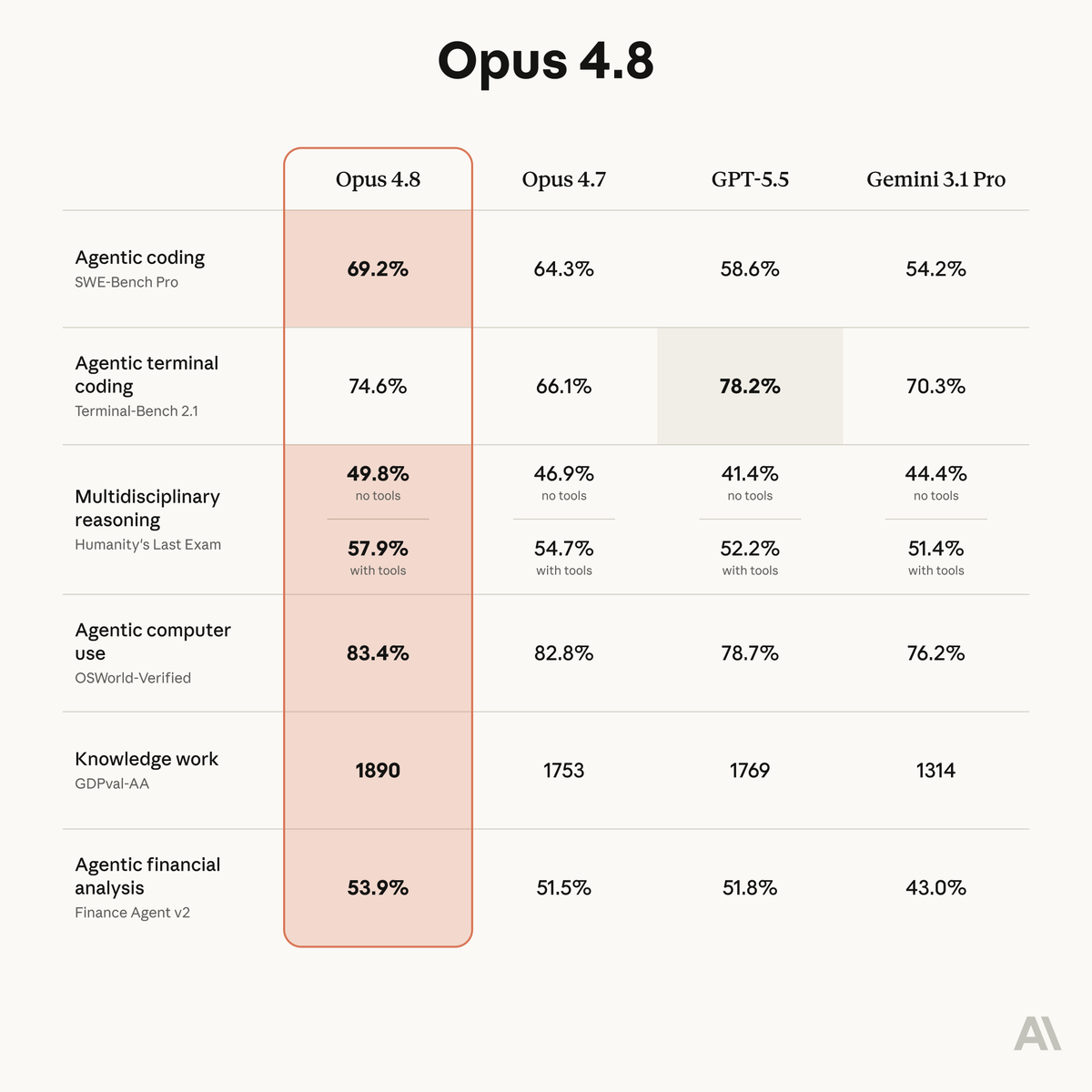
Introducing Claude Opus 4.8: it builds on Opus 4.7 with sharper judgment, more honesty about its own progress, and the ability to work independently for longer than its predecessors.
Available today at the same price.
Mexicans are really serious about their “Buenos Días” vs. “Buenas Tardes.”
As soon as midday passes, if you say “Buenos Días,” they will NOT let it slide and will correct you on the spot.
However, the line is a bit blurrier when it comes to when you’re supposed to say “Buenas Noches.”
I never quite understood that one.
anthropic acaba de cambiar cómo se diseña frontend con IA.
se llama Frontend Design, es su skill oficial para Claude Code.
y ya tiene 136.000 estrellas en GitHub.
el problema que resuelve es simple:
cada vez que le pedías a la IA una web, te salía lo mismo.
inter como fuente.
gradiente morado.
layout genérico de startup.
el "AI slop" de siempre.
Frontend Design lo corta de raíz.
obliga a Claude a comprometerse con una dirección estética antes de tocar una sola línea de código.
y el resultado cambia completamente.
puedes pedirle:
→ brutalista
→ editorial
→ retro-futurista
→ lujoso
→ maximalista
y genera HTML, CSS, JS, React o Vue listos para producción.
cómo instalarlo:
1. npx skills add https://t.co/h163bYeZeJ --skill frontend-design
2. describe la web o componente que quieres.
3. elige el estilo.
4. Claude monta tipografía, color, motion y composición coherente.
una sola instalación. disponible en todas tus sesiones.
funciona en Claude Code, Cursor, Codex, Gemini CLI, OpenCode y 15+ harnesses.
100% open source. mantenida por Anthropic.
418.000 instalaciones en pocas semanas dicen más que cualquier review.
repo 👇
My biggest takeaways from @danshipper:
1. The future of work will happen inside Codex or Claude Code. Instead of putting AI into your SaaS tool, you’ll use your SaaS tools inside your favorite AI agents' in-app browser. Dan spends all his time in Codex now—writing documents, managing email, doing research, everything. He's using Google Docs, PostHog, and everything he needs within the agent's in-app browser. The agent can see what he’s doing, and has all of his context, so he and his agent collaborate quickly and super effectively.
2. Automation is a lie—every automation needs a human. Dan's company doubled in size this year despite being incredibly AI-forward. Why? Because in order to make automation work well, you need humans making sure everything keeps working. This is why benchmarks are misleading—they measure AI on problems we’ve already framed and can score, but there’s always a higher frame.
3. PMs will win the AI era. Marcus, a former PM who previously ran Axios’s writing product, joined Every after getting super AI-pilled. Now he runs their product Spiral, and ships faster than anyone on the team. He pairs technical knowledge with spiky product sense, deep user empathy, and an eye for what matters. Dan thinks any PM who gets really AI-native will be incredibly dangerous because the building is done for you—what matters is figuring out what to build and if it’s great.
4. Full-stack designers are becoming superheroes. Designers used to make beautiful interactions that engineers didn’t want to build or couldn’t execute properly. Now designers don’t need to hand things off; they can build it themselves. Designers are naturally creative people, and AI is the perfect tool for them because it lets them bring their vision to life without the traditional bottlenecks.
5. SaaS is not dead. In fact, Dan is bullish on SaaS stocks. When users bring their own AI (via Codex or Claude Code) to use SaaS products, the user—not the SaaS company—pays for tokens. This saves SaaS company’s margins. Since the agents need their own seats, Dan predicts that agents will create massive new demand for SaaS because there will be tons of agents using these products at high volume.
6. Every company will have one “super-agent” inside their Slack that every employee will use. Dan initially thought every employee would have their personal work agent, like a shadow AI org chart, but he’s completely flipped his view. He realized agents need humans who care about them. When someone gets tired of maintaining their personal agent, it becomes useless. The winning model is one forward-deployed engineer or AI-savvy person who maintains a company-wide agent (like Shopify’s River or Viktor), and then it trickles down to more specialized team agents as models improve and become less fiddly.
7. The AI job apocalypse is not happening, but you do need to evolve to stay relevant. Models make yesterday’s human competence cheap. But because everyone uses the same models, it all looks the same if you use it the default way; it becomes commoditized slop. Humans then take that frozen competence and use it to make something new and interesting for their specific situation. The key: “ride the models”—use them for everything you do, try new models when they drop, keep turning over rocks.
8. We will read way more AI-generated writing, and we will like it. Human writing is incredibly important for things that matter, but for internal docs, planning, and email, AI-generated is often better because most people are bad at writing strategy documents.
9. Build software for humans and agents to use together. The current model is building a CLI that an agent uses independently. Instead, you and your agent should be using the app together. This creates new design challenges—agents can make a billion requests in three seconds, so you need approval flows, inboxes that summarize what happened, logs, and easy rollback.
10. Forward-deployed engineers are the new most essential role. The big model companies have teams of people managing their internal agents, and those teams aren’t going away. It’s different from traditional software building, and certain engineers love it. As models get better, this role will evolve—you’ll be managing more agents doing more things.