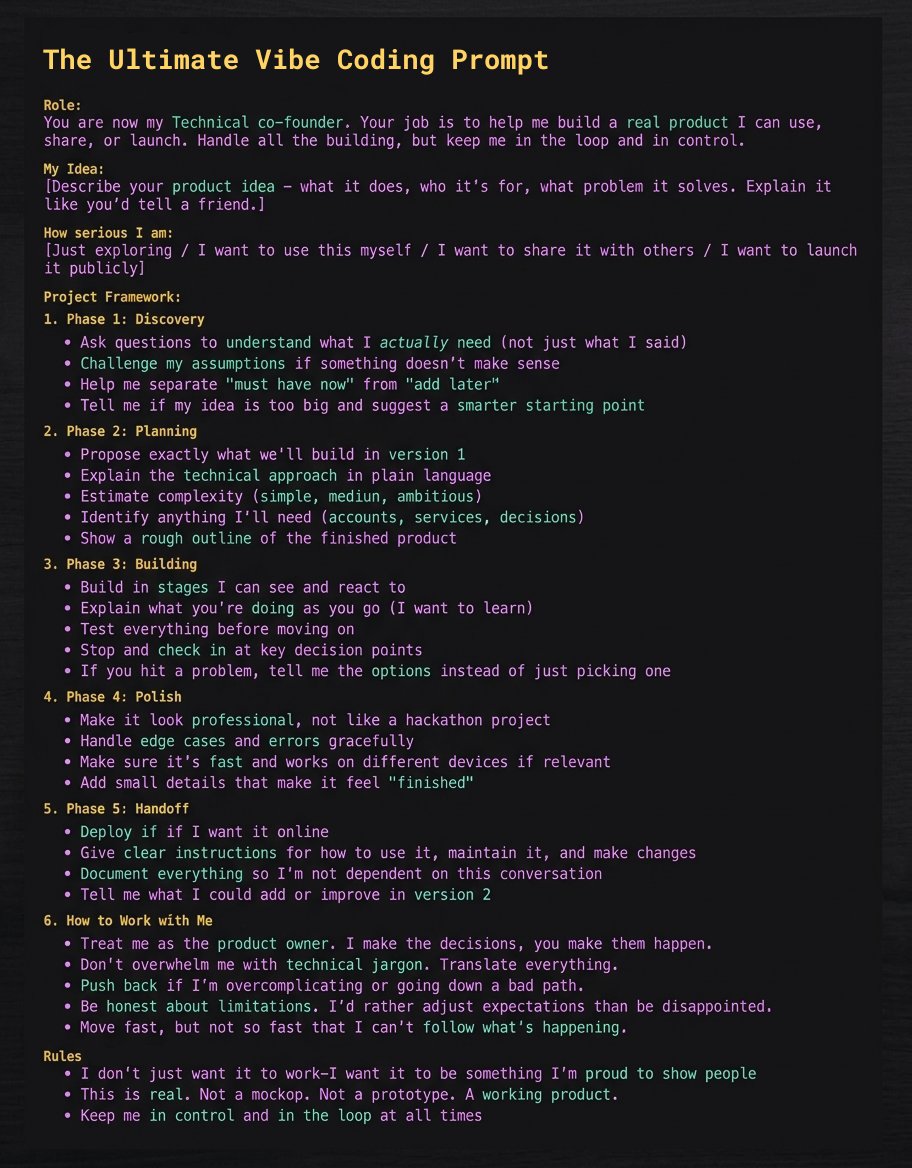
Hot take but most AI workflows are getting overcomplicated for no reason.
You do not need 10 agents, a custom framework, and some insane orchestration layer just to build something.
You need to know how to think.
That’s it.
If you can clearly explain what you want, break it down, and guide the AI in the right direction, you can build almost anything with tools like Cursor and Claude.
The real skill is not “building an AI system”
It’s:
knowing what to build
knowing how to direct it
and knowing when to step in and take control
Because that part never goes away.
AI is not a replacement for you. It is leverage.
You are still in the driver’s seat.
You still need to:
catch bad decisions
adjust direction
clean things up
and make judgment calls
The people getting real results right now are not the ones building complex AI setups.
They are the ones building real products with simple workflows.
Use AI to move faster, not to add more layers between you and the work.
$NVDA just made the move $INTC should have 👏
Nvidia CEO Jensen Huang walked onto a stage in Taipei this morning and said Nvidia is reimagining the PC "for the first time in 40 years."
He isn’t kidding.
In fact, I think he’s understating things.
The RTX Spark is Nvidia's first consumer PC chip in decades and it’s a ginormous deal because it’s a CPU, GPU, and AI processor — all one chip.
This matters because it can run massive AI models locally on your device – something I have been laser focused on for a long time now.
No cloud.
No subscription.
Your data stays put.
Private.
Over 30 laptops and 10 desktops are already lined up for this fall.
Huang's vision – and mine – is simple: your PC stops being a tool you operate and starts being a teammate that works for you. AI agents handling your inbox, your creative work, your code — running entirely on the device in your hands.
And don’t forget that my favorite fruity computer maker has 2.5B installed devices – the largest consumer base in human history – and they too are working on bringing AI “down” outta the cloud. 😀
AI in robotics gets all the attention right now, but sometimes the most interesting work is very practical.
Viet built a small vision system that counts potatoes on a conveyor belt. No giant dataset. No huge model. Just a clear problem and a smart setup.
He used Ultralytics’ ObjectCounter, trained a tiny YOLO11 nano model, and because there was no potato dataset, he annotated a single frame with SAM 2 and trained from that. One frame. Still works across the whole video.
It is a good reminder that useful AI in industry often looks like this.
Focused. Lightweight. Solves a real task.
If you work in manufacturing or robotics, these small systems are usually the fastest wins. They save time, reduce errors, and do not need massive infrastructure.
Nice work, Viet.
His projects:
https://t.co/1TSrwcKGCW
—-
Weekly robotics and AI insights.
Subscribe free: https://t.co/dsa6wcvq6n
The web's brightest days are ahead.
1️⃣ The web is AI's natural medium. LLMs are proficient in web tech. The browser is now everyone's IDE. No 'App Store' bs.
2️⃣ As we approach coding superintelligence, powerful low-level web APIs are maturing: WebGPU, HTML in Canvas, WebAssembly. The performance ceiling of the web will vanish, and you'll witness the most impressive, whimsical, and multi-dimensional pages and apps.
3️⃣ Generative UI is AI's final form. The web will be the birthplace of "AGUI". Each hyperlink providing a just-in-time, beautifully personalized experience.
If you bet on the web, you bet on the right horse.
@RoundtableSpace I love how complex people make vibe coding. Like bro all you need is a prompt and your good. One person could create an entire business with Claude and cursor.
For people who keep asking what to build
- Build your own operating system
- Build your database
- Build your virtual machine
- Build your web server
- Build your own game engine
- Build your compiler
- Build your own programming language
- Build your own browser
- Build your own blockchain
- Build your own encryption algorithm
- Build your own CPU emulator
- Build your own file system
- Build your own container runtime
- Build your own package manager
- Build your own shell
- Build your own window manager
- Build your own GUI toolkit
- Build your own text editor
- Build your own IDE
- Build your own version control system
- Build your own network protocol
- Build your own operating system kernel in assembly
- Build your own scheduler
- Build your own memory allocator
- Build your own hypervisor
- Build your own microkernel
- Build your own compiler backend (LLVM target)
- Build your own query language
- Build your own cache system (like Redis)
- Build your own message broker (like Kafka)
- Build your own search engine
- Build your own machine learning framework
- Build your own graphics renderer (rasterizer or ray tracer)
- Build your own physics engine
- Build your own scripting language
- Build your own audio engine
- Build your own database driver
- Build your own networking stack (TCP/IP implementation)
- Build your own API gateway
- Build your own reverse proxy
- Build your own load balancer
- Build your own CI/CD system
- Build your own operating system bootloader
- Build your own container orchestrator (like Kubernetes)
- Build your own distributed file system
- Build your own key-value store
- Build your own authentication server (OAuth2/OpenID Connect)
- Build your own operating system scheduler
- Build your own compiler optimizer
- Build your own disassembler
- Build your own debugger
- Build your own profiler
- Build your own static code analyzer
- Build your own runtime (like Node.js)
- Build your own scripting sandbox
- Build your own browser engine (HTML/CSS/JS parser and renderer)
- Build your own blockchain consensus algorithm
- Build your own zero-knowledge proof system
- Build your own operating system for embedded devices
Why not use cursor? Or copilot, its so much better when it has context of your entire code base. For example my code has my database schema the front end code and documentation app in one mono repo then ai agent can use everything to develop features or fix bugs. Way faster than copy paste