@TihoBrkan I keep thinking about your post. I’d love to hear how you’d define the “top 500 best properties.” Would you rank them by income/population growth, rental yield, location quality, flip potential, or something else?
Two weeks without mobile internet improved mental health more than antidepressants and reversed roughly 10 years of attentional decline.
Screen time dropped 49% (314 to 161 min/day).
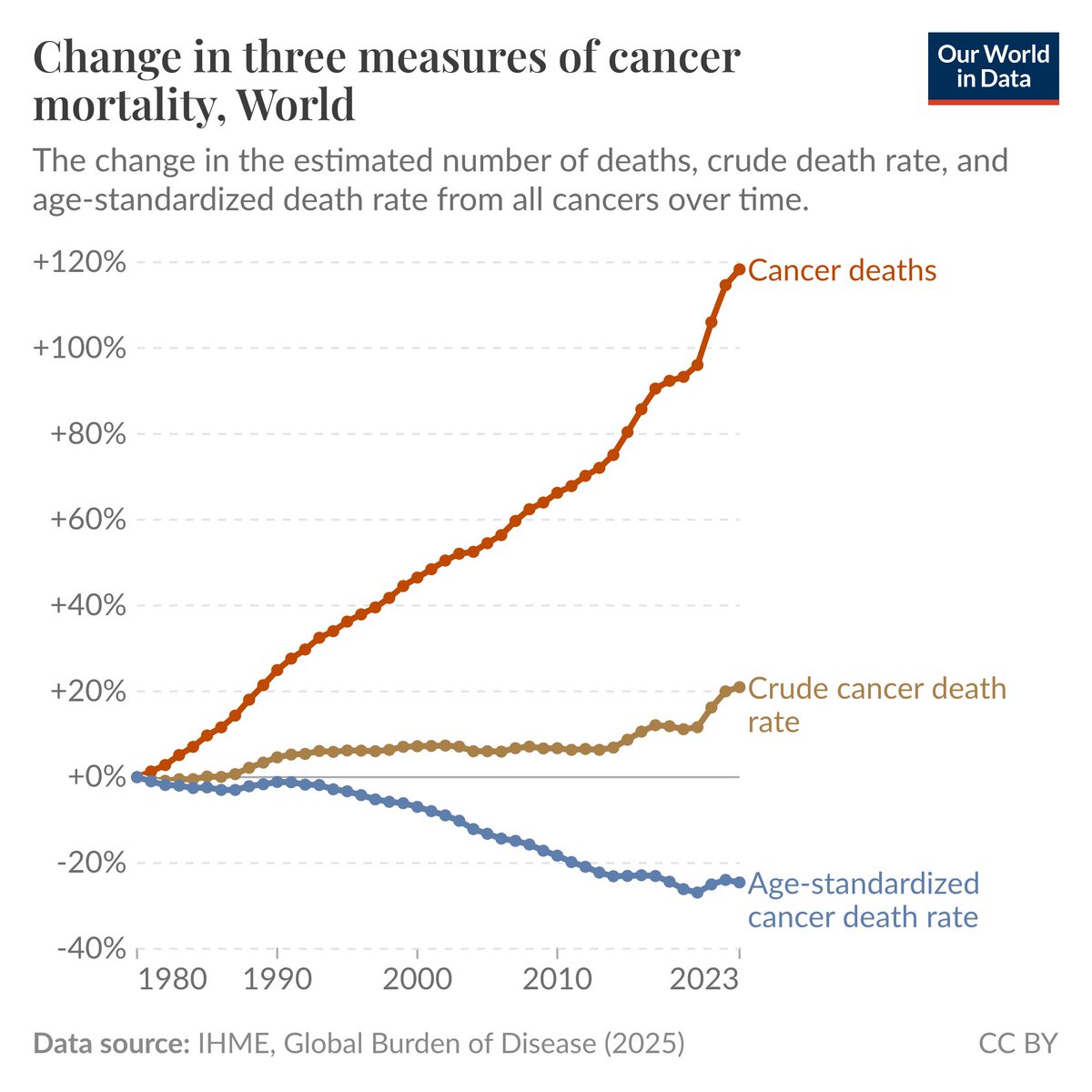
The number of cancer deaths worldwide has more than doubled since the 1980s. Does that mean we're losing the fight against cancer? Not necessarily, because it depends on how you measure it. On this chart, you can see three ways to look at the same data.
The red line shows the total number of cancer deaths. It has increased by about 120%, but this measure doesn't account for the fact that the world's population has also grown enormously over this period.
Another approach is to look at the death rate: the number of cancer deaths divided by the total population. That's the brown line, called the crude cancer death rate. It has increased too, but much less — around 20%.
But there's still a problem: the world's population has been getting older. Cancer is mostly a disease of old age, so even per capita, we'd expect more cancer deaths simply because there are more older people than before.
That's where the method of “age standardization” comes in. It's a way of asking: what would the cancer death rate look like if the age structure of the population hadn't changed?
The blue line shows this age-standardized rate: it's fallen by about 25%. At any given age, people are now less likely to die of cancer than they were in the 1980s.
The same underlying data gives us three different pictures. The absolute number of deaths is up; the crude rate is up slightly; the age-standardized rate is down. None of these are inaccurate, but they answer different questions.
Age standardization is one of the most important statistical methods for making sense of health data. Without it, population aging can hide progress or mask problems.
Sieć sklepów Lidl całkowicie wycofała ze sprzedaży jajka z chowu klatkowego. Oznacza to, że klienci nie znajdą już na półkach tzw. „trójek”.
Obecnie w sklepach dostępne są wyłącznie jaja ściółkowe, z wolnego wybiegu oraz ekologiczne.
@tobaccoinsider They didn’t mention it anywhere so it’s just your speculation. You should mention it clearer, I’ve misinterpreted your tweet when I’ve read it.
Biblioteka opensource do "deblurowania obrazów"
W testach udostępnionych przez twórców dobrze odszyfrowuje, sam jeszcze nie testowałem.
Jakby ktoś chciał przetestować, to wszystko jest na githubie i można łatwo odpalić po instrukcji:
github . com/DachunKai/Ev-DeblurVSR
🤖AI zjada Internet🕸️
Niedawno dowiedzieliśmy się, że Stack Overflow - forum dla programistów, które darzymy sentymentem już w zasadzie wyzionął ducha.
Czemu? Bo ChatGPT lub inny Copilot jest szybszy i prawie równie dobry.
To część szerszego zjawiska...🧶[1/6]
Announcing a new chapter for AI agents: Lindy 3.0.
Our vision has always been the "Al employee": as capable as humans (can do anything on a computer) and as easy to use (just ask).
3.0 takes 3 giant steps in this direction, with Agent Builder, Autopilot, and Team Collaboration.
@UnfairValue1 💯i niestety żadne z tych tematów nie są nawet poruszane w debacie publicznej.
W ostatniej kampanii prezydenckiej kandydaci też znaleźli „ważniejsze” kwestie.



![Pekao_Analizy's tweet photo. 🤖AI zjada Internet🕸️
Niedawno dowiedzieliśmy się, że Stack Overflow - forum dla programistów, które darzymy sentymentem już w zasadzie wyzionął ducha.
Czemu? Bo ChatGPT lub inny Copilot jest szybszy i prawie równie dobry.
To część szerszego zjawiska...🧶[1/6]](https://pbs.twimg.com/media/G1MxN9DXAAAqzZg.png)


