I do love that central banks are buying at the fastest pace in decades and the US debt just crossed $37 trillion. If you think the dollar weakens from here, gold and silver are a legitimate hedge.
But I'd push back on calling it a no brainer brother. Remember this, gold returned 0% from 2011 to 2020 while the S&P tripled. It pays no yield, no dividends, and in a real deflationary crash (like 2008), gold initially sold off too as everyone liquidated everything for cash.
the practical move is allocation, not all or nothing in my opinion brother. A 5-10% position in gold (GLD, IAU) or miners (GDX) as portfolio insurance makes sense.
For me, I'm never extreme. I'm always balanced with tilts in certain directions, and a cautious bull at all-times.
If you are expecting the crash within a few months, buying the 2 year at 4.80% is safer from a capital preservation perspective than the 10 year at 5.30%, while only giving up 50BP of yield (the curve is too flat!).
Yes the 10 year will (probably) rally when the crash happens, but the question is what level will it rally FROM? If it goes to 6% and you have bought at 5.30%, you may be out of the money when you look to sell your 10 year to buy stocks, by up to 5% on price
No strong conviction but I have been in the bond market for 33 years and not feeling too bullish on the long end here (yet)
Save this. This is the most important post you'll ever see.
With BOTH the 10-year yields and the U.S. dollar rising, here is how to plan for the worst-case scenario. I've experienced this market scenario already in my life.
Markets kept making all-time highs for 4 - 5 months, and then a -57% crash happened in the markets. But rising yields and dollar rising does NOT crash the markets alone. Something UNDERNEATH is typically the trigger.
The 2026 - 2027 triggers would be:
1. Private credit - this is the scarier one in my opinion. Seven major platforms (Blue Owl, Apollo, Ares, BlackRock, and Blackstone) have capped or blocked investor withdrawals. $4.6 billion is trapped basically.
2. Auto loan delinquencies hit a record - 5.5% at 90+ days, worse than 2008 peak (5.3%). The consumer is cracking at the bottom.
3. Commercial real estate is at record deliquicieis - office CMBS delinquiency at 12.3%, higher than 2008 crisis.
4. Corporate bankruptcies at 16 year highs - 372 large filings through mid-2026. Small business bankrupties up 50% as well.
5. S&P 500 is looking a lie right now - every sector fell in Sept except for tech - banks, utilities, equal weight S&P 500, only a few BIG tech names are holding up the markets
6. Six banks have failed in 2026 - small ones, but the most in any year this decade.
I find that the pattern is the same throughout our history; rates stay high, something that was relying on cheap money can't handle it, then that thing breaks, the break spreads to other things, and by the time the Fed cuts rates to fix it, the damage is already done.
So how do you prepare for this since we cannot TIME a top?
1. Raise cash gradually - don't sell everything. Don't go all-in on a few names. Raise cash from work and you'll have the opportunity of a life time waiting for you when the dip comes
2. Buy the 10 year - a 5.35% risk free yield is the highest in 24 years. You can park cash in short term Treasuries (SHV, BIL, SGOV) and get paid 5%+ while you wait. My wife and I have started buying 10 year as well.
3. Watch the leaders, not the index - the S&P is being held up by 5-7 names. When $NVDA, $AAPL, $MSFT start breaking lower on volume, that's your signal the last pillar is cracking. The rest of the market is already weak.
4. Avoid the junk, or size appropriately - small caps, unprofitable tech, high debt companies, anything that needs to refinance soon. The Russell 2000 has a third of its constituents classified as zombie companies. These get destroyed when credit tightens.
5. Quality over momentum - if you're staying long, own companies with no debt, strong cash flow, and pricing power. Think $GOOGL, $AMGN, $BRK. Companies that don't need to borrow money at 5%+ don't care about rates.
6. Don't short the top - the market can stay irrational longer than you can stay solvent. In 2007 the S&P rallied 5% for 4 months after the 10Y peaked. Being early on a short is the same as being wrong. Can hedge with defensives instead and/or raise cash.
7. Have a plan before you need one - decide now what you'll do if the S&P drops 10%, 20%, 30%. Write it down. When panic hits, you execute the plan instead of making emotional decisions.
The goal isn't to predict the crash. It's to survive it with enough capital to buy the bottom and become a multi-millionaire.
Because 1/ growth is the one reason yields are going up no one wants to talk about and 2/ yields are actually suppressed and would be much higher if they were left with no intervention
Of yields were to reach or surpass their natural level then stocks and the economy would get hit.
We are not there yet but at this pace of yield increases, we may be there soon !
I disagree. High enough yields could suck liquidity our fo the stock market and the economy, stabilize the bond market and pop the stock market bubble and economic growth.
This would result in central bank intervention further boosting bond markets and of course liquidity to save the stock market and the economy.
Expect volatility ahead. Stay nimble.
Goldman Sachs says yields are surging because there are "zero buyers" of US debt, and it's "totally bidless"
This is not a doomsday prediction, just an observation that sellers are finding it difficult to find liquidity without moving the price
This isn't solved by higher yields attracting liquidity either, because the largest buyers of US debt don't care about absolute yield, they care about their spread
This is a liquidity issue, and can only be "solved" (temporarily) by a large enough increase in the money supply
We are one "dis" away from "disorderly". Once the "disorderly" word is out, governments are obligated to intervene and asset prices will scream. Until then, it's open season selling long bonds all over the world.
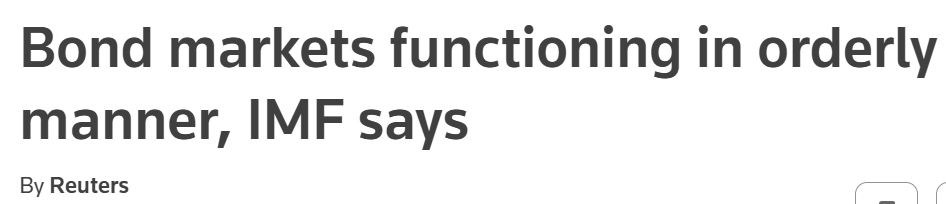
The IMF issuing a statement to reassure the public that bond markets are "functioning in an orderly manner" is highly unusual—and risks raising more questions than it answers.
#economy#markets#bonds#yields@IMFNews
These strong data releases make it even more impressive that the short end is rallying!
The market is gradually realizing that it got way too pessimistic regarding Fed rate hikes.
An in-line or weak number tomorrow Friday could result in a massive short covering rally!
Today's US data releases, which come ahead of tomorrow's more comprehensive jobs report, point to continued robust economic activity, solid labor market, and greater cost pressures.
Specifically:
Labor market: With initial jobless claims below 200,000 once again (at 197,000), this partial indicator points to continued strength.
ISM Manufacturing: The slight dip in September to 54.5 (below the consensus forecast of 55.0 and down from 54.6 in September) occurred even though new orders beat expectations (55.3 vs. 54.7).
Price pressures: Costs are well ahead of expectations (79.9 vs. 73.0 consensus, up from August's 71.1). This is contributing to longer lead times for supply deliveries.
#economy #markets #inflation #growth
Gold is going to rip once yields stabilize. An asset that barely goes down in the face of adverse news is likely to rally very strongly once the bad news fades.
Now apply the same logic to Bitcoin and to equities and you can expect a massive "everything rally" once the bond market drama calms down just a little bit.
Particularly given year-end and post-midterm seasonality !
Gold ETF holdings continue to rise & are near Feb 2026 highs (below).
Major North American gold dealer "Out of Stock" on Canadian .9999 1 oz. Maple Leaf coins for 1st time I can recall in years.
Gold over $1,000 off ATH's, LOL
This is huge ! Only reason the market is not much higher already is that we have a wall of data this week. But risks are significantly skewed to the bullish side … fasten your seatbelts!
New Fed guidance: “There is no need for urgency.”
John Williams, the vice chair of the FOMC, delivers notably precise pushback in guiding against an October rate hike that has been getting priced by investors.
https://t.co/oiiGMrism4
He lays out his base case: One more hike “may be appropriate late this year.”
Following Warsh’s press conference two weeks ago, markets had pushed pricing of an October rate increase above 50% — to as high as 70% in futures markets in recent days.
Here is the key passage from the NY Fed president’s prepared remarks on Tuesday afternoon: “With the policy action we took at our September meeting, there is no need for urgency, and we have time to gather more information. The accumulation of more data should provide greater clarity on the underlying trends in the economy and the associated risks to achieving our goals—and thereby the appropriate setting of monetary policy.”
“If the economy evolves in a manner broadly consistent with my forecast, one further upward adjustment of the federal funds target range may be appropriate late this year to support a timelier return of inflation to target. But that is just my forecast, and time—and the totality of the data—will tell.”
I have been a bond bear for longer than I can recall.
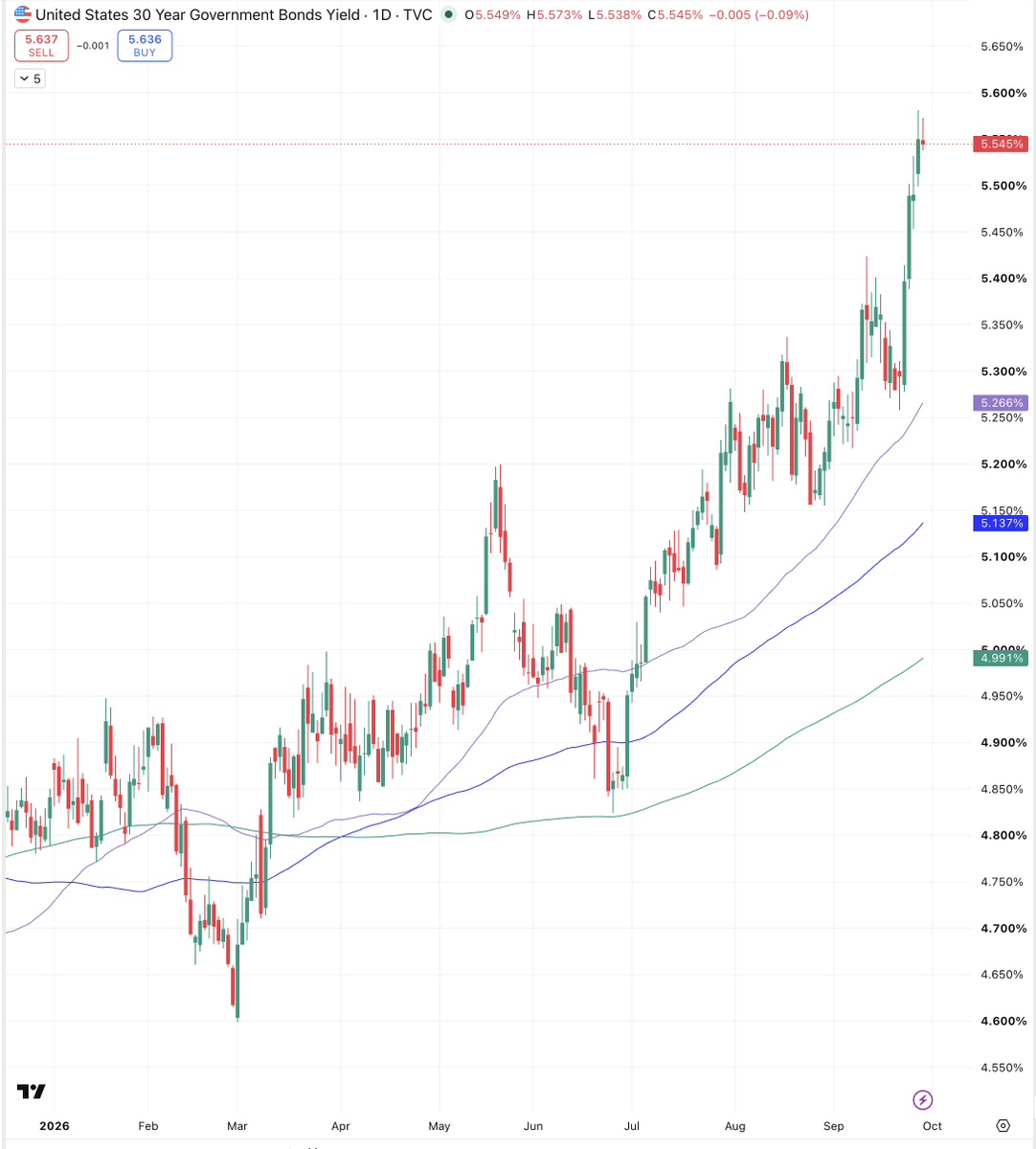
But now I think we are probably at the end of this hyperbolic move in yields, at least for now. Looks like a blow-off top to me!
Why? 1/ Bearish sentiment is at an extreme. 2/ The short end is pricing hikes beyond what the Fed would actually deliver (probably). 3/ Economic growth is good but the market is not pricing any downside risks
What will be the catalyst for yields to snap back down? Probably this week's PCE, or more likely the Non Farm Payrolls on Friday, a notoriously volatile series prone to large revisions.
Watch this space!
@ZiadMDaoud Sovereigns replenishing their strategic reserves? Shorts who were keeping the market down and waited for this time to cover having to cover at higher prices?
I was thinking the same until I saw yesterday’s record move being catalyzed effectively by a strong PMI number. We have to consider the fact growth, in addition to fiscal woes and inflation is resulting in a perfect storm for bond markets. Why would the move be led by the short end if it was only about fiscal and inflation worries? Even the Bloomberg bros know you can’t print diesel
More importantly, in more than 30 years of investing and trading in all markets from emerging to developed, the “market” always loves to take the other side of government intervention - and it usually wins.
Ironically one of the most famous cases of this is Soros “breaking the Bank of England” but there are many others, particularly in EM currencies and rates.