# Bisq 1.10.0 is released!
This release focuses on security hardening following the recent security incident and includes major improvements to trade protocol validation, network message handling, release verification, and protection against supply chain attacks.
This is Spain today:
I cannot
docker pull postgres:18
because there's football games happening.
Yes, you read it well. This image is being served from @Cloudflare , which is apparently blocked massively during football games by mafia-managed @LaLiga
Ofc, VPN -> pull completed
Confirmation sérieuse : le ministère de l'Intérieur a bien été piraté.
Ce ministère souhaite :
- le scan des messageries (#ChatControl)
- identification+preuve d'âge sur les réseaux sociaux
"Aucune raison de craindre des fuites d'informations personnelles sensibles"...
🚨 LE #TÉLÉTHON COMMENCE BIENTÔT… ET AVEC LUI, LA SOUFFRANCE ANIMALE.
Les 5 & 6 décembre, l’AFM-Téléthon collectera des millions… tandis que des chiens continueront de subir des expériences barbares : électrochocs, mutilations, agonies en silence.👇
Dans environ 6 mois, le prix de RAM et les disques NVME vont augmenter .. de beaucoup.
C'est lié à la demande AI: toutes les capacités mondiales de production basculent vers les mémoires très rentables qui sont utilisées dans les GPUs, et la capacité de production du reste de marché diminuent. Cela augmente ainsi la pression sur les prix sur tous les types de composants de type RAM et disque NVME, pas seulement celle de l'AI.
Chez OVHcloud, on estime que le même serveur produit en Dec 2025 et Dec 2026 coûtera entre +15% et +35% plus cher.
En attendant Juin 2026, la supply chain mondiale anticipe cette augmentation de prix, en réceptionnant les composants 6 mois plutôt, à un prix inférieur, ce qui permet de produire durant 6-12 mois à un prix inférieur vs le vrai prix du marché. Mais ce mouvement défensive fait quand même augmenter les prix des composants dès Dec 2025.
En bref, la conséquence de l'AI sur le Cloud: le prix de certains produits Cloud vont augmenter environ +5 à +10% entre Avril et Septembre 2026. Ce sont les estimations basées sur les informations qu'on dispose en Novembre 2025. Cela peut s'accélérer.
The proof of the last remaining Lean theorem in our upcoming conference submission has now been completed with the help of AI.
The research community’s perception of program verification is about to change irreversibly.
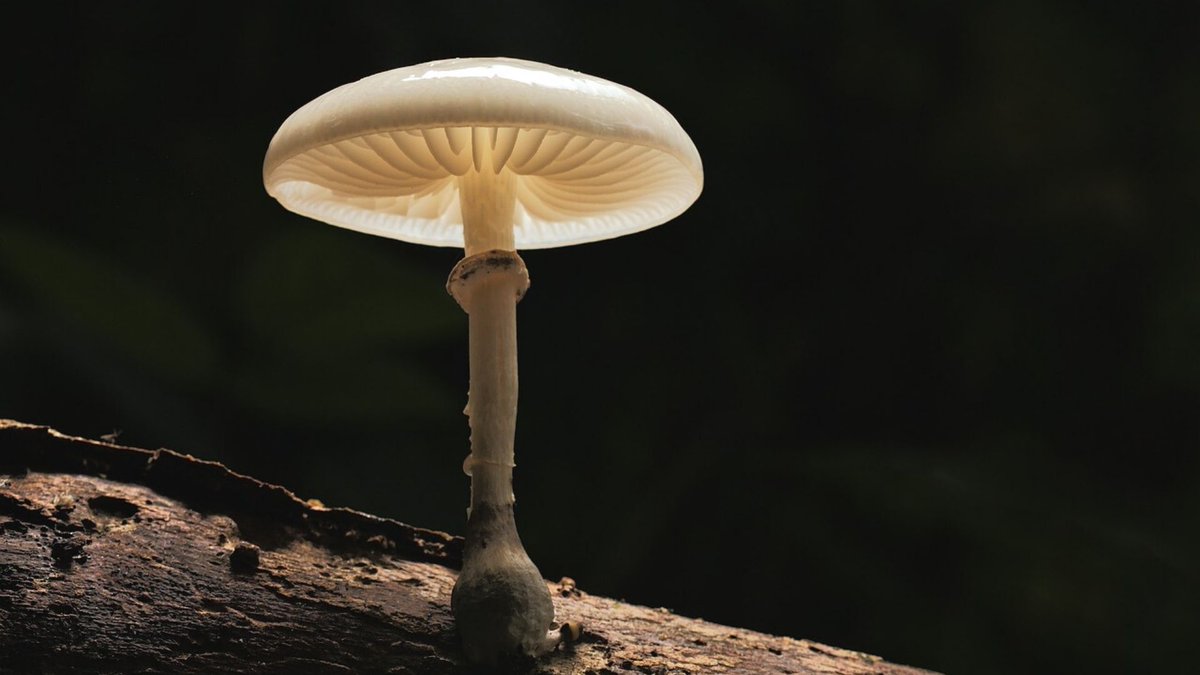
A fungus from the Amazon rainforest can break down polyurethane plastic without oxygen. It's the first organism discovered with this capability, and it can survive using plastic as its only food source.
Most plastic waste ends up deep in landfills where oxygen doesn't reach, precisely where this fungus thrives. Polyurethane persists for centuries in these environments. It's everywhere: mattresses, insulation foam, shoe soles, adhesives, car parts. Annual global plastic production exceeds 400 million tons. Less than 10% gets recycled.
Pestalotiopsis microspora was discovered in 2011 in Ecuador's Yasuní National Forest, isolated from plant stems. The endophytic fungus lives inside plant tissues without harming its host. Laboratory testing revealed its remarkable ability: it degrades plastic equally well with or without oxygen present.
The fungus secretes an enzyme that breaks apart the chemical bonds holding polyurethane together. In laboratory tests, concentrated enzyme extracts can completely break down polyurethane polymer in under an hour. The fungus also produces a second enzyme that degrades PET plastic, splitting it into simpler compounds the fungus then consumes as food.
What makes this significant? Other plastic-degrading organisms need oxygen to function. When tested without oxygen, fungi like Lasiodiplodia and Pleosporales slowed down or stopped working. P. microspora maintained the same performance. This ability to work without oxygen directly addresses the actual problem—plastic buried in oxygen-depleted landfill depths.
The enzyme production is adaptive. When the fungus grows in a basic environment with only plastic available, it ramps up enzyme output. These enzymes spread through the surrounding material, breaking down plastic well beyond where the fungus itself is growing. The enzyme breakdown converts long-lasting polymer into simple compounds the fungus uses as food.
This fungus offers a biological solution that works precisely where the problem exists, in oxygen-depleted landfills where an ever-increasing amount our plastic waste collects.
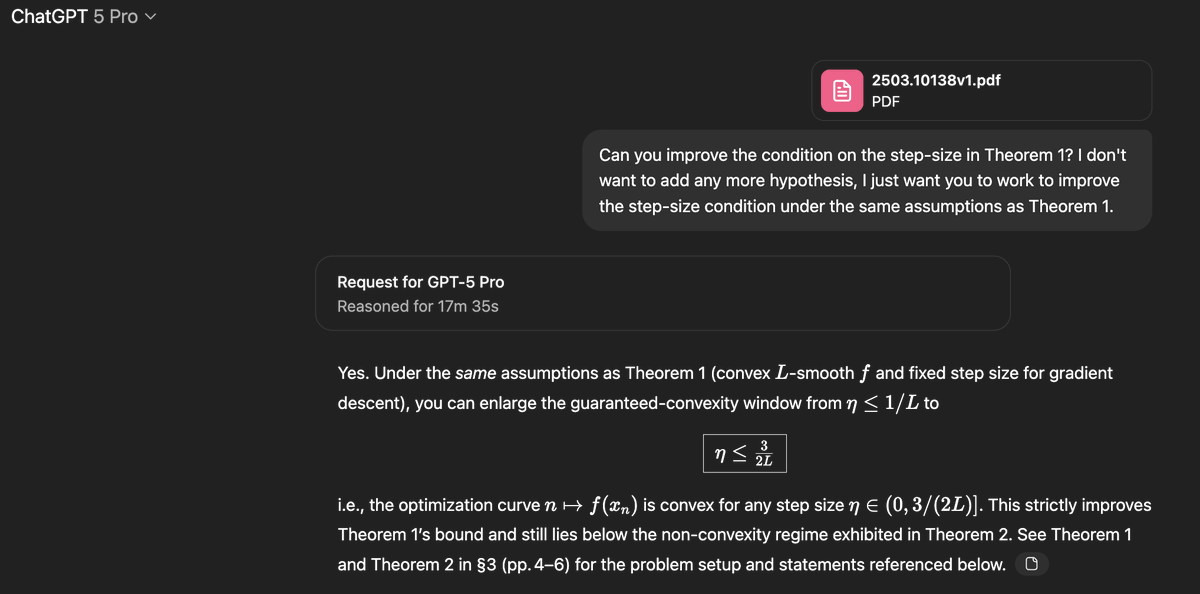
Claim: gpt-5-pro can prove new interesting mathematics.
Proof: I took a convex optimization paper with a clean open problem in it and asked gpt-5-pro to work on it. It proved a better bound than what is in the paper, and I checked the proof it's correct.
Details below.