Today we share the worldview behind our mission.
Human values don't average out. Local knowledge can't be centralized. The good future has many AIs, raised in different places, shaped by the people they serve, disagreeing with each other the way we do.
https://t.co/A14SurOM2K
Adam Brown (@A_G_I_Joe) is back!
General relativity is said to be the most beautiful idea the human mind has ever produced.
Most of us will never get to fully appreciate its elegance by taking the 20-lecture graduate course Adam taught on it at Stanford.
But in the video below, Adam distills the key idea at its heart so clearly and compellingly that even I could keep up lol.
At the core of general relativity, Einstein is trying to figure out the principle behind a particular coincidence: that the mass that resists acceleration and the mass that gravity pulls on just happen to be exactly the same. Adam then leads us through the path of insight which Einstein called his “happiest thought.”
Then Adam lectures on black holes. First, by showing how even under special relativity you could create a perpetual motion machine if black holes weren't truly black. And then, by explaining why the observations of an infalling observer and a distant bystander to the black hole would be so radically different
Adam leads Blueshift, the team at Google DeepMind cracking science and reasoning.
Which gave us the opportunity to discuss at the very end how close we are to AIs that could rediscover general relativity from scratch. Stay till the close for some philosophy of science.
0:00:00 – The coincidence that led Einstein to general relativity
0:16:42 – Gravity is a consequence of curved spacetime, not a force
0:31:46 – Why black holes prevent unlimited energy extraction
0:47:12 – Black holes are the ultimate power plants
1:13:50 – What falling into a black hole would actually feel like
1:18:51 – The three ways we know black holes are real
1:24:21 – The first time we saw gravity bend light
1:29:33 – How far can AI get without experimental evidence?
Look up Dwarkesh Podcast on YouTube/Spotify to watch. Enjoy!
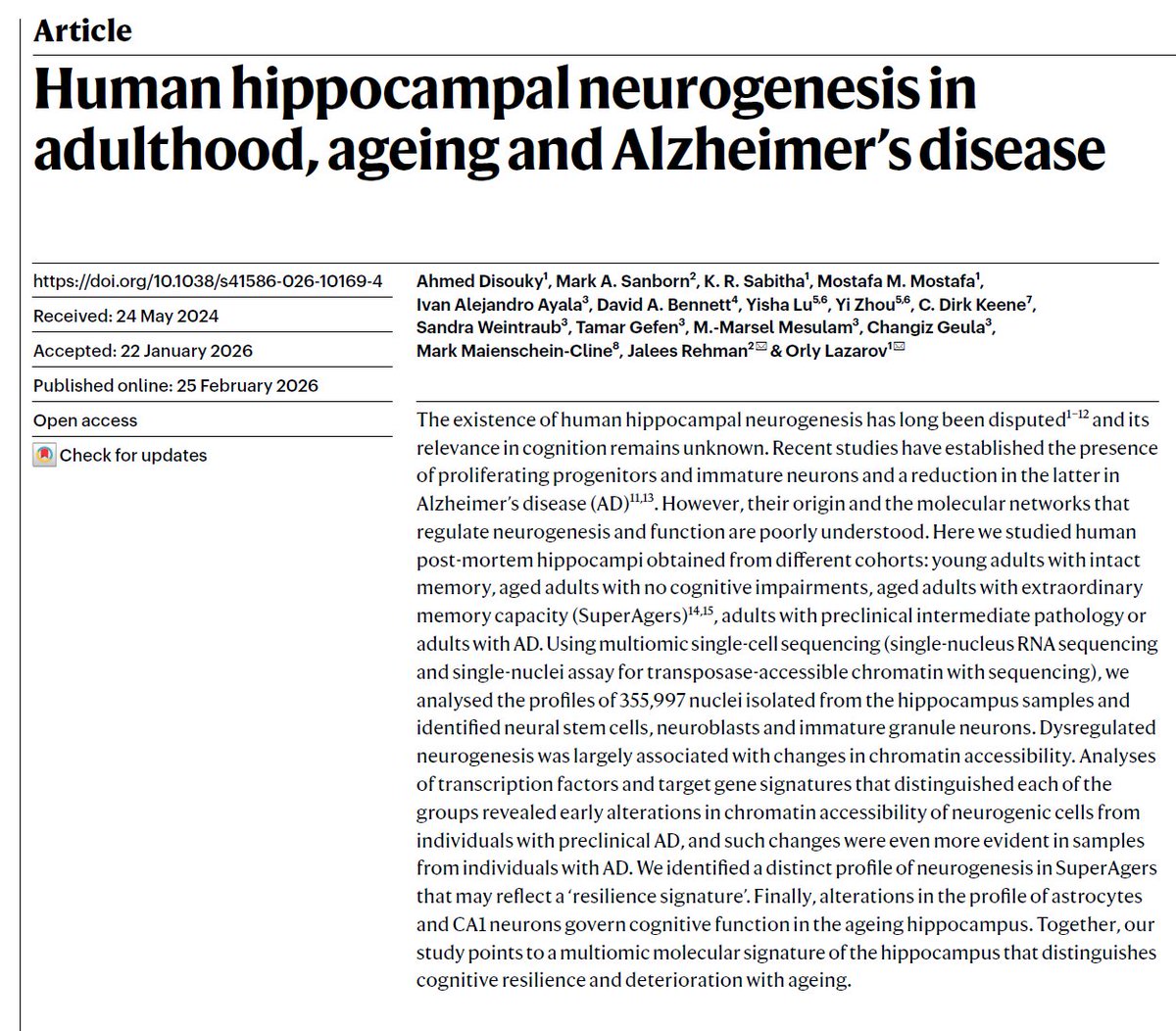
The science of human aging is flourishing, perhaps best exemplified by remarkable advances in organ and cellular clocks, tracked from proteins in the blood. These clocks tell us about the pace of aging within an individual and are linked to healthspan, longevity, and diseases.
@wysscoray and I reviewed the field of biological clocks, published today @NatureMedicine
free access
https://t.co/2PDZOgUmLu
This is one of the best breakdowns on the fundamentals of LLMs I've ever read.
Anytime someone asks me for resources to climb the steep AI learning curve, I always provide the same list.
1) @3blue1brown's neural network videos
2) @karpathy's zero to hero playlist
3) @dwarkesh_sp's whiteboard explainers
Now @_raghavdixit_'s "Vectors are all you need" and future articles in the explainer series are getting added to the list.
Bridgewater used their unique financial knowledge and partnered with us on @tinkerapi to fine-tune a model that helps their analysts focus on what's important. Experts improving AI that empowers experts.
https://t.co/6RJITMG2BJ
The most valuable person in techbio right now isn’t the AI researcher or the bench biologist.
It’s the rare engineer-scientist fluent in all three - ML, comp bio, wet lab - with a beginner’s mind across the whole stack.
Skills that have nothing to do with money but are worth dedicating an immense amount of practice to:
- Charisma
- Metacognition
- Critical thinking
- Sitting with discomfort
- Articulating what you believe and why
- Changing your beliefs when presented with new information
Almost nobody actually practices these and it shows.
Today we’re sharing the most detailed scan ever taken of a living human brain.
None of us were ultrasound scientists before this. We worked backwards from a desire for brain interfaces and taught ourselves physics, ultrasound, electromagnetism.
This is a story four years in the making (1/n)