@dusangran One wrong payment could outweigh all the time saved. Inkling missed 12 of 144 test attempts and Gemma missed 13. A miss is any wrong call, argument or final balance, and we counted each one equally. What those misses would cost in practice is still an open question.
Agentic work: Inkling 2 Mini (3.4B active) averaged 15.8 s per attempt on our harder finance tool tasks, 16 at a time. Liquid LFM2.5-24B-A2B took 21.2 s; the dense Qwen3.8-27B and Gemma 4 31B took 53 and 63.
Inkling 2 Mini passed 132 of 144 attempts. All four tie on accuracy.
Some of you thought that Inkling 2 Small was too big at 594B parameters. We heard you: Inkling 2 Mini is a looped transformer with just 26B parameters, small enough to run on your laptop, powerful enough for agentic work with a score of 20.1 on AA Index.
https://t.co/9HzaUMwghb
Where Inkling 2 Mini trails: on Logic + Math it scores 93.1%, Gemma 4 31B 97.3% and Qwen3.8-27B 97.4%. On English reading: 86.0%, 90.5% and 89.0%.
We priced local runs at $2.49 per GPU hour and hosted runs at API list prices. All results: https://t.co/r6RtBBxNXK
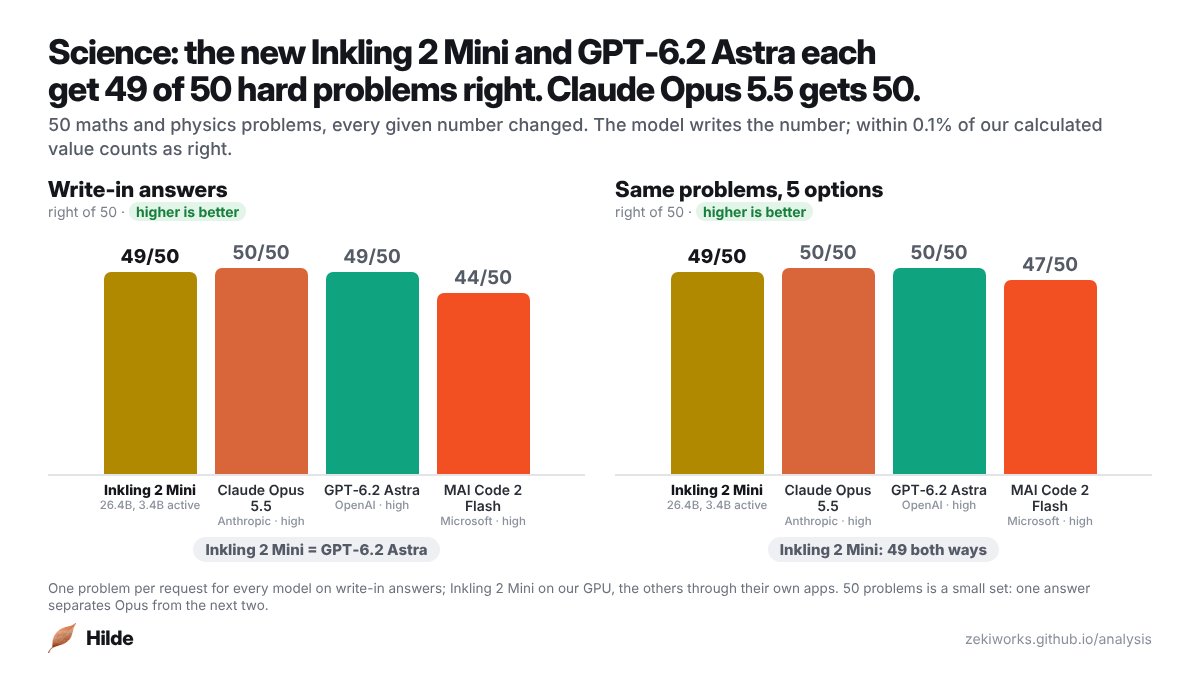
Inkling 2 Mini and GPT-6.2 Astra each got 49 of 50 maths and physics problems right. Claude Opus 5.5 got all 50.
We took problems from textbooks and exams, changed every given number and removed the answer choices. Answers within 0.1% of our calculated value counted as correct.
@mervenoyann@liquidai Noticed one more thing: Liquid d1-2B keeps its accuracy at 4 bits. In llama.cpp it scored 66.2% on our English reading test, vs 65.6% in our BF16 run with Liquid's code. The Q4_K_M file is 1.1 GB, about a third the size of the BF16 file. @liquidai
Same GPU: Liquid d1-2B answers an estimated 19× as many English reading questions a minute as Liquid LFM3-1.7B, and about 30× as many as MiniCPM5-2B and Qwen3.5-2B, which it ties on accuracy.
With thinking off, Liquid LFM3-1.7B is the most accurate: 71.8%. @liquidai
decision models are faster than their LLM equivalents in multipliers
because for LLM you do prefill + decode for the JSON structured output, whereas with decision models it only does a forward pass
benchmarked LFM3 against d1 @liquidai (excluding warmup) on Llama
@mervenoyann@liquidai Tried llama.cpp as you suggested, fully on GPU with flash attention. Answers matched, and Liquid's d1 server was faster for us: 11 vs 18 ms per answer. Packing 15 questions about one text sped both up about 10×, and Liquid's stayed ahead: 43 vs 195 ms.
https://t.co/24Xrv2fVvi
@KalinJunYAI@mervenoyann@liquidai Yeah, all 15 questions were about the same invoice. Sending them in one request meant the model only had to read it once. On our GPU, that took 43 ms total vs about 450 ms when we sent them one by one.
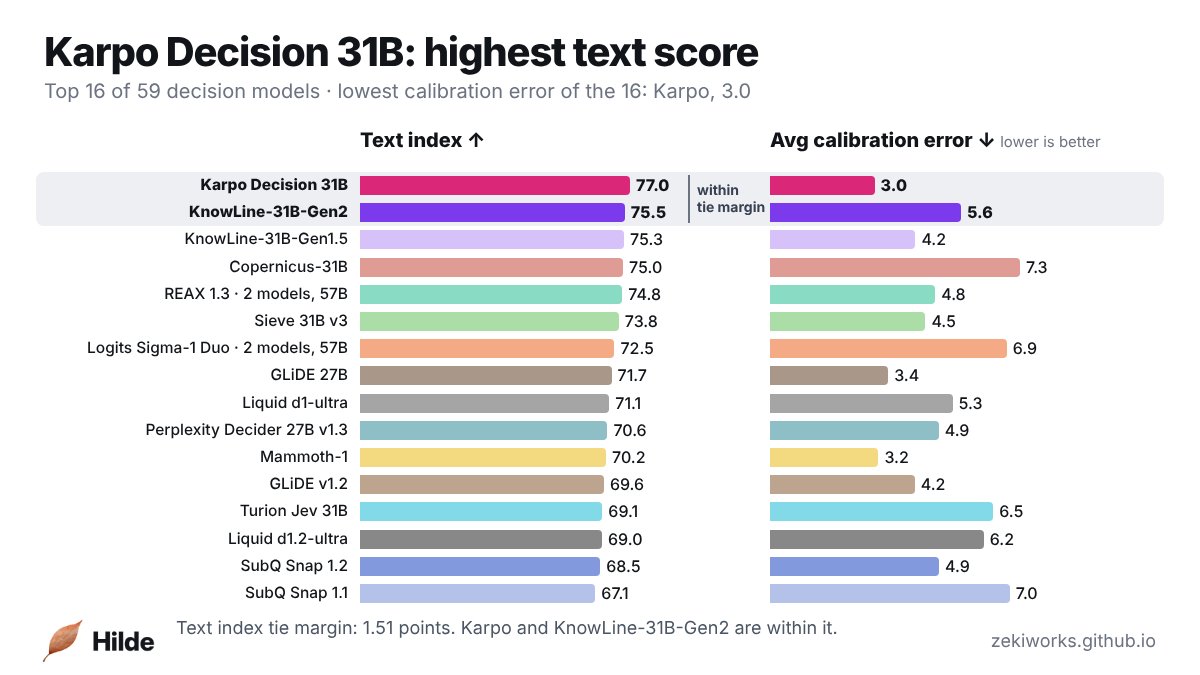
@MachinePulse_AI Calibration error: the gap between how sure a model is and how often it is right. Lower is better.
Karpo's error was lower than KnowLine-31B-Gen2's on 3 of our 4 tests, most on English reading: 2.4 vs 7.7. The one exception was Logic: 5.7 vs 3.7.
https://t.co/C60f7bBUn0
Karpo Decision 31B from @MachinePulse_AI averaged 77.0 on our four text tests, the highest score among 59 decision models. KnowLine-31B-Gen2 scored 75.5, within our tie margin.
Karpo had the lowest average calibration error among the top 16, at 3.0 points versus KnowLine's 5.6.
Picking the next tool shouldn’t take a paragraph.
We built Karpo Decision. A family of six open-weight models, from 0.8B to 31B.Give it the context, a question, and the options. It returns a probability for each option in one forward pass.
Karpo Decision 31B
🏆 73.9 on Decision Index, tied for #1 on the Nov 12 board
⚡ 94 ms median per request on a single RTX PRO 6000
📊 87.2 on JevBench Capability vs. 78.5 for Google’s Gemini Decision 1
🤗 Hugging Face
https://t.co/HpEmbxOSzD
📝 Technical write-up
https://t.co/Rt3WeXfuBD
Here’s where I’d try it first: Search. Recommendations. Tool choice. Model routing. Browser actions. Point it at the slowest decision in your stack and tell us what breaks.
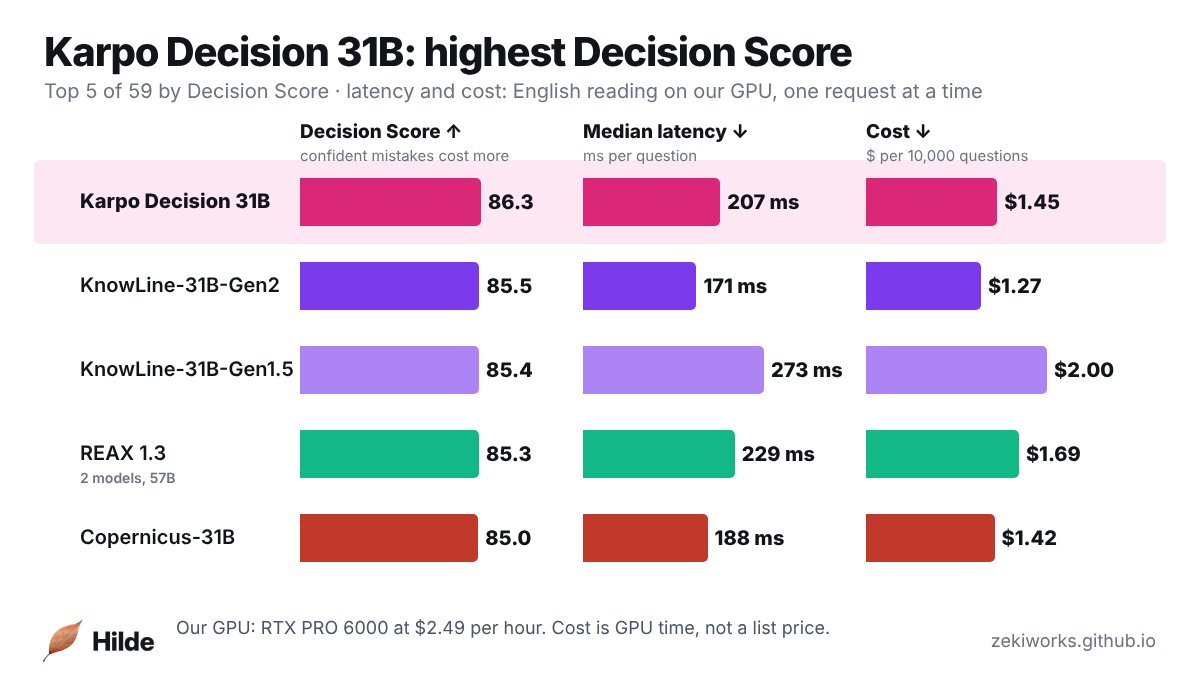
@MachinePulse_AI Karpo led all 59 models on Decision Score, which penalizes confident mistakes: 86.3 to KnowLine-31B-Gen2's 85.5.
On English reading, one request at a time on our GPU, Karpo's median was 207 ms per question. Estimated GPU cost: $1.45 per 10,000 questions.
Two jobs. Liquid d1 models pick the answer or the tool iTwo jobs. Liquid d1 models pick the answer or the tool in one pass. Liquid LFM3-1.7B reasons and writes the tool call.
With thinking on, Liquid LFM3 scores 93.9% on Logic + Math and passes 92% of standard tool tasks: top tier for its size.
Tools: https://t.co/uWreNEaraQ
@liquidai With a skip option on 3,288 Logic and Math questions, the Liquid ultras get about 6% wrong. The other 14 of our top 16 decision models average 26%.
Liquid d1.2-ultra skips 51.9% and is right on 88% of the questions it answers. Skipped questions can go to a reasoning model.
@liquidai On single English reading calls, our median time through Liquid's API went from 220 to 221 ms for the ultra, and from 173 to 219 ms for d1.2, network included. On our RTX PRO 6000, GLiDE v1.2 takes 104 ms and Decider Flash v1.3 33 ms.
https://t.co/TLNfnKBZqd
@liquidai At Liquid's list prices, we estimate $6.66 per million English reading questions for d1.2 and $13.98 for d1.2-ultra, the same as their predecessors. No current model scores higher for less.
The extra $7.32 buys 69.0 vs 65.3 on our index. d1.2 gains 3.9 on Logic over d1.1.