Family, Science, Nature. Studies how the immune system and metabolism regulate each other. PC1/3, insulin processing, HPA axis, islet amyloid and inflammation
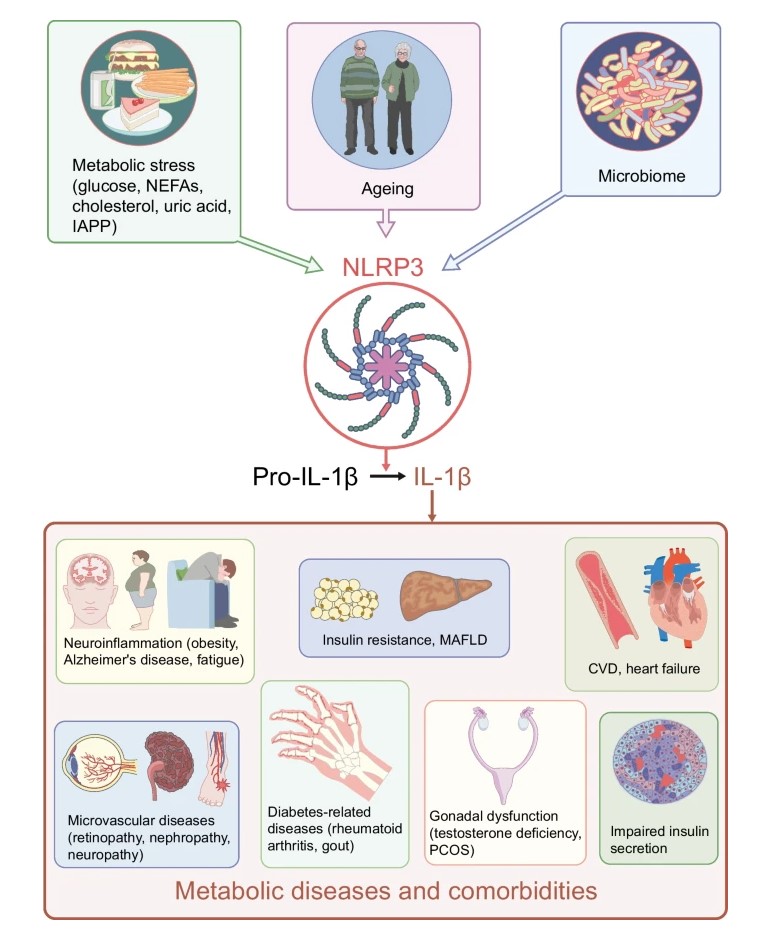
Up front & free to read in our Jan issue #editorspicks: Targeting the NLRP3 inflammasome–IL-1β pathway in type 2 diabetes and obesity https://t.co/BOa02hVFVm
Targeting the NLRP3 inflammasome–IL-1β pathway in #T2D + obesity. @zemanmeier et al review the role of IL-1β in physiology, pathology + clinical translation and the potential of IL-1β–NLRP3 inhibition to modify disease. @DepBiomedicine@UniBasel_en https://t.co/BOa02hV85O 🔓
Our newest addition: Review on the NLRP3/IL-1 pathway in health and disease and its clinical potential to treat #diabetes and its comorbidities. @DiabetologiaJnl@DepBiomedicine@UniBasel_en 🔓
https://t.co/eJIykXl8q3
PC1/3 KO in Pomc-expressing tissues reproduced the phenotype of PC1/3 null mice, including an enlarged spleen size, reduced corticosterone and LPS hypersensitivity. We propose that lack of PC1/3 leads to hyperinflammation via reduced anti-inflammatory action of steroids.
New: We investigated why lack of prohormone convertase 1/3 (PC1/3) in mice leads to sepsis hypersensitivity. We find that there is no role for PC1/3 in immune cells and that lack of PC1/3 in the HPA axis ➡️ less steroids is responsible for this phenotype. https://t.co/pgA38nt0Ql
Based on the literature, we hypothesized that PC1/3 processes an anti-inflammatory peptide in immune cells. However, myeloid/hematopoietic PC1/3 KO did not do anything. We also doubt the literature showing that PC1/3 is expressed in the immune compartment.
New: The cytokine IL-1beta promotes adiopogenesis in early-differentiation cells but not at later stages when IL-1b induces only inflammation. There is no metabolic role for IL-1beta in adult adipocytes 👉https://t.co/D6LCrTSlck @UniBasel_en@DepBiomedicine@karolinskainst
@DanielJDrucker@uoftmedicine@SinaiHealth@UofT_LMP Interestingly, we don't get a clear immune picture when we knock out gut hormones. Also not when LPS-provoked. This anti-inflammatoty action might be a feature of GLPra but probably not endogenous peptides.
@CaATiER_Chop_ER@MouseCentral@VanderbiltU@JimJohnsonSci@KevinH_PhD@JohnSpeakman4 Probably more my interpretation and less the author's hypothesis, but the data suggest that insulin sensitivity is adapted to deal with temperature via change EE/insulin action. It's associative thus manipulating only one factor (sensitivity) might help to get more causation.
@JimJohnsonSci@BruceVerchere@YCC_YiChunChen Rip-cre (Herrera) and Pdx-creERT. Give the same result (supernatant of isolated islets). My constitutive whole-body PC1/3 KO was not viable and I did not analyze the wb inducible (UBC-ERT).
Interested in #exocrine-#endocrine crosstalk? Our newest publication details a protocol on how to isolate and analyse (#immune) cells from both parts of the (mouse) #pancreas in parallel. Part of a bigger project driven by MD-PhD student @Laurasteiger14. https://t.co/EXscPaxYZW
Second (and last) publication by Axel deBaat about Cystine/Glutamate antiporter System Xc, this time with a focus on immune cells. We show that SXc is essential for maintaining glutathione levels, mitochondrial functionality and cytokine production. 👇1/2
It was a difficult endeavor due to ex vivo/in vitro artefacts and lots of trial and error experiments. Now Axel is off to Boston for new adventures...
https://t.co/9X7ZOZDiEb 2/2
Metabolic consequences of pharmacological depletion of tissue macrophages: A story that started many years with some curious PhD students in our lab. It didn't make sense why CSF1r inhibition should only target microglia (given that many other cells express this receptor). 👇
We find that CSF1r inhibition depletes macrophages of various "metabolic" tissues (including my favorite panc islets). In terms of metabolism, depletion lead to increased (liver) insulin sensitivity but to impaired insulin secretion. More to come about the mechanisms soon 👇