@Krysia830073 I get my health products from Nina at Lili for a while now. While others in groups I am in work with Mia. Both great to work with. Thanks @krysia for doing this important work and meeting with them. Just awesome. 🤙🏽
Richard Horton, editor-in-chief of The Lancet, concluded that medical journals had “devolved into information-laundering operations for the pharmaceutical industry.”
This statement comes from his March 2004 New York Review of Books essay “The Dawn of McScience.” He described how companies sponsor meetings, pay speakers, have communications firms turn the talks into articles (often with minimal or no peer review), and then pay publishers large sums to run them as journal supplements. The result, he argued, is marketing dressed up as science that seeds the literature with weaker evidence used to promote products.
Around the same period, in written and oral evidence to the UK House of Commons Health Select Committee (2004–2005), Horton described the journal–industry relationship as “somewhere between symbiotic and parasitic,” noting that it had swung too far toward the parasitic side. He highlighted financial pressures (e.g., companies promising large reprint orders if a favorable paper is published, or threatening to pull papers if criticism is not softened) and listed roughly 10 distorting practices, including:
• Manipulation or selective reporting of findings
• Bias toward positive results in industry-sponsored studies
• Hiding negative or adverse data
• Ghostwriting
• Lightly peer-reviewed supplements used for marketing
• Undisclosed conflicts of interest
He stated that commercial sponsorship of research and its intrusion into academia represented “one of the gravest threats to the independent evaluation of new medicines—indeed to the notion of an independent science base,” and that the for-profit motive of the sector clashes with public-health values and independent scientific research.
In a 2013 Lancet piece (“Falling out with pharma”), Horton withdrew the journal’s support from industry-linked guidance on doctor–pharma collaboration, saying the document’s claims did not match the evidence on company behavior regarding transparency, medical education, and prescribing influence.
His better-known 2015 editorial (“Offline: What is medicine’s 5 sigma?”) was broader—arguing that “much of the scientific literature, perhaps half, may simply be untrue” due to small samples, invalid analyses, tiny effects, and “flagrant conflicts of interest”—but conflicts of interest (often industry-related) were explicitly part of that critique.
These statements reflect Horton’s long-standing concerns about industry influence on the medical evidence base rather than a single one-off finding.
When the editor of the world’s most prestigious medical journal concluded that much of the clinical research it published could no longer be trusted, the problem was no longer abstract.
Marcia Angell, a pathologist who joined the New England Journal of Medicine staff in 1979, rose to executive editor and then served as interim editor-in-chief from 1999 to June 2000. She stepped down after more than two decades at the journal, formally to write a book. The deeper context was her growing conviction, formed from years of editing manuscripts, that pharmaceutical industry influence had compromised the independence of clinical research. She and previous editors had enforced strict conflict-of-interest rules, yet industry-sponsored studies continued to arrive with designs, analyses, and selective reporting that favored the sponsor’s product. Negative results were often suppressed, side effects minimized, and “academic” authors frequently carried undisclosed financial ties.
In a widely cited 2009 New York Review of Books essay, Angell wrote the line that crystallized her position: “It is simply no longer possible to believe much of the clinical research that is published, or to rely on the judgment of trusted physicians or authoritative medical guidelines. I take no pleasure in this conclusion, which I reached slowly and reluctantly over my two decades as an editor of The New England Journal of Medicine.” She described an industry that had shifted from discovering useful drugs toward marketing, co-opting academic medical centers, researchers, and even the journals that were supposed to serve as independent arbiters. Her 2000 editorial “Is Academic Medicine for Sale?” and later book The Truth About the Drug Companies expanded the critique, arguing that commercial priorities systematically distorted what research was done, how it was conducted, and what reached publication.
Angell’s departure marked the end of an era of tighter editorial resistance to industry influence at the NEJM. Her public statements afterward made clear that she viewed the problem as systemic rather than isolated: once the bulk of clinical research depended on commercial funding, journals could no longer function as reliable filters of medical evidence.
You must be such a concerned local Miami–Key Biscayne citizen, Mostly Peaceful Latina! In fact, I don’t think I’ve ever seen you at any of the Key Biscayne cleanup or mangrove restoration events hosted by my Aabad and Rickenbacker Marina. Oh, right, Peaceful Latinas, you’re here on X defaming someone because you care so much about Key Biscayne. ¡Pobre latinaaa! 😂
Wow Indian, racist much Peaceful Latina? No te parece bastante racista? Y tú eres Cubana? Apostaría a que sí. Y si no, de cualquier otro origen latino. Puedes volver al lugar de donde viene tu familia por favor. Before you go after me for being Spanish, Im Puerto Rican and born American. Wonder how much money you are getting paid? 😂
I’d like to report a robbery: it’s the City of Miami budget!
These Miami Mafiosos just passed a $3.7 BILLION budget filled with grift and graft.
The commission didn’t double in size, the population didn’t double, the city workforce didn’t double, lord knows the quality and quantity of our services haven’t doubled — the cost of government DOUBLED.
This mayor and commission are going to bankrupt the city — while enriching themselves and their cronies… #BecauseMiami
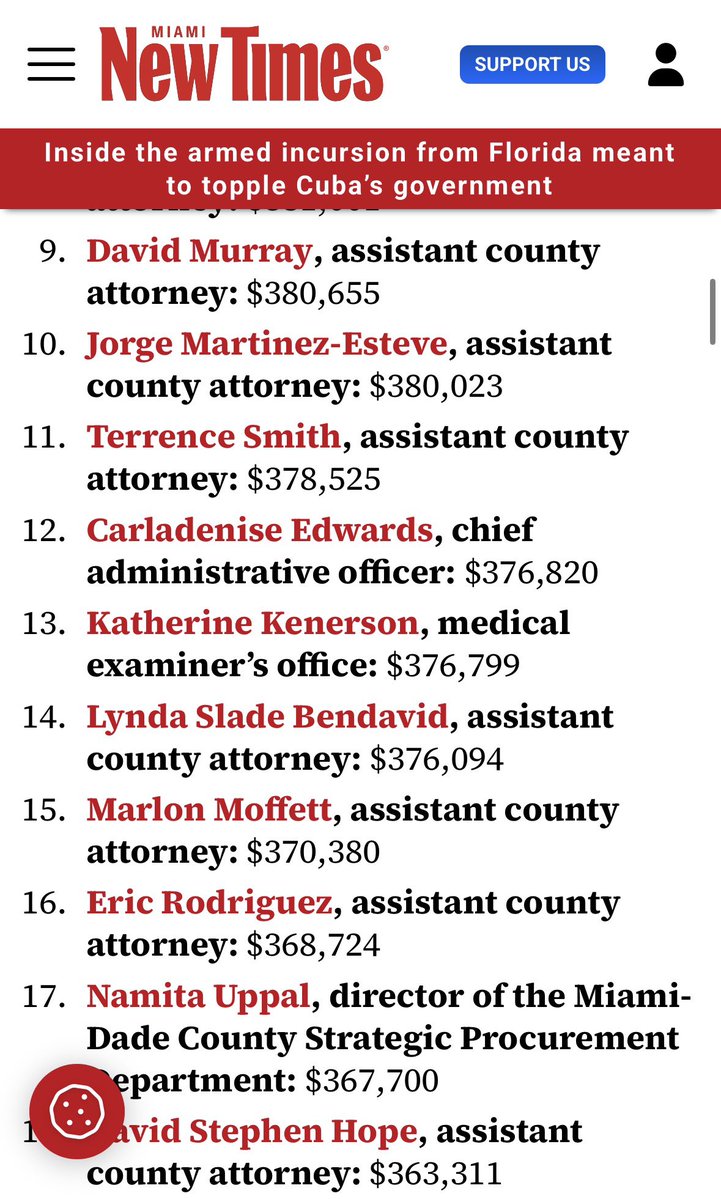
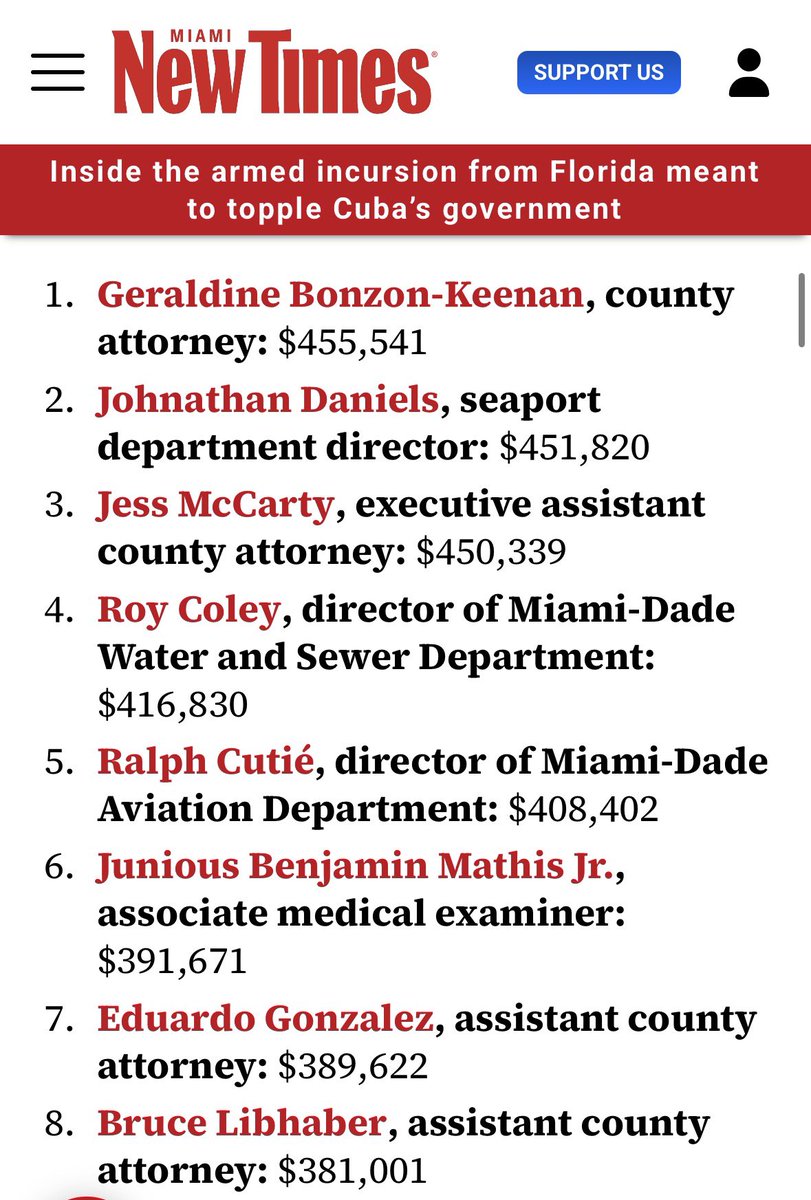
In Miami you have multiple Assistant County Attorneys making over $350,000.
The County Attorney herself makes $450,000.
The Director of Water and Sewer makes $416,000
And they cry that they won’t survive if Amendment 3 passes 🥴