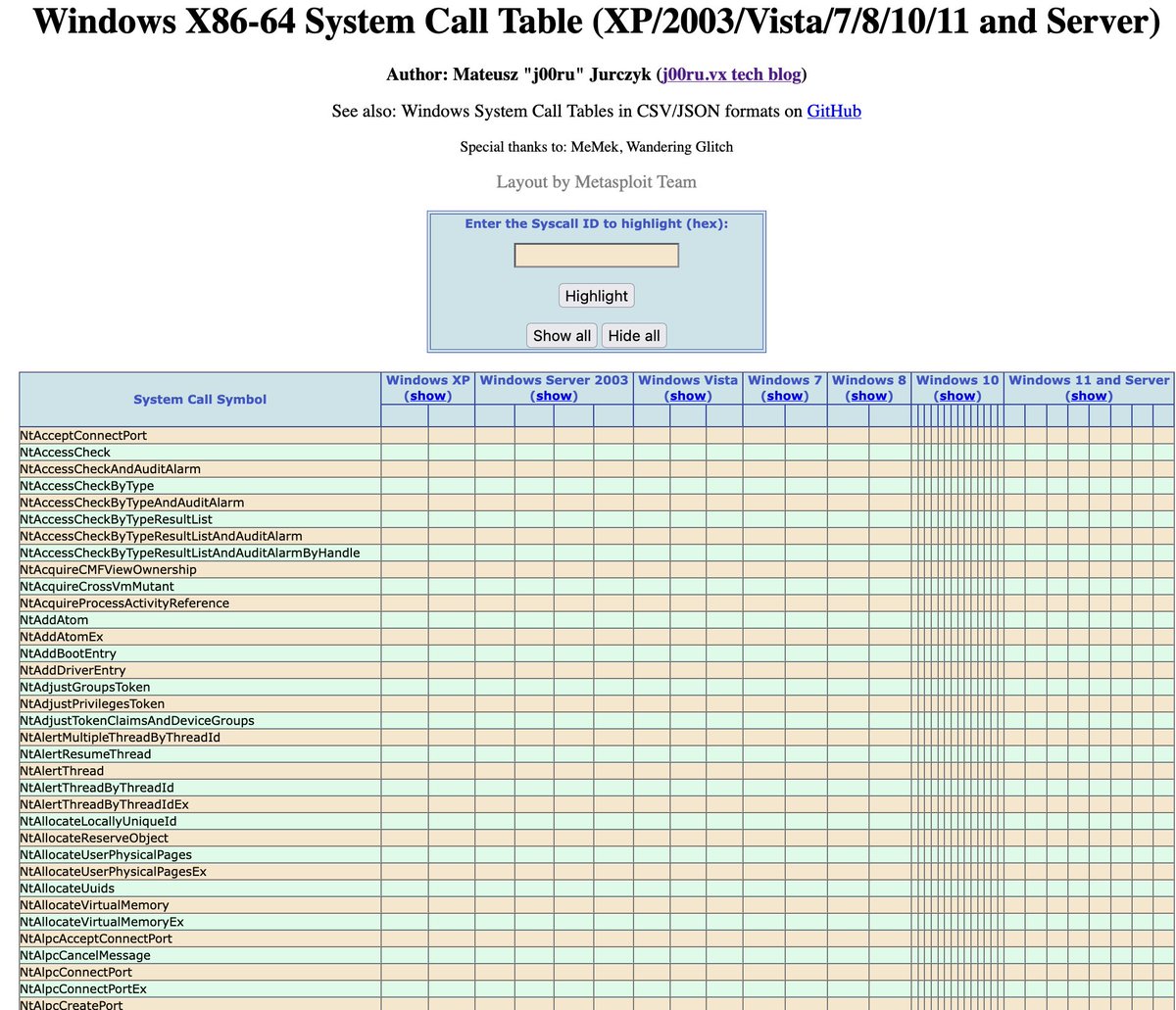
If you work with Windows internals, reverse engineering or exploit development, bookmark this.
@j00ru 's blog is one of the best FREE archives of low-level Windows security research online.
It covers:
Windows kernel internals
Kernel exploitation
Reverse engineering
Memory corruption + infoleaks
Win32k internals
NT + Win32k syscall tables
CSRSS APIs + internals
Fuzzing + instrumentation
Windows mitigations
Conference talks
Technical papers + research
Exploit development
Some of this research goes back more than 15 years and is still incredibly useful for understanding how Windows works under the hood. The site also maintains dedicated Windows syscall tables and CSRSS reference material.
Absolute rabbit hole for anyone serious about Windows security.
https://t.co/ATqvtIFVGP
#WindowsInternals #ReverseEngineering #ExploitDevelopment
“It takes something more than intelligence to act intelligently.”
- Dostoevsky
Solomon's Paradox is the tendency to reason more wisely about other people's problems than our own.
It's named after the biblical King Solomon — famous for his wise judgments, but who in his later years is depicted as making increasingly poor choices in his own personal and political life.
The term was introduced in 2014 by psychologists Igor Grossmann and Ethan Kross. In their studies on relationship conflicts, they found that people were better at taking multiple viewpoints into account, acknowledging what they didn't know, and looking for compromise when they were thinking about someone else's problem instead of their own.
They also found a way to counteract it: self-distancing. If you look at your own situation as an outside observer would, or ask yourself, "What would I tell a friend to do if they were in this exact position?" it becomes easier to think more clearly and objectively.
It's important to mention how does C++ tells you the computer mechanics and pure programming. Most languages abolish the misleading abstraction despite C++. C and C++ have separated concreteness from abstraction.
Being a reverse engineer exposed to me that modulation destroyed modern programming.
I'd rather sift through thousands of functions or look at disassembled binaries than go through a GitHub repository where every little thing is split into a 100 files across 10 directories.