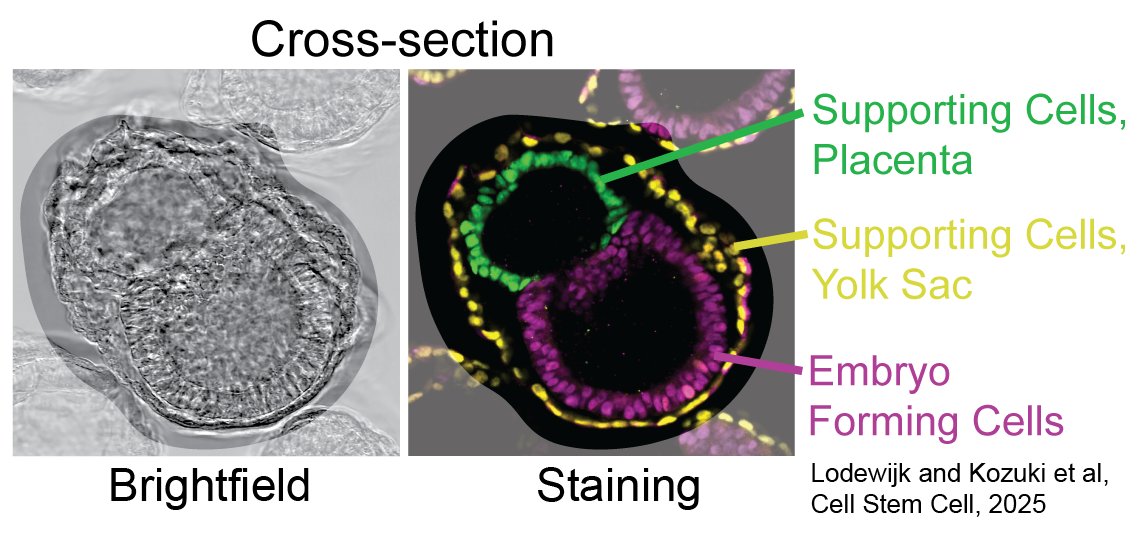
organs develop in a dynamic environment where their boundaries are constantly changing shape, relaxing, compressing, etc. in synchrony with the embryo.
see how this inspired us to create a material for optimal organoid bioprinting & self-organization!
https://t.co/GVJXRmTFNU
8. We thank team member Zuzhi Jiang, collaborators Binyamin Zuckerman, Leor Weinberger, Matt Thomson, funding sources @cancerresearchinst (@CancerResearch) @NIH@czbiohub@czi@UCSF, the thoughtful reviewers for @NatureBiotech, and everyone else who shared data and feedback!
1. Excited to share CONCORD, now out in @NatureBiotech! It's an ML framework for single-cell analysis that solves integration, dimensionality reduction, and denoising in one go. Huge effort led by @qinzhu1.🔗 https://t.co/0FZRX1w2J1 Check out this CONCORD atlas of worm development resolving detailed differentiation trajectories:
7. Best of all, it's fast (1M cells in <10 mins) and memory-friendly.
💻 Open Source: https://t.co/ijkPJvspJA 📖 Docs: https://t.co/NJGCry1urx Try it out and let us know what you think!
1. Struggling to integrate single-cell datasets? Finding it hard to resolve clear differentiation trajectories? Reveal the underlying structure in your data with CONCORD.https://t.co/63eZug0Dbp
4. We validated CONCORD on an embryonic atlas of C. elegans and C. briggsae from @jisaacmurray. CONCORD captured known bifurcations, subtle cell states, and lineage convergence events missed by other methods (click here for interactive 3D UMAP! https://t.co/vSyfbNjQjO...):
5. An intestinal development atlas demonstrated CONCORD's ability to resolve complex topologies, including differentiation trajectories intertwined with cell cycle loops (click here for interactive 3D UMAP! https://t.co/vSyfbNjQjO...):
9. While we focused on scRNA-seq, early results suggest CONCORD’s applicability to spatial transcriptomics & scATAC-seq. It’s open-source in Python. See galleries: https://t.co/vSyfbNjQjO.... Try it: https://t.co/2Bu5rzLDT8....