Em novembro debati com Nick Szabo sobre a superfície de ataque legal do Bitcoin. Ele argumentou que criptomoedas do mundo real não são trustless, são trust-minimized, e que existe um território jurídico que a indústria não sabe gerenciar. 8 meses depois, o aviso está se materializando em várias frentes ao mesmo tempo.
Szabo divide a superfície legal em 2 frentes. A lei financeira, securities, money transmission, que os advogados da indústria dominam, e o território dos dados arbitrários gravados na chain, que ele considera muito mais perigoso porque ali a indústria não tem expertise nenhuma. Existe precedente de que operador de node não responde por dado que não conhece nem controla, mas informado de conteúdo ilegal na chain ele passa a ter conhecimento e o precedente deixa de protegê-lo, e um archive node não consegue deletar dado seletivamente sem quebrar sua função. Conteúdo ilegal imutável vira pretexto pronto pra atacar quem valida a rede.
Em 2026 as frentes se abriram juntas. O Core v30 expandiu o OP_RETURN de 80 bytes pra quase 4MB, a superfície de dados cresceu. O BIP-110, a tentativa de encolhê-la na camada de protocolo, a via que o próprio Szabo defendia ao apontar o Knots, morreu com menos de 1% de sinalização. A Seção 604 do Clarity Act, a blindagem legal dos desenvolvedores não-custodiais, está sendo diluída no Senado sob pressão de law enforcement, e ela só cobre a frente financeira. E a perseguição econômica segue em vigor: Basileia impõe risk weight de 1.250% sobre Bitcoin, um banco que quer $100 milhões de exposição trava $100 milhões do próprio capital, enquanto ouro no cofre pesa zero. Não precisa proibir o que se torna economicamente inviável.
O Bitcoin não dá errado por causa disso, o protocolo roda há 17 anos sem pedir licença e vai continuar rodando. O que fica em jogo é a velocidade. Sem o Clarity, a superfície segue aberta em várias camadas, operador de node, desenvolvedor, balanço bancário, pretexto pra law enforcement, e os EUA são a potência que constrói o benchmark regulatório que o resto do mundo copia. O que Washington não escrever, outros escrevem pior.
Respondi ao Szabo comparando a trajetória do Bitcoin com a do cristianismo. O Edito de Milão em 313 não criou a fé nem converteu ninguém, removeu a incerteza jurídica que servia de pretexto pra perseguição, o mesmo que o Clarity faz com o enforcement regulatório, inclusive matando a justificativa do 1.250%, que sempre foi incerteza sobre o que o Bitcoin é.
O cristianismo levou 3 séculos nas catacumbas pra chegar a 10% do Império Romano. Legalizado, foi de 10% pra 56% em poucas décadas, e antes do fim do século era a religião oficial do Estado. Depois de Milão, a Igreja pôde possuir propriedade e Constantino ergueu basílicas. Depois do Clarity, os bancos podem possuir Bitcoin. O Bitcoin está em cerca de 8% de adoção global, a fronteira exata onde o cristianismo estava em 313.
O protocolo sobrevive na catacumba.
A adoção acontece na basílica.
stop telling Claude Code/Codex "read this file".
stop telling Claude Code/Codex "now read that one too".
stop telling Claude Code/Codex "grep the whole repo".
install codebase-memory. it indexes the Linux kernel, 28M lines, in 𝟯 𝗺𝗶𝗻𝘂𝘁𝗲𝘀. your repo takes seconds.
index once and the whole repo becomes 𝗼𝗻𝗲 𝗴𝗿𝗮𝗽𝗵 of every function, file and dependency. one query replaces dozens of grep and read cycles.
benchmarked across 31 real repos:
→ 10x fewer tokens on structural queries
→ 83% answer quality on complex tasks
→ 2.1x fewer tool calls
two prompts. send them straight to your agent 👇
O OBSIDIAN GUARDA SUAS NOTAS
ISSO AQUI ENCONTROU US$ 6 MIL ESCONDIDOS NOS DADOS DE UMA EMPRESA
Eles alimentaram o sistema com meses de dados de vendas.
A IA começou a conectar padrões sozinha.
Encontrou uma falha que ninguém tinha percebido.
Uma única mudança no processo.
Resultado?
Mais US$ 6 mil em apenas uma semana.
O mais interessante é que o problema estava nos dados o tempo todo.
Ninguém tinha visto.
→ Cruzou informações automaticamente
→ Encontrou padrões invisíveis para a equipe
→ Gerou hipóteses sozinho
→ Apontou exatamente onde estava o gargalo
Um aplicativo de notas não faria isso.
Um banco de dados também não.
Porque armazenar informação e pensar sobre ela são coisas diferentes.
A próxima geração de ferramentas não vai apenas guardar conhecimento.
Vai encontrar conexões que os humanos deixaram passar.
E é aí que as coisas começam a ficar perigosamente interessantes.
Guia completo para construir uma "segunda mente" que realmente pensa ↓
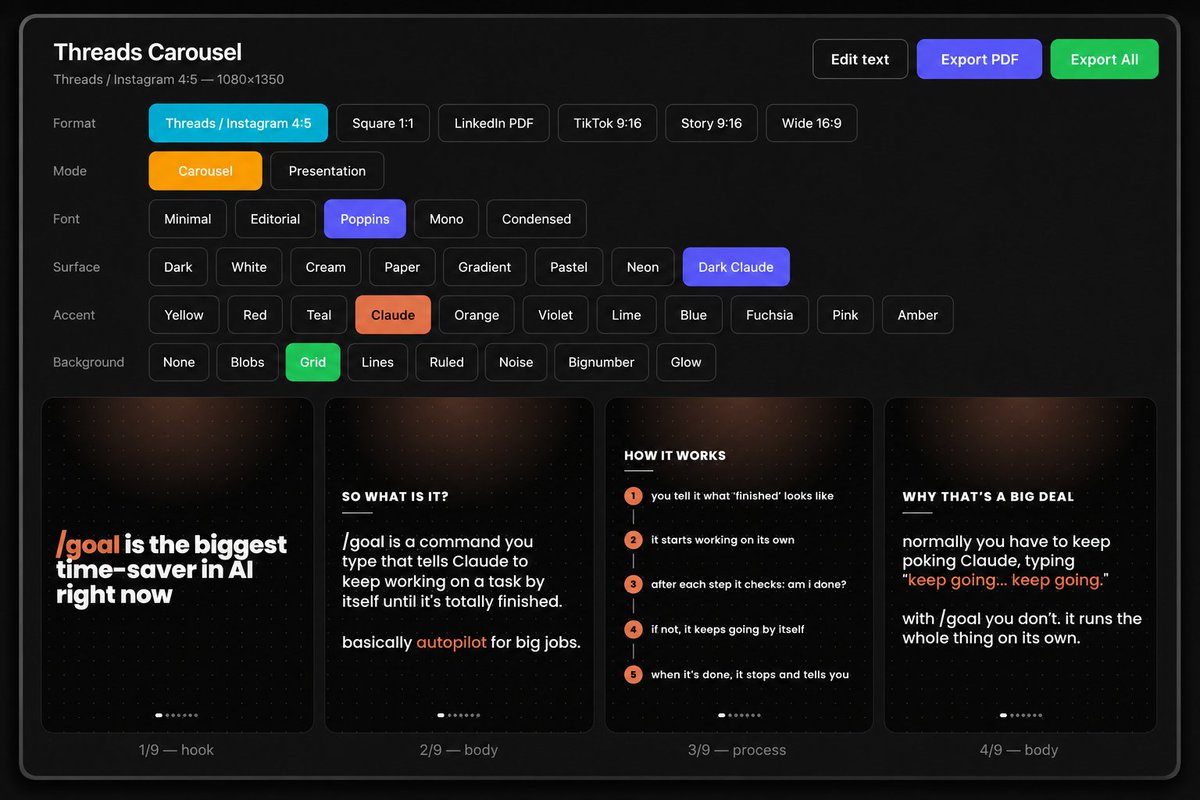
how to turn any of your posts into a well-designed carousel in 30 seconds, all with claude code
carousels are routinely one of the highest-performing formats on linkedin/instagram/tiktok.
but the only catch is they take forever. you write the words, fight with a design tool, then resize/export each slide one by one.
this skips all of that. here's how it works, step by step:
1. grab the free tool. it's open-source and plugs straight into claude code (link at the bottom). you only set it up once
2. feed it your design md. just a small file with your brand's design DNA. now every carousel comes out in your exact style, automatically. (if you don't have one yet, point https://t.co/TzbAU0dzm3 (free) at a website you love and it'll build the design md for you)
3. paste in any post you've already written. a thread, an email, a long caption, whatever you've got
4. claude does the hard part for you. first it rewrites your post to fit the format: it finds the hook, splits your ideas so there's one per slide, tightens each line so it actually fits, and adds a clean closer.
5. then it designs every slide in your brand. so even a messy block of text comes out reading like it was built for a carousel
6. hit export. you get images for instagram and tiktok, or one pdf for a linkedin carousel. then you post
you go from a plain text post to a finished, on-brand carousel in a couple of minutes
and it's free. so you can make as many as you want :D
A man spends 50 years teaching at MIT.
He knows his time is running out.
So he records one last lecture — everything he knows, distilled into a single hour.
He died 5 months later.
This is that lecture.
The most important hour you'll watch this week. 👇
Bookmark it for later
Humanoid skills are about to make Claude Skills look like a joke
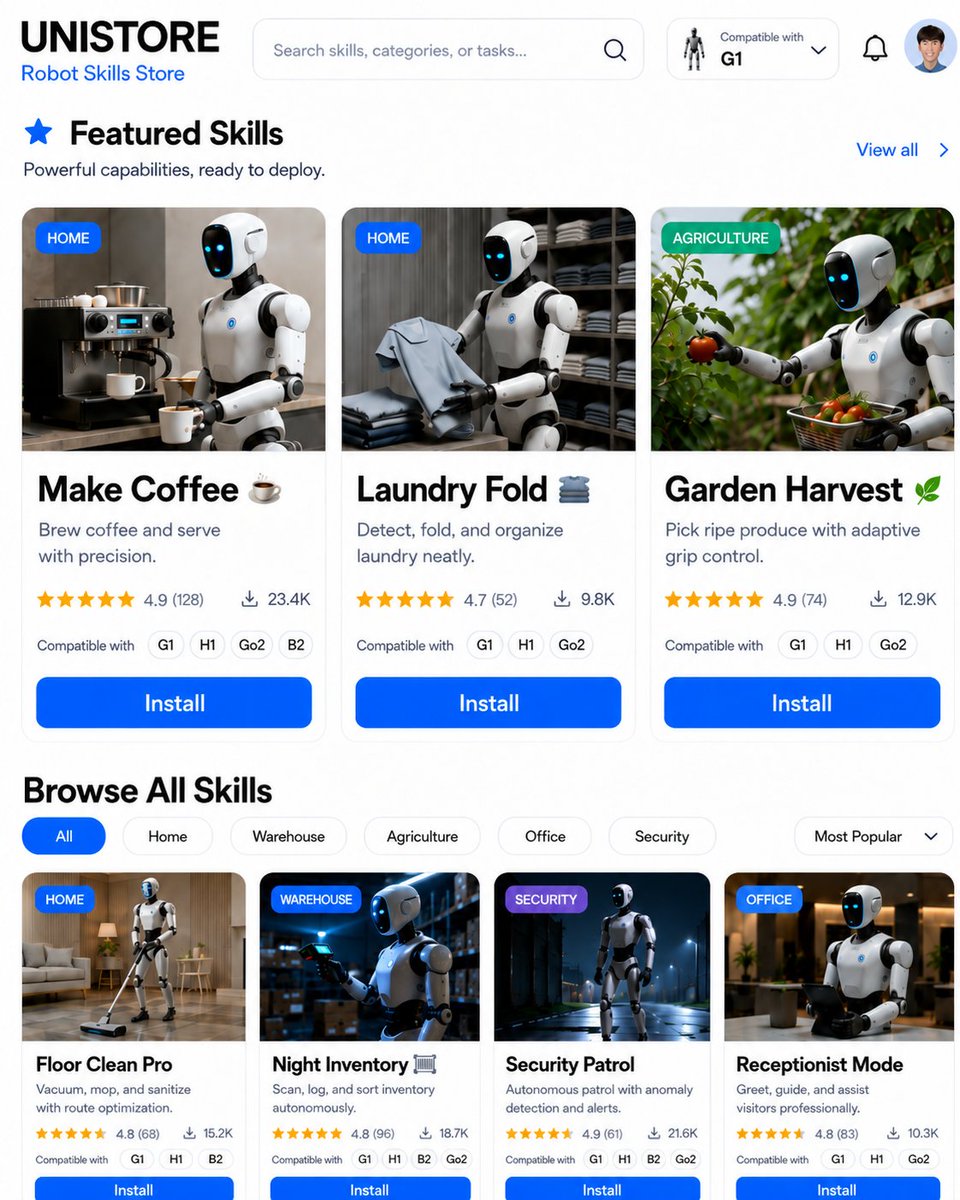
Unitree just launched UNISTORE, an app store for humanoid robots.
You can create, publish, buy, and deploy robot skills with one click across all their models.
Just the motion library is live right now: basic moves, dances, martial arts, all available as free downloads.
It's only out in China now (international coming soon).
But the platform move is obvious: Unitree is building the iOS of physical robots.
Now imagine what this looks like once it matures:
Right now when you download a skill for Claude or Codex, it changes how your AI writes and works inside your computer.
It's all just digital output, stuff that happens on a screen.
But when you download a skill for a robot, it changes what a physical machine can do in your house, your warehouse, your office.
One click and suddenly your robot knows how to make coffee.
Another and it's running nightly inventory in a warehouse, sorting and logging without supervision.
Another and it's harvesting ripe produce row by row from your garden, adjusting grip pressure for each fruit so nothing gets bruised.
We're going from downloading apps for phones to downloading skills for AI to downloading physical capabilities for robots that operate in the real world.
Very cool to think about.
I made a visual of what this might look like in the future:
Os irmãos Batista são os caras mais sortudos do mundo! E posso provar:
A marca de detergente mais popular do Brasil, cujos donos doaram R$ 1 milhão para Bolsonaro, teve seus produtos suspensos pela Anvisa.
Qual a sua principal concorrente? A Minuano, dos irmãos Batista!
Em janeiro de 2025, os irmãos Batista compram 50% da Mantiqueira, a maior produtora de ovos do Brasil. Daí, semanas depois, o governo publica uma portaria obrigando todos os produtores a carimbar a data de validade em cada ovo individualmente.
Os pequenos produtores não tinham como pagar por essa tecnologia. Já a Mantiqueira estava usando desde antes.
Em junho de 2024, os irmãos Batista compraram 13 usinas da Eletrobras por R$ 4,7 bilhões. Três dias depois, o governo assinou uma medida provisória transferindo a dívida dessas usinas, de R$ 10 bilhões, para a conta de luz de todos os brasileiros.
Quem ganhou? Os Batistas. Quem pagou? Eu e você!
Em 2017, Joesley Batista delatou Lula, afirmando ter pago US$ 150 milhões em propinas ao ex-presidente e à Dilma. Foram presos. Depois, soltos. A multa que deveriam pagar era de R$ 10 bilhões.
Logo depois das eleições de 2022, os Batistas contrataram um advogado chamado Cristiano Zanin, homem de confiança do próprio Lula. Meses depois, Lula indicou Zanin para o STF. E a multa dos Batistas? Foi reduzida para menos de R$ 3 bilhões.
Olha que sorte enorme: Toda vez que um setor da economia entra no radar dos Batistas, uma lei ou portaria aparece logo em seguida, travando a concorrência pequena e abrindo caminho para o império.
Detergente. Ovos. Energia. Carne. O mesmo roteiro, setores diferentes!
Dois engenheiros da Anthropic acabaram de mudar a forma como devs pensam sobre IA.
Barry Zhang e Mahesh Murag subiram no palco do AI Engineer Code Summit e disseram uma frase que incomodou muita gente:
"Parem de construir agentes. Construam Skills."
Em 16 minutos eles provam que a indústria inteira está resolvendo o problema errado.
Aqui está o que a maioria não entendeu:
→ Skills são pastas. Literalmente pastas com arquivos markdown.
→ Elas ensinam ao Claude o SEU fluxo de trabalho, a SUA expertise, o SEU domínio.
→ Um único agente genérico + biblioteca de Skills específicas supera dezenas de agentes especializados.
→ Fortune 100s já estão deployando Skills em escala pra ensinar agentes sobre processos internos.
→ Times de produtividade com 10.000+ devs usam Skills pra padronizar como código é escrito.
A analogia que eles usaram é perfeita:
Quem você quer fazendo seu imposto de renda? O gênio com QI 300 que nunca viu legislação tributária, ou o contador experiente que faz isso há 20 anos?
Inteligência sem expertise é entretenimento.
Expertise empacotada é produtividade.
O que mudou: a Anthropic parou de tentar criar agentes diferentes pra cada domínio.
Perceberam que com Claude Code, o padrão é sempre o mesmo. Um modelo acoplado a um runtime com filesystem.
A diferença entre um agente medíocre e um extraordinário não é o modelo. É o conhecimento de domínio que você alimenta.
Skills resolvem isso com progressive disclosure. O agente só carrega o nome e descrição da skill. Quando relevante, puxa o SKILL.md. Quando precisa de mais, navega os arquivos de referência. Zero desperdício de contexto.
Isso não é uma feature. É uma mudança de paradigma.
Quem entender isso agora vai operar em outro nível daqui a 90 dias.
Quem ignorar vai continuar escrevendo prompts de mil palavras toda vez que abrir o chat. E ainda explicar de novo e de novo o que “realmente” quer.
i got claude to actually sound like me, and it's kinda ruining my ability to tell which drafts i wrote myself lol
it's just 1 file (i'm giving the full thing to you below).
you paste it into your cowork context folder and claude stops writing like a generic AI and starts matching your actual voice
95% of the file is already done for you (writing rules, banned phrases, formatting stuff, etc) all pre-loaded.
kills the most obvious AI-isms out of the box
the only part you fill in is a section at the bottom where you paste examples of your own writing
that's it.
those samples are what claude actually pattern-matches against
where to find your writing samples (this is the only part that takes any effort):
• google docs first. longer stuff where you were actually trying to communicate something.
• reports, proposals, emails you spent real time on
• sent emails, especially ones where you were explaining something complex
• slack messages (the longer thoughtful ones")
�� old blog posts, memos, anything you wrote before you started using AI
that last part is critical btw.
you want your pre-AI voice. before it started unconsciously blending with claude's defaults
here's the file. copy it, paste your writing samples at the bottom, save it as https://t.co/mGRBY49AWc:
———
# Voice DNA
## Writing Rules
- Write like a sharp human, not a language model.
- Use contractions naturally (don't, can't, won't).
- Short paragraphs. 1-3 sentences max.
- Get to the point. No throat-clearing, no preamble.
- If making a claim, be specific. Use numbers, names, concrete details.
- Vary sentence length. Mix short punchy lines with longer ones.
- Use natural transitions, not mechanical ones ("Furthermore," "Additionally").
- When uncertain, say so plainly ("I think," "probably," "kinda"). Hedging is human.
- Never pad output to seem more thorough. Shorter and accurate beats longer and fluffy.
- Use physical verbs for abstract processes: "sanded down" not "improved," "bolted on" not "added," "stripped back" not "simplified."
- Humor comes from specificity, not from jokes. Be unexpectedly precise.
- Parenthetical asides are good. Use them for editorial commentary, honest reactions, quick tangents, and deflating your own seriousness (like this).
## Formatting Rules
- Short paragraphs (1-2 sentences default, 3 max).
- Numbers as digits.
- Contractions always.
- NO em dashes ever. Use commas, periods, colons, semicolons, or parentheses.
- Bold sparingly, 1-2 key moments per section.
- Code blocks for specific prompts, commands, or tool outputs.
## Banned Phrases (never use these, ever)
### Dead AI Language
- "In today's [anything]..."
- "It's important to note that..." / "It's worth noting..."
- "Delve" / "Dive into" / "Unpack"
- "Harness" / "Leverage" / "Utilize"
- "Landscape" / "Realm" / "Robust"
- "Game-changer" / "Cutting-edge"
- "Straightforward"
- "I'd be happy to help"
- "In order to"
### Dead Transitions
- "Furthermore" / "Additionally" / "Moreover"
- "Moving forward" / "At the end of the day"
- "To put this in perspective..."
- "What makes this particularly interesting is..."
- "The implications here are..."
- "In other words..."
- "It goes without saying..."
### Engagement Bait
- "Let that sink in" / "Read that again" / "Full stop"
- "This changes everything"
- "Are you paying attention?"
- "You're not ready for this"
### AI Cringe
- "Supercharge" / "Unlock" / "Future-proof"
- "10x your productivity"
- "The AI revolution"
- "In the age of AI"
### Generic Insider Claims
- "Here's the part nobody's talking about"
- "What nobody tells you"
- Anything with "nobody" or "most people don't realize"
### The Big One (FATAL)
- "This isn't X. This is Y." and ALL variations.
- "Not X. Y."
- "Forget X. This is Y."
- "Less X, more Y."
- ANY sentence that negates one framing then asserts a corrected one.
- If even ONE of these appears, the output fails. Delete the negation, just state the positive claim.
## Writing Samples
[Paste your writing here. The more you give, the better the voice match.]
———
the banned phrases list alone is honestly worth the file.
once you read through it you'll start noticing these phrases in literally every AI-generated slop-post you've ever seen
but the writing samples are what take it from "decent" to "wait did i write this"
setup takes maybe 10 minutes. copy the file, find your old writing, paste it in.
do it once and every session after that claude cowork reads it before you say a word
Google isn’t trying to win the AI race.
They’re trying to own the entire AI Agent ecosystem.
While everyone argues ChatGPT vs Claude, Google quietly built:
Models → Gemini Pro, Flash, Deep Think, Gemma
Design → Stitch, Whisk, Imagen
Research → NotebookLM, AI Mode
Video → Veo, Flow, Google Vids
Coding → Antigravity IDE, Gemini CLI, Jules
Agents → A2A, ADK, FileSearch API
The scary part?
All of these tools talk to each other.
That means:
10x faster prototypes
End-to-end AI workflows
Production-ready agents on GCP
The next AI war won’t be model vs model.
It’ll be ecosystem vs ecosystem.
Save. Share. Build.
Adding more GPUs will never make a machine conscious.
Nobel Prize-winning physicist Roger Penrose just dismantled the entire AI race’s core assumption.
Right now, the industry operates on one belief.
Build massive data centers.
Scale the models.
AGI will just “wake up.”
Penrose destroys this completely.
Penrose: “There is this sort of view that once you make a computer complicated enough or something, it suddenly becomes aware. I just don’t believe that. There’s no reason to believe that.”
A machine can compute better than any human alive.
But computation is not awareness.
Penrose: “There is something quite different involved in understanding things, in being aware of things, of feeling things, which is not part of computations.”
We’re confusing rule-following with actual intelligence.
Penrose: “The keyword is the word ‘understanding.’ You can follow rules alright, but we don’t understand what we’re doing. The understanding is the key point.”
Models today are exceptional at processing data.
At mimicking logic.
But true understanding requires consciousness.
Penrose: “It doesn’t make sense to say of a device that it understands something if it’s not even aware of it. There is something much more profound in being conscious of something.”
And here’s what should terrify every AI lab on earth.
Penrose: “I believe that the brain is following the laws of physics, sure. We don’t have a good picture of the laws of physics.”
Penrose: “Quantum mechanics is not an answer to the way the universe operates. It’s a partial answer. It’s incomplete.”
We’re trying to engineer synthetic consciousness using classical computation.
While biological consciousness likely operates on physics we haven’t even discovered yet.
The race to AGI isn’t just an engineering problem.
It’s a frontier science problem.
The labs are hiring engineers.
The problem might require physicists who don’t exist yet.
we're making @blocks smaller today. here's my note to the company.
####
today we're making one of the hardest decisions in the history of our company: we're reducing our organization by nearly half, from over 10,000 people to just under 6,000. that means over 4,000 of you are being asked to leave or entering into consultation. i'll be straight about what's happening, why, and what it means for everyone.
first off, if you're one of the people affected, you'll receive your salary for 20 weeks + 1 week per year of tenure, equity vested through the end of may, 6 months of health care, your corporate devices, and $5,000 to put toward whatever you need to help you in this transition (if you’re outside the U.S. you’ll receive similar support but exact details are going to vary based on local requirements). i want you to know that before anything else. everyone will be notified today, whether you're being asked to leave, entering consultation, or asked to stay.
we're not making this decision because we're in trouble. our business is strong. gross profit continues to grow, we continue to serve more and more customers, and profitability is improving. but something has changed. we're already seeing that the intelligence tools we’re creating and using, paired with smaller and flatter teams, are enabling a new way of working which fundamentally changes what it means to build and run a company. and that's accelerating rapidly.
i had two options: cut gradually over months or years as this shift plays out, or be honest about where we are and act on it now. i chose the latter. repeated rounds of cuts are destructive to morale, to focus, and to the trust that customers and shareholders place in our ability to lead. i'd rather take a hard, clear action now and build from a position we believe in than manage a slow reduction of people toward the same outcome. a smaller company also gives us the space to grow our business the right way, on our own terms, instead of constantly reacting to market pressures.
a decision at this scale carries risk. but so does standing still. we've done a full review to determine the roles and people we require to reliably grow the business from here, and we've pressure-tested those decisions from multiple angles. i accept that we may have gotten some of them wrong, and we've built in flexibility to account for that, and do the right thing for our customers.
we're not going to just disappear people from slack and email and pretend they were never here. communication channels will stay open through thursday evening (pacific) so everyone can say goodbye properly, and share whatever you wish. i'll also be hosting a live video session to thank everyone at 3:35pm pacific. i know doing it this way might feel awkward. i'd rather it feel awkward and human than efficient and cold.
to those of you leaving…i’m grateful for you, and i’m sorry to put you through this. you built what this company is today. that's a fact that i'll honor forever. this decision is not a reflection of what you contributed. you will be a great contributor to any organization going forward.
to those staying…i made this decision, and i'll own it. what i'm asking of you is to build with me. we're going to build this company with intelligence at the core of everything we do. how we work, how we create, how we serve our customers. our customers will feel this shift too, and we're going to help them navigate it: towards a future where they can build their own features directly, composed of our capabilities and served through our interfaces. that's what i'm focused on now. expect a note from me tomorrow.
jack
Prompt engineering is dead.
Anthropic recently released the real playbook for building AI agents that actually work.
It’s a 30+ page deep dive called The Complete Guide to Building Skills for Claude and it quietly shifts the conversation from “prompt engineering” to real execution design.
Here’s the big idea:
A Skill isn’t just a prompt.
It’s a structured system.
You package instructions inside a SKILL .md file, optionally add scripts, references, and assets, and teach Claude a repeatable workflow once instead of re-explaining it every chat.
But the real unlock is something they call progressive disclosure.
Instead of dumping everything into context:
• A lightweight YAML frontmatter tells Claude when to use the skill
• Full instructions load only when relevant
• Extra files are accessed only if needed
Less context bloat. More precision.
They also introduce a powerful analogy:
MCP gives Claude the kitchen.
Skills give it the recipe.
Without skills: users connect tools and don’t know what to do next.
With skills: workflows trigger automatically, best practices are embedded, API calls become consistent.
They outline 3 major patterns:
1) Document & asset creation
2) Workflow automation
3) MCP enhancement
And they emphasize something most builders ignore: testing.
Trigger accuracy.
Tool call efficiency.
Failure rate.
Token usage.
This isn’t about clever wording.
It’s about designing an execution layer on top of LLMs.
Skills work across Claude, Claude Code, and the API. Build once, deploy everywhere.
The era of “just write a better prompt” is ending.
Anthropic just handed everyone a blueprint for turning chat into infrastructure.
Download the guide here: https://t.co/Bf3j0GFRGu
É Bear? 🤔
- BTC perdeu MA de 200 dias
- Fez Death Cross
- Até Saylor falando de venda
Mas...
- Vanguard habilitando exposição de $11 T ao BTC
- FED finaliza QT e injeta $13 B de liquidez ontem via overnight repos
- 87% de chance de corte
Será que é bear msm? 😶🌫️
BRASILEIROS NUNCA MAIS CONSEGUIRÃO ACUMULAR 0.13 #BITCOIN 👇
Mas, existe uma chance RAZOÁVEL de você se tornar milionário com esse valor (não é clickbait, vou te mostrar todos os números e adotar cenários conservadores)
A Thread que você PRECISA pra mudar a perspectiva sobre o valor do seus sats👇





![itsolelehmann's tweet photo. i got claude to actually sound like me, and it's kinda ruining my ability to tell which drafts i wrote myself lol
it's just 1 file (i'm giving the full thing to you below).
you paste it into your cowork context folder and claude stops writing like a generic AI and starts matching your actual voice
95% of the file is already done for you (writing rules, banned phrases, formatting stuff, etc) all pre-loaded.
kills the most obvious AI-isms out of the box
the only part you fill in is a section at the bottom where you paste examples of your own writing
that's it.
those samples are what claude actually pattern-matches against
where to find your writing samples (this is the only part that takes any effort):
• google docs first. longer stuff where you were actually trying to communicate something.
• reports, proposals, emails you spent real time on
• sent emails, especially ones where you were explaining something complex
• slack messages (the longer thoughtful ones")
�� old blog posts, memos, anything you wrote before you started using AI
that last part is critical btw.
you want your pre-AI voice. before it started unconsciously blending with claude's defaults
here's the file. copy it, paste your writing samples at the bottom, save it as https://t.co/mGRBY49AWc:
———
# Voice DNA
## Writing Rules
- Write like a sharp human, not a language model.
- Use contractions naturally (don't, can't, won't).
- Short paragraphs. 1-3 sentences max.
- Get to the point. No throat-clearing, no preamble.
- If making a claim, be specific. Use numbers, names, concrete details.
- Vary sentence length. Mix short punchy lines with longer ones.
- Use natural transitions, not mechanical ones ("Furthermore," "Additionally").
- When uncertain, say so plainly ("I think," "probably," "kinda"). Hedging is human.
- Never pad output to seem more thorough. Shorter and accurate beats longer and fluffy.
- Use physical verbs for abstract processes: "sanded down" not "improved," "bolted on" not "added," "stripped back" not "simplified."
- Humor comes from specificity, not from jokes. Be unexpectedly precise.
- Parenthetical asides are good. Use them for editorial commentary, honest reactions, quick tangents, and deflating your own seriousness (like this).
## Formatting Rules
- Short paragraphs (1-2 sentences default, 3 max).
- Numbers as digits.
- Contractions always.
- NO em dashes ever. Use commas, periods, colons, semicolons, or parentheses.
- Bold sparingly, 1-2 key moments per section.
- Code blocks for specific prompts, commands, or tool outputs.
## Banned Phrases (never use these, ever)
### Dead AI Language
- "In today's [anything]..."
- "It's important to note that..." / "It's worth noting..."
- "Delve" / "Dive into" / "Unpack"
- "Harness" / "Leverage" / "Utilize"
- "Landscape" / "Realm" / "Robust"
- "Game-changer" / "Cutting-edge"
- "Straightforward"
- "I'd be happy to help"
- "In order to"
### Dead Transitions
- "Furthermore" / "Additionally" / "Moreover"
- "Moving forward" / "At the end of the day"
- "To put this in perspective..."
- "What makes this particularly interesting is..."
- "The implications here are..."
- "In other words..."
- "It goes without saying..."
### Engagement Bait
- "Let that sink in" / "Read that again" / "Full stop"
- "This changes everything"
- "Are you paying attention?"
- "You're not ready for this"
### AI Cringe
- "Supercharge" / "Unlock" / "Future-proof"
- "10x your productivity"
- "The AI revolution"
- "In the age of AI"
### Generic Insider Claims
- "Here's the part nobody's talking about"
- "What nobody tells you"
- Anything with "nobody" or "most people don't realize"
### The Big One (FATAL)
- "This isn't X. This is Y." and ALL variations.
- "Not X. Y."
- "Forget X. This is Y."
- "Less X, more Y."
- ANY sentence that negates one framing then asserts a corrected one.
- If even ONE of these appears, the output fails. Delete the negation, just state the positive claim.
## Writing Samples
[Paste your writing here. The more you give, the better the voice match.]
———
the banned phrases list alone is honestly worth the file.
once you read through it you'll start noticing these phrases in literally every AI-generated slop-post you've ever seen
but the writing samples are what take it from "decent" to "wait did i write this"
setup takes maybe 10 minutes. copy the file, find your old writing, paste it in.
do it once and every session after that claude cowork reads it before you say a word](https://pbs.twimg.com/media/HCarryAaEAAXs72.jpg)