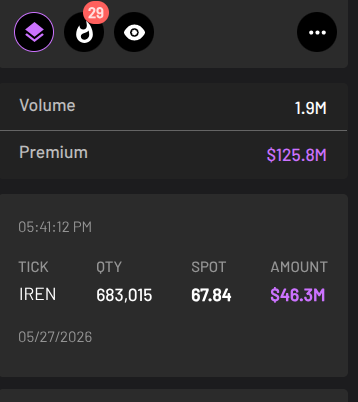
I have purchased an additional 280,000 shares of BKKT via my affiliated entity Alpine Fox LP. Alpine Fox LP now holds 905,000 shares in total and has become the 4th largest institutional shareholder in the company. See SEC Form 4 filing here: https://t.co/ADd32fLoVX
$IREN: The cloud market's dark horse
I bet most $IREN bulls are starting to get increasingly exhausted by the price action. I certainly am.
However, as long-term investors, we should see day-to-day price action as nothing more than noise.
$IREN is particularly "noisy," which makes it an especially difficult hold. Yet in times like these, it's important to step back and refocus on the company's fundamentals rather than let price action sway one's emotions.
And the way I see it, $IREN's competitive standing is rapidly improving.
I recently came across an interesting research report by Goldman Sachs that highlighted the discrepancy between planned data center capacity and realized capacity.
Out of the ~18 GW planned to be commissioned over the past 6 quarters, only about ~11 GW actually got built.
Not only is the gap between planned and realized capacity rapidly widening, but the rate at which new capacity is coming online has actually declined over the past couple of quarters.
Much of this discrepancy comes down to power continuing to be a major bottleneck.
As grids get more and more constrained with lead times reaching 5+ years, many developers are moving toward behind-the-meter (BTM) generation (on site power generation), circumventing the need for grid connectivity.
Yet that comes with its own set of problems and bottlenecks. The end result is an increasing amount of delays and outright project cancellations.
This industry backdrop plays directly into the hands of $IREN, which now has 5.8 GW of secured grid-connected power across global jurisdictions.
The only reason the industry is switching toward BTM is that it's the only option if you don't want to wait in multi-year queues to secure grid connections. But don't get it twisted, grid-connected power remains the preferred option.
$IREN is in a unique position to capitalize on this structural bottleneck and become one of the few cloud providers that can actually bring on 5+ GW of compute capacity over the coming years.
I'd even go as far as saying that this structural advantage is the primary reason the $NVDA partnership came to be.
While $NVDA undoubtedly remains king of the hill, even they face a real dilemma that could cause cracks in their growth trajectory.
On the supply side, they have to come to terms with the fact that the gap between planned and realized data center capacity is widening, while the trend of new capacity coming online is actually decelerating.
This is the issue I just flagged, and it could act as a potential growth bottleneck for $NVDA, since fewer builds means fewer GPU sales.
Layered on top of this is the demand side. It's perfectly clear that demand for $NVDA's AI hardware remains insatiable. However, when looking closer, it's also apparent that competition is increasing.
Pretty much every hyperscaler is working on their custom chips (TPU, Trainium, Maia, MTIA), and not exclusively for internal use cases anymore, but increasingly to service the compute needs of large AI labs. Anthropic alone has signed deals worth billions for Google TPU and AWS Trainium capacity.
Then you obviously have the likes of AMD and Cerebras directly competing against the AI giant, trying to claim market share.
Taken in aggregate, these two issues could gradually lead to a growth problem for $NVDA if not addressed.
This is exactly where $IREN comes in.
They've got the largest secured power portfolio of any neo-cloud at 5.8 GW and growing fast, they develop 100% of their data centers themselves, and they're not building competing silicon.
That makes them the most reliable demand outlet $NVDA can partner with at scale.
The Sweetwater partnership, positioning the 2 GW campus as a "flagship DSX deployment," isn't $NVDA doing $IREN a favor. It's $NVDA solving its two biggest problems at once.
I'm sure you know the popular saying that "history never repeats, but often rhymes." I think today's neo-cloud market is somewhat similar to the dot com era search engine war.
Back then, the front-runners leading the race were AltaVista, Excite, and Yahoo, while Google was a latecomer that ultimately came out on top.
Today, the vast majority of investors in this space are declaring either $CRWV or $NBIS the obvious winners in the race to become the next hyperscaler.
However, I believe the real dark horse that the mainstream doesn't give much credit to is $IREN.
I believe they have all the ingredients to leapfrog every competitor in a short amount of time, in large part due to their structural advantages and pursuing the right long-term strategy from the get go.
The asset-light model, which both $CRWV and $NBIS have been leaning into, doesn't work well in capital-intensive industries, at least not over the long run.
It's somewhat of an oxymoron, since it seems intuitive that one way to circumvent some of the CapEx burden is to outsource from colocation providers.
Yet that approach leaves you with less control, less flexibility, and ultimately higher costs in aggregate in the form of operating expenses (the landlord also has to earn $).
I studied the Bitcoin mining industry for years, and the asset-light model was once a popular strategy around the 2021 bull market. While it proved to be a strong growth lever, it ultimately ended up being a disaster for anyone who adopted it.
Companies like $MARA are the perfect example.
$MARA heavily adopted the asset-light model and grew to become the largest $BTC miner, yet ended up as one of the most unprofitable public miners of all, leading to significant value destruction for shareholders over time.
Once it became obvious that asset-light wasn't a sustainable strategy, $MARA tried to pivot away from it by increasing self-deployments. But developing infrastructure in-house is a much harder discipline to master, and you don't simply switch into it overnight.
$IREN ultimately won the mining race last cycle by doing the exact opposite of $MARA from the start.
They developed all of their data center infrastructure in-house, backed by a seemingly unlimited pipeline of secured power, which ended up making them the fastest growing and most profitable miner of all time.
While the cloud sector has significant differences from the mining industry, the primary drawbacks of the asset-light model carry over.
Over time, it will become obvious to Wall Street and the broader market that this strategy sounds great in theory, but in practice leads to a stack of operational issues and severe margin compression.
Out of the two current front-runners, $CRWV and $NBIS, I think Nebius will do better. They've at least started moving toward a more diversified mix of self-owned capacity rather than purely relying on hosted colocation, which is the right direction even if they're still early in that pivot.
That said, as the $MARA example showed, developing in-house gigawatt projects at scale is not something you learn overnight.
It's clear to me that a player like $IREN, which has been building this discipline from day one, has the most realistic pathway toward sustained, profitable growth in this space.
In my view, $IREN is the dark horse that will end up winning the race. Thus overthinking today’s price action wouldn't do me any favors.
Cheers guys, have a great weekend! ✌️
$CIFR CEO Tyler Page says the company may generate its own power on-site to move faster on AI data center demand.
Hyperscalers need power faster and Cipher may be able to “tap the pipeline” instead of waiting years on the grid.
The greatest deal ever?
$920,000,000*12=$11.04B ARR
11,040,000,000/110,000=
$100,363.64 per GPU
$100,363.64/365/24=$11.46 per hour
@elonmusk@xai@SpaceX maybe IAAS / PAAS is your bread and butter.
Unlikely these are Vera Rubin and likely GB300s or lower.
$IREN $CRWV $NBIS are worth way more if @Google is willing to pay these rates for bare metal or maybe Kubernetes
THE $SPCX VALUATION JOURNEY
• 2002: $27M valuation with no rocket flown yet
• 2010: ~$1B valuation after Falcon 9’s first flight
• 2015: ~$10B valuation after $GOOGL invested with Starlink announced but still pre-revenue
• 2024: ~$350B valuation as Starlink became a real revenue engine
• 2025: ~$800B valuation as IPO plans firmed up & Starlink subscription revenue scales
• Jan 2026: ~$1.3T valuation after xAI was folded in which added AI optionality
• June 2026: ~$1.8T reported pre-IPO valuation with Starlink anchoring the core and xAI driving the final valuation leg
SpaceX has just announced that they have entered into a $920 million per month agreement with Google to provide compute capacity, according to a new filing.
"On June 5, 2026, we entered into a Cloud Service Agreement with Google with respect to access to compute capacity. The customer has agreed to pay us $920 million per month from October 2026 through June 2029, with capacity ramping up through September at a reduced fee. The compute capacity provided includes approximately 110,000 NVIDIA GPUs, CPUs, memory, and other related components.
After December 31, 2026, the agreement may be terminated by either party upon 90 days' notice. The customer will retain ownership of, and intellectual property rights in, its content, Al models, and related data."
This is WILD!
One week before SpaceX's historic IPO, Google signed a deal to pay SpaceX $920 million per month from October 2026 through June 2029 for access to 110,000 Nvidia GPUs, CPUs, and related infrastructure (Save this).
That is $11 billion per year and up to $30 billion over the life of the contract.
This comes less than a month after Anthropic committed $1.25 billion per month for full access to the Colossus 1 data center in Memphis, 200,000+ GPUs, 300+ megawatts of power capacity, through 2029.
Two of the most consequential AI labs in the world combined committed value over $70 billion.
The question that haunted SpaceX's IPO roadshow was why did Elon keep spending billions constructing Colossus, Macro Hard and Macro Harder, three facilities totaling nearly 2 gigawatts of AI compute when xAI's revenue wasn't yet on the same trajectory as OpenAI or Anthropic?
Wall Street was pricing in a risk that Elon was building capacity ahead of revenue which would mean sustained cash burn without a clear payback timeline.
That concern was legitimate on its face, because xAI had been aggressive on model development but had not yet demonstrated the enterprise revenue numbers to justify the infrastructure cost.
The answer is that the compute itself was always the product.
Amazon has AWS, Microsoft has Azure, Google has Google Cloud, Elon just confirmed that he has been quietly building the fourth major hyperscale AI cloud and his first two paying customers are Google and Anthropic, the very companies most aggressively competing in the AI race.
xAI's Colossus facility in Memphis was built at a speed that no traditional data center developer could match, it went from groundbreaking to operational in roughly 122 days.
That is what happens when you have direct Nvidia relationships, a construction operation built around SpaceX-style execution, and a founder who treats infrastructure buildout the same way he treats rocket launches: compress every timeline and eliminate every bottleneck.
The result is that SpaceX now has three operational facilities, Colossus, Macro Hard, and Macro Harder with Macro Hard and Macro Harder in Blackwell architecture running 1.2 gigawatts combined.
Colossus 1, built on H100s and optimized for inference, is the facility that went to Anthropic first.
The Blackwell-era facilities are where the next-generation training workloads happen and Google's deal suggests they are renting into that capacity as it comes online through the second half of 2026.
Elon's compute leasing business would generate approximately $45 billion in incremental annual revenue on top of the mid-$20 billion range analysts had been modeling for SpaceX more than enough to fully subsidize the infrastructure investment and take the financial pressure off xAI delivering immediate AI product revenue.
That changes the entire valuation conversation of SpaceX completely!
Milk road remains bullish on Space and come join Milk Road Pro and get our full SpaceX IPO breakdown, how we're thinking about the $1.75 trillion valuation and our entire AI thesis. Link below!
IREN has announced a planned 800MW data center campus in Bundey, South Australia.
This marks IREN’s first announced Australian data center project and one of the largest in the Asia-Pacific region announced to date.
Learn more: https://t.co/3bOYCUG3pk
BREAKING: As Anthropic confidentially files a draft S-1 for an IPO, the company is now expected to close above $1.8 trillion in market cap on its first day of trading.
Between SpaceX and Anthropic, combined market cap on IPO day is expected to exceed $3.5 trillion.
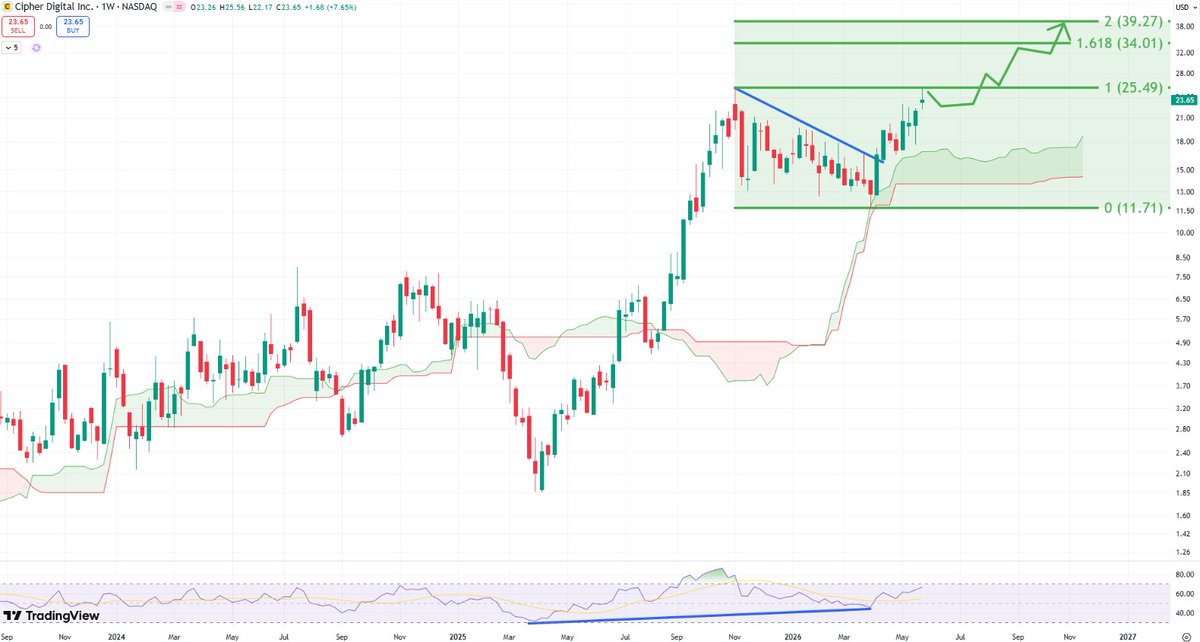
$CIFR is already back at all-time highs, so I view any pullbacks here as potential buying opportunities ahead of what could be a significant blue-sky breakout.
Once price clears this level decisively, the measured move projects upside into the $34–$39 range.
I've been long since the $4 area, so naturally I'd love to see this one complete the journey and turn into a true 10x winner. The trend remains firmly intact, and the chart continues to look exceptionally strong.
$PLTR is on pace for ~$10B in annual profit by 2028:
• 2026: $4.5B (+220% YoY)
• 2027: $6.7B (47% YoY)
• 2028: $10B (+50% YoY)
Palantir is building the layer that turns AI from intelligence into action & market is still underestimating how valuable owning that layer becomes
We've raised $65 billion in Series H funding at a $965 billion post-money valuation, led by @AltimeterCap, Dragoneer, @Greenoaks, and @sequoia.
This investment will help us advance our research and expand our capacity to meet growing demand for Claude.