2025 was an eventful/disruptive year for computer science research, for two reasons: 1) a shock to federal funding, and 2) the arrival of AI models capable enough to assist mathematical research. 1) is unambiguously bad and 2) is probably mostly good. I'll write about AI first.
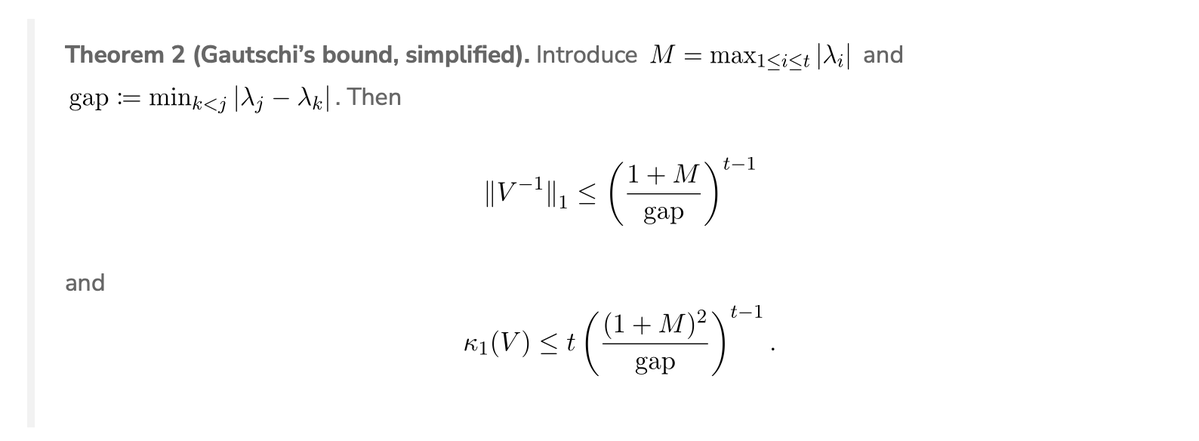
New blog post out! Vandermonde matrices are famously ill-conditioned, but just how bad are they? In this post, I discuss Gautschi’s 1962 bound showing that Vandermonde matrices are merely exponentially ill-conditioned https://t.co/2IZNfNVrw3
Flow Matching (FM) is one of the hottest ideas in generative AI - and it’s everywhere at #ICML2025.
But what is it? And why is it so elegant? 🤔
This thread is an animated, intuitive intro into (Variational) Flow Matching - no dense math required.
Let's dive in! 🧵👇
Excited to share our #ICML2025 Spotlight paper "On the Guidance of Flow Matching", a framework of exact energy guidance in flow matching models. This work theoretically studies how to achieve controlled generation in the powerful generative model, flow matching, and proposes an array of practical algorithms to achieve asymptotically exact or approximate guidance: https://t.co/zFrtux5G2G
One reason why "AI for science" discussions are confusing is that it could refer to a lot of different things. I came up with a spectrum for organizing them: is AI being used to process scientific ideas or scientific data? The figure shows where a selected set of applications would be placed on this spectrum. Each application has very different benefits and risks.
One of the insights in my work with Sayash Kapoor (such as the paper "Leakage and the reproducibility crisis in machine-learning-based science") is that we're only starting to discover the pitfalls of using traditional ML for science. I suspect that it will take a long time to learn all the risks of applying generative AI to science (by which time, of course, there will be many more applications).
Another nice classification of the various visions of AI for science is in the paper "Artificial intelligence and illusions of understanding in scientific research" by Lisa Messeri and @mollycrockett — they distinguish between "Oracle", "Surrogate", "Quant" and "Arbiter".
Certainly, one must treat it critically, as existing studies are based on experience, whose pattern or even nature may not hold in the future, i.e. the problem of induction, as David Hume pointed out.
🎉Thrilled to share that our paper on improving diffusion models with a better covariance estimation method has been accepted at #ICLR2025 with an average score of 8/10! Stay tuned for our camera-ready version, and I look forward to meeting old and new friends in Singapore.
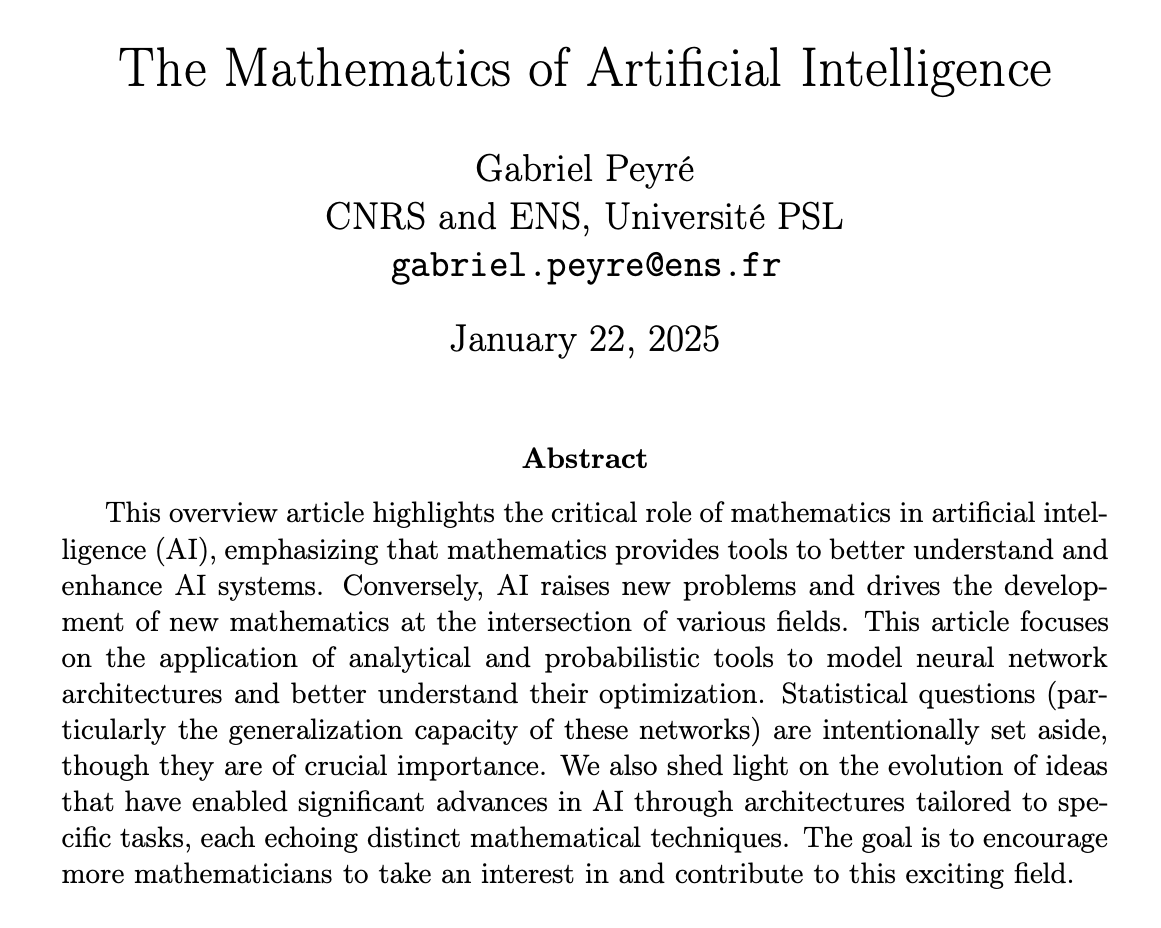
The Mathematics of Artificial Intelligence: In this introductory and highly subjective survey, aimed at a general mathematical audience, I showcase some key theoretical concepts underlying recent advancements in machine learning. https://t.co/FdxBkdLYrw