Top tech giants iterate LLMs at breakneck speed behind closed doors, only releasing final model weights without revealing the internal trade-offs, trial-and-error, or architectural decisions. Meanwhile, the traditional academic publishing cycle—from paper submission to peer review—moves too slowly to keep up. As a result, the most valuable frontier insights are left circulating through word-of-mouth and industry rumors.
We desperately need a shared, transparent space to track the real science of LLM pre-training.
That’s why we launched ArchSpace—a platform pioneering "Crowdsourced Architecture Exploration" for LLMs.
Here is how the new game is played:
🔹 Complete Pre-training Transparency: ArchSpace will open up full checkpoints, training logs, and experimental results for each of the architectural ideas, in the form of GitHub issues and pull requests. Both successful and negative trials will be logged. A PR including a terse description, a change log of code, and the corresponding experimental results makes it complete. No more need to write a 10 page paper and wait for several months for acceptance!
🔹 The ArchSpace (repo at https://t.co/UB5dQuptbP) starts from a standard Decoder-only Transformer, specifically the Olmo-3 architecture released by @allen_ai , and accepts ideas of architectural innovation from the community.
🔹Anyone in the community can propose their own ideas through GitHub Issues, and submit their experiment results through Pull Requests. If the idea turns out to work well, it gets scaled up, and can get merged into the original repo. Every idea and experiment is tracked and credited in this way, thus enables to disseminate proper recognition to every contributor.
🔹All changes can be visually traced through the interactive ArchSpace website (https://t.co/wJ9Z7Kwcy0)
Let’s shift LLM research from industry rumors to transparent, reproducible science!
🌐 Explore the platform: https://t.co/wJ9Z7Kwcy0
And GitHub repo: https://t.co/UB5dQuptbP
Sick of LLMs over-optimizing for a single reasoning path? 📉
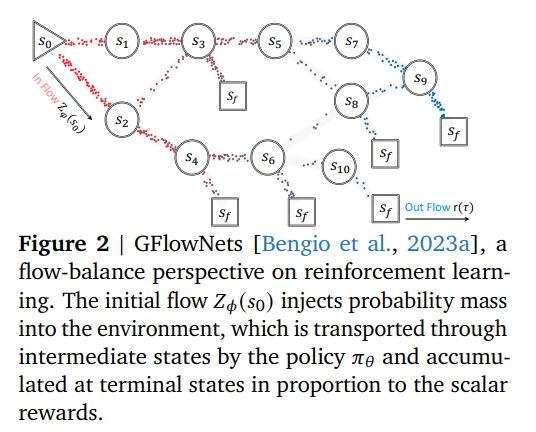
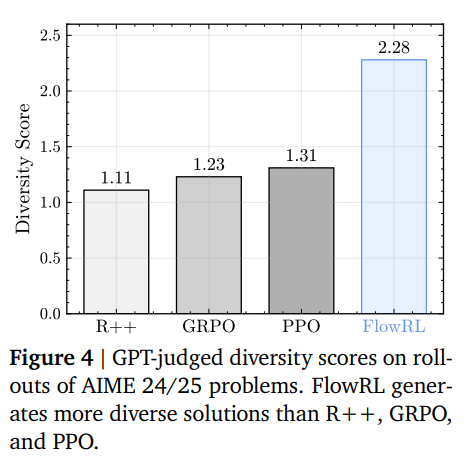
Meet FlowRL at #ICLR2026! We use flow balancing to capture the full reward distribution, ensuring more diverse and robust reasoning. 🌈It moves beyond the reward maximization objective of PPO/GRPO, and introduces a new objective of reward distribution matching, to promote diverse & generalizable reasoning paths via flow balancing. 🌊
📍 Come chat at our ICLR 2026 poster!
⏰ Apr 24, 11:15 AM – 1:45 PM
🏢 Pavilion 4, P4-#4607
📄 Paper: https://t.co/tn2BrXrUTu
💻 Code: https://t.co/Xtvx9Gxg2K
#ICLR2026 #LLM #ReinforcementLearning #FlowRL @hongyuan_mei@zhu_xuekai
🚨 Is that "new" model actually yours? 🕵️♂️
Stop by our ICLR poster to see AWM (Accurate Weight-Matrix Fingerprint) in action. We’ve built a high-fidelity metric to verify LLM lineage—even after intensive post-training or structural changes.
✅ No more worrying about model "washing" or fine-tuning obfuscation.
✅ Robust against pruning, scaling & permutations via LAP + Unbiased CKA.
✅ 100% detection rate.
📍 Pavilion 4, P4-#4109
⏰ Apr 24, 9:30 PM - 12:00 AM CST
🔗 Paper: https://t.co/87CCjIbVIt
🔗 Code: https://t.co/JMNfcgeIqn
See you there! 👋 #ICLR2026 #LLM #IPProtection
🚨 Is that "new" model actually yours? 🕵️♂️
Stop by our ICLR poster to see AWM (Accurate Weight-Matrix Fingerprint) in action. We’ve built a high-fidelity metric to verify LLM lineage—even after intensive post-training or structural changes.
✅ No more worrying about model "washing" or fine-tuning obfuscation.
✅ Robust against pruning, scaling & permutations via LAP + Unbiased CKA.
✅ 100% detection rate.
📍 Pavilion 4, P4-#4109
⏰ Apr 24, 9:30 PM - 12:00 AM CST
🔗 Paper: https://t.co/87CCjIbVIt
🔗 Code: https://t.co/JMNfcgeIqn
See you there! 👋 #ICLR2026 #LLM #IPProtection
Presenting our #ICLR2026 work on Apr. 23: "MLP Memory: A Retriever-Pretrained Memory for LLMs." We are trying to solve the Long-term Memory challenge by shifting from external document access to a differentiable parametric module.🧠✨
✅ True Parametric Memory: An external neural network pre-trained to imitate retriever patterns.
✅ Unlimited Scaling: Handles large-scale, long-term knowledge that context windows can't reach. Theoretically, we could memorize the whole pretraining set into the external memory!
✅ Seamless Integration: Zero-latency retrieval for deep knowledge synthesis.
Stop by to see how we’re giving LLMs a permanent, scalable memory!
📍 Pavilion 4 #P3-135
📅 Thu, Apr 23 | 3:15 PM – 5:45 PM
🔗 Paper: https://t.co/iKJMiMdGUE
🔗 Code: https://t.co/c6vWYoQskC
🚀 Excited to present our latest work #PonderLM at #ICLR2026!Why just scale parameters when you can scale Latent Thoughts? 🧠Inspired by the pondering process, PonderLM repeatedly invokes the forward pass in continuous space within a single token step—refining predictions without any human labels. Highlights:
✅ Efficiency: PonderPythia-2.8B rivals Pythia-12B with 4x fewer params.
✅ Data-Savvy: PonderPythia-1B matches TinyLlama-1.1B using 90% LESS training data.
✅ Flexible: Performance scales dynamically with inference-time pondering steps.
Come chat with us at the Poster Session!
📍 Location: Pavilion 3 Poster Location: P3-#717
📅 Time: April 23, 10.30 am-1.00 pm
🔗 Paper: https://t.co/hMSFgsJXLe
🔗 Code: https://t.co/8bb2Wb1esC
#LLMs #ICLR #MachineLearning @iclr_conf
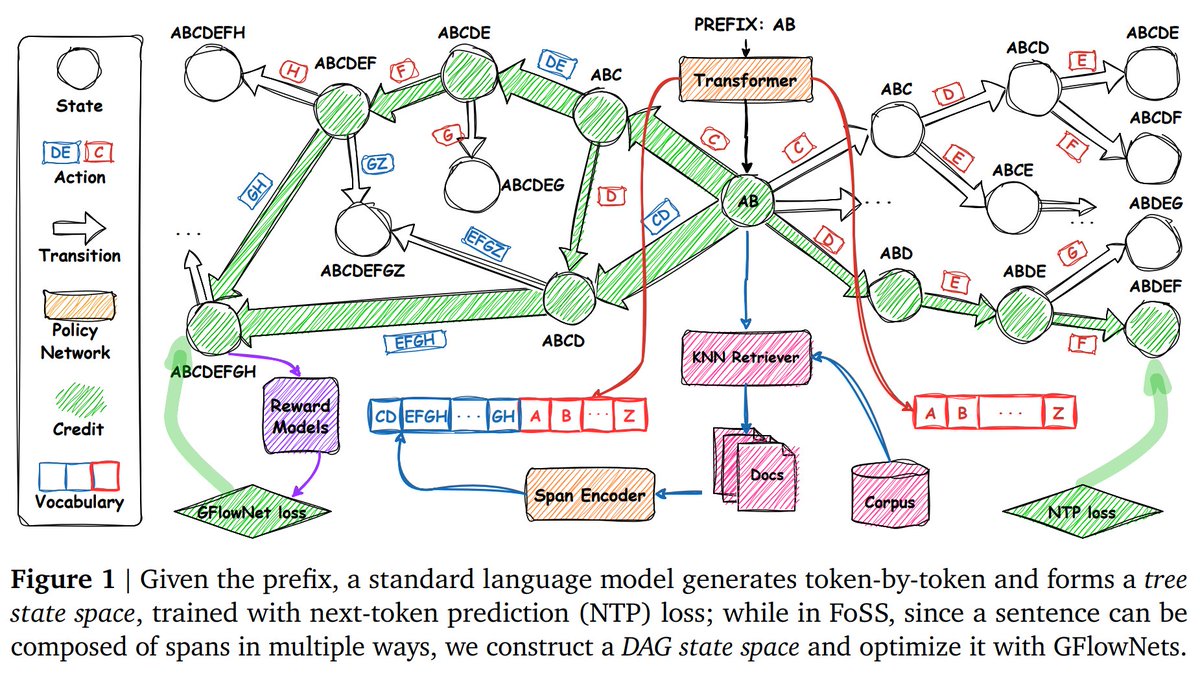
Standard LMs are confined to token-by-token generations and form a tree-structured trajectory. We introduce Flow of Spans (FoSS), a novel framework that generalizes LMs to generate text in dynamic spans via GFlowNets.
Key highlights:
✅ Modeling generation trajectory as a DAG
✅ Flexible span sampling for better expressiveness
✅ Superior performance in retrieval-augmented tasks
📍 Come chat with us at ICLR 2026 Poster Session!
📅 Thu, Apr 23, 2026 | ⏰ 3:30 PM – 6:00 PM CEST | 📌 Pavilion 3 Poster Location: P3-#705
#ICLR2026 #LLM #GFlowNets #DeepLearning @iclr_conf
Looks like this recent paper is closely related to what you described: https://t.co/QfYvbiMivh . The model learns from its own experiences without updating its internal weights or using gradients. It introspects its actions, identifies successful strategies, and stores them as "semantic advantage" in natural language.
@Yuchenj_UW Not sure why Elon proposed this. It'd be very easy to think of some tasks in coding that LLMs fail. What Andrej said in the interview is just one of them. Grok-5 is definitely going to lose if such a contest happens.
@haider1 Really True! AI agents have mastered the low-hanging fruit in various applications. The hard, unsolved problems in those applications won't be fixed with more tweaks. To solve them, you'll need to go all the way down to fundamental model architectures and pretraining tasks!
Really True! AI agents have mastered the low-hanging fruit in various applications. The hard, unsolved problems in those applications won't be fixed with more tweaks. To solve them, you'll need to go all the way down to fundamental model architectures and pretraining tasks!
Andrej Karpathy says today's agents aren't ready to work like real coworkers or interns
They lack intelligence, can't use computers, aren't multimodal, lack continual learning, and forget what you tell them
Fixing these gaps will take about a decade
Unpopular opinion: Finding a simple idea that actually works is way harder than publishing a fancy one that kinda works. You have to fight the urge to overcomplicate, give up many fancier ideas, fail and pivot again and again until you hit the first principle that truly holds.