Qwen3.8-27B at 144 tok/s on an M5 Max MacBook Pro ⚡
Meet Inco Splash: our open-source inference engine, built around the model and around Apple silicon.
Up to 3× the decode speed of Ollama, 2× oMLX, and almost 4× when an agent fans out into sub-agents.
Qwen3.8-27B at 144 tok/s on an M5 Max MacBook Pro ⚡
Meet Inco Splash: our open-source inference engine, built around the model and around Apple silicon.
Up to 3× the decode speed of Ollama, 2× oMLX, and almost 4× when an agent fans out into sub-agents.
SWE-2 is post-trained on Kimi-K3 and proves that our RL recipe continues to scale on stronger base models.
On FrontierCode, SWE-2 achieves a score of 50.0%. It beats SWE-1.7, Grok 4.6, and GPT 5.6 Sol while matching Fable 5.1 at 64% lower cost.
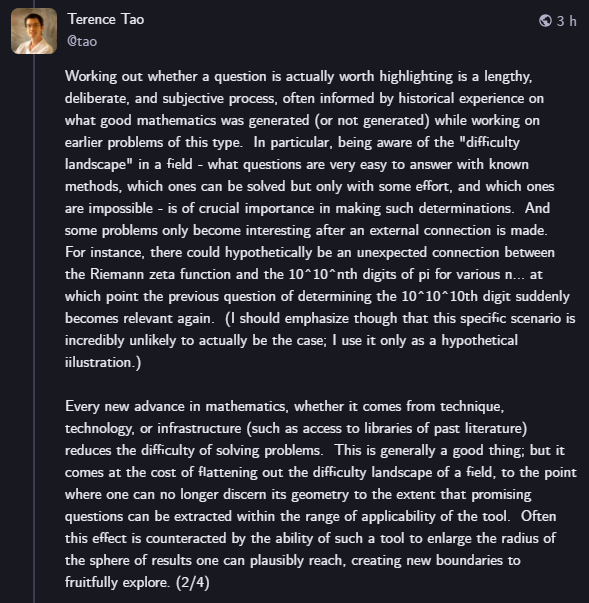
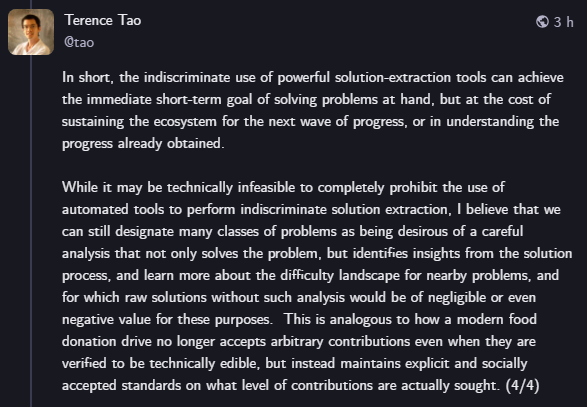
Un thread passionnant de Terence Tao qui met en lumière un vrai risque pour les IA actuelles et futures: il existe peu de problème mathématiques difficiles à résoudre, et tous ont été identifiés par des humains.
En l'absence de méthode et d'historique pour évaluer où chercher, en l'absence de "gradient de la difficulté", l'IA pourrait bien assécher le pool de problèmes et se retrouver face à un paysage mathématique plat, avec simplement des murs à franchir sans trop savoir où chercher.
Pour l'instant, l'intuition humaine qui consiste à voir où on galère et où la solution pourrait mener à de nouveau problème n'est pas entrainable pour une IA, on ne peut pas tagger ce genre d'idées. Les IA qu'on fait tourner sur les vieux problèmes déjà résolus arrive à les re-résoudre mais part dans une infinité de directions ensuite.
Le nombre de problèmes mathématiques à résoudre est infini, mais le nombre de problèmes mathématiques pertinents à résoudre ne l'est pas, et des puissances de calcul et d'analyse décuplés ne sont pas une garantie de pouvoir identifier ces sujets, ces montagnes à gravir sans devoir franchir une falaise à l'aveugle.
D'ailleurs c'est déjà un sujet d'actualité, la source se tarit et une fois tous les "problèmes du millénaire" résolus soit des mathématiciens humains sauront comprendre les implications et trouver des pistes vers de nouveaux problèmes, soit l'IA risque de dire "bon, et maintenant je vais où, je ne vois plus rien émerger là ?".
Pour les ingénieurs qui lisent ça, ça serait une situation un peu similaire à demander à une IA de résoudre un problème sans rien lui spécifier. L'IA est aujourd'hui incapable d'inventer des spécifications pour un problème qu'elle ne connait pas. L'analogie a ses limites, mais c'est un peu là où se dirige les IA pour les maths. L'évolution et la façon de contourner ces problèmes sera ardue, nécessitera de nouveaux outils, mais sera passionnant à suivre.
Thoughts About Scaling Law
Scaling, but not only of parameters. Every model release now ends with the same question: how many parameters? It isn't a question that can be answered on its own. Parameter count is only meaningful alongside three others — how much data you have, where you intend to spend your compute, and who will run the model, under what conditions.
The field learned this the hard way. Kaplan et al. (2020) fit an exponent that told everyone to grow parameters faster than data — roughly 2.7:1 — and the industry complied: GPT-3, Gopher, MT-NLG. Hoffmann et al. (2022) redid the experiment across four hundred models and found the compute-optimal split is closer to 20 tokens per parameter, and that with sufficient compute the two should grow at the same rate rather than drifting apart. The error in the earlier fit compounded with every order of magnitude of compute, which is why the largest models of that generation were the most misallocated. The trillion-parameter round was, in retrospect, a detour the whole field took together and then reversed.
Chinchilla wasn't the end either. It optimized training compute for models that would be trained once and evaluated. Today a model is called billions of times a day and inference dominates lifetime cost. Put inference into the objective and the optimum moves toward smaller models trained far longer — deliberate over-training, which is what Llama-2-7B and Gemma-2-9B were doing at roughly 290 and 889 tokens per parameter.
Sparsity moved the target again. In a MoE model two quantities have to be kept apart: total parameters govern roughly how much the model can hold — knowledge, facts, the long tail — while activated parameters and effective depth govern roughly how far it can think, how many steps of a causal chain it can carry before it comes apart. A dense 20:1 ratio does not transfer. And the ratio isn't a single number at all: Roberts et al. (2025) find the optimal tokens-per-parameter is task-dependent, with memorization favoring more parameters and reasoning favoring more data. Follow-up work on MoE observes that at fixed TPP, pushing total parameters higher actually degrades reasoning, while activating more experts reliably helps it.
This matters for what we are building toward. Finding a vulnerability is not a retrieval problem. It doesn't come from having memorized more CVEs; it comes from carrying a twenty-step chain of inference to the end without losing the thread. That capability does not live in total parameter count.
Which brings us to this release. Total parameters appear to matter up to a threshold — enough to hold the world — after which additional capability comes from scaling elsewhere: effective depth per forward pass, and above all post-training. GLM-5.3 is our controlled experiment on that claim. Same base, same architecture, same total and activated parameters as GLM-5.2. One month of scaling long-horizon environments and RL. The gains are not marginal. Well, scaling has more than one dial. We turned the post-training one this time because it had the most slack left in it — not because the others are finished. Base model size, pretraining data, compute spent per forward pass: all of them are still on the table, and we will come back to each. What this experiment taught us is that the dials do not have to be turned together, and that the one worth turning next is rarely the one that was worth turning last. We are not done scaling. Next time, maybe mid-training, pre-training, and even more.