Collecting teleop data for mobile robots with two dexterous hands is slow and costly. Can they learn from human demonstrations instead? 🤔
Yes! Introducing DexRoam (#CoRL2026) 🦾 Aligned egocentric human demos raise avg success: 29%→56% (GR00T N1.7), 32%→57% (π0.5).
🥽 Capture with a Quest 3 + head-mounted ZED Mini. No trackers or external cameras.
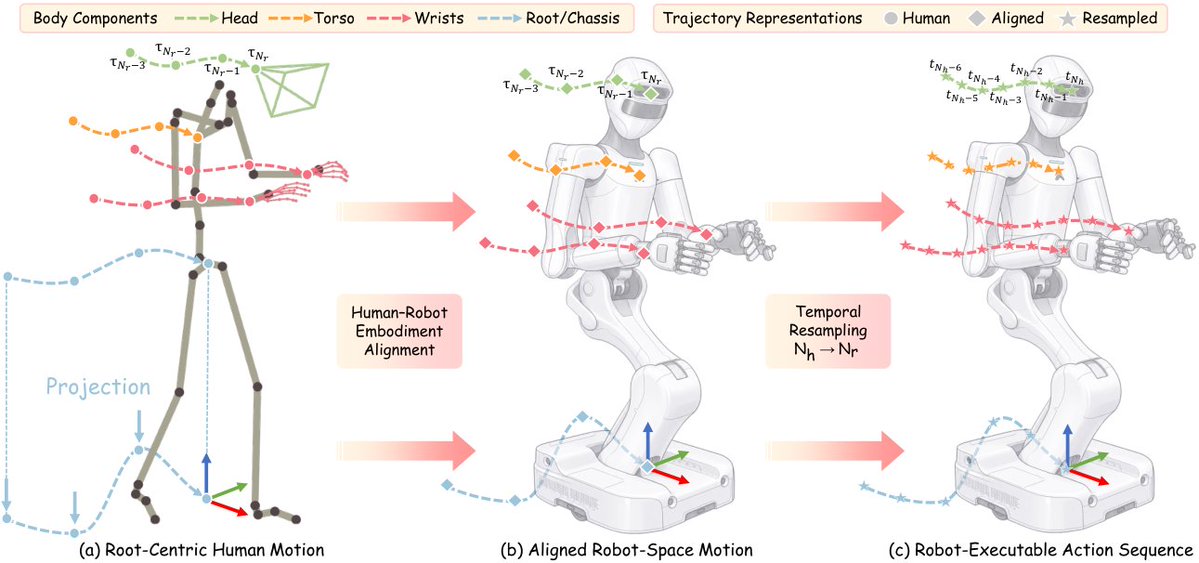
🔗 3-stage alignment maps human motion into the robot's full 56-D whole-body action space.
📉 Matches robot-only training with half the robot demos.
🔓 Code, data, and hardware guide are open-source.
🌐 https://t.co/ogbVvuC1xC
📄 https://t.co/vqJ8MxKRzs
🧵 1/9
In real-world experiments, adding human demonstrations raises average success from 29% to 56% with GR00T N1.7, and from 32% to 57% with pi-zero-point-five.
HKUST, Beijing Academy of Artificial Intelligence and collaborating researchers introduce DexRoam in an arXiv preprint.
Mobile dexterous manipulation needs demonstrations that preserve the coordination between locomotion, body motion and fingers. DexRoam captures egocentric human demonstrations with a consumer VR headset and a head-mounted stereo camera. Three alignment stages map embodiment, action meaning and timing into the robot's action space. This makes the human demonstrations compatible with robot demonstrations for training standard vision-language-action policies, while retaining continuous whole-body motion.
These comparisons apply to the paper's tasks and training protocols. The contribution combines the capture and alignment system with policy learning, so the data-transfer pipeline is part of the evaluated result.
DexRoam: Learning Mobile Bimanual Dexterous Manipulation from Egocentric Whole-Body Human Demonstrations
Paper: https://t.co/90Z1UbcK6s
Our Report: https://t.co/ixM1eVsO4I
📬 #PapersAccepted by Jiqizhixin
🎉 Robots in the real world have to move around. Teleoperating a robot to do both at once is still slow and awkward
Today we're excited to release HALO, Human-Aligned Data Collection for Dexterous Whole-body Mobile Manipulation!
HALO lets you hold the robot's grippers directly and just walk, and the platform rolls with you 🚶 You get natural whole-body motion and fine bimanual control at the same time.
Three key results:
🔑 Demo collection approaching natural human speed: operators walk at a normal pace (~0.7 m/s), up to 2.9× faster than Mobile ALOHA with comparable or higher success
🔑 Dexterous skills: the policy model trained on HALO data fastens a short zip tie and disassembles Lego, while policies trained on Mobile ALOHA or VR data fail
🔑 Mobile skills: very high success on a six-stage long-horizon mobile manipulation task
Let's check out our demos 👇
🚀 Introducing RoboMoCap!
We are releasing the largest locomotion-centric egocentric vision × optical motion capture dataset for humanoid robot learning, joint effort with @GroundedSI@BitRobotNetwork@NokovMocap
📊200+ hours of recordings
🏃 290+ diverse actions
👓 Egocentric Vision
🎥 120 Hz optical motion capture with ~10 mm tracking accuracy
🌐 https://t.co/3ytj6M8h7o
🧵👇
I scraped all 38,101 ICLR 2027 submissions and counted the names before the colon.
LLM has a naming crisis.
🏆 The leaderboard:
TRACE: 47 papers
PRISM: 42
PACE: 22
SCOPE: 21
SAGE: 17
MOSAIC: 16
COMPASS: 14
750 names are used by 2+ papers. That's 2,209 papers sharing a name.
Best parts:
• Two papers called TRACE both fix VLM hallucination. Same name, same problem, different authors.
• Four papers called PRISM do time series. Good luck, reviewers.
• "PACE: Discovering Options via Self-Distillation." None of P, A, C, E appear in the title. They picked the name first.
• 47 TRACEs cover quantum computing, materials discovery, seizure localization, carbon emissions, traffic control, and circuit design. TRACE is everywhere.
• The formula: 5 letters, looks like a real word, sounds cool. CAST. PACT. CRAFT. GRAFT. FORGE.
Tip for ICLR 2028: search OpenReview before you name your method 😂
Follow for more data-backed ML nonsense.
Our DexRoam poster is LIVE at #CoRL2026 right now! 🚀
Feel free to stop by Poster #58 at JW Marriott Austin to check it out. I'll be online throughout the entire poster session—feel free to reach out for discussions or just to chat!
📍 Poster #58
⏰ Nov 10, 5:00–6:30 PM CST (Poster Session 2)
Since I'm not attending in person, please feel free to reach me through:
💬 X (replies or DMs)
📱 Cvent Events App (CoRL Event)
✉️ Email: [email protected]
Our DexRoam poster will be on display at #CoRL2026 today! 🤖
I won't be able to attend in person this year due to visa issues😭, but I'd still love to connect and discuss our work with everyone!🤗
📍 JW Marriott Austin | Poster #58
📅 Nov 10, 5:00–6:30 PM CST
📌 Poster Session 2
If you're attending CoRL, feel free to stop by and check out our work!
I'll be ONLINE throughout the entire poster session and available for live Q&A! 💬
Whether you have questions about human data collection, cross-embodiment alignment, policy training, or just want to exchange ideas, I'd be more than happy to chat!
Feel free to reach out through:
💬 X (replies or DMs)
📱 Cvent Events App (CoRL Event)
📧 Email: [email protected]
I'll be actively checking messages and responding in real time throughout the session! Looking forward to connecting with everyone, even if it's virtually!
📄 Paper: https://t.co/vqJ8MxKRzs
🌐 Project: https://t.co/lglglUrGVT
Our full DexRoam poster is here! 📌
Feel free to check it out and reach out if you'd like to discuss our work or exchange ideas. I'll be online throughout the session and happy to chat! 💬
Our DexRoam poster will be on display at #CoRL2026 today! 🤖
I won't be able to attend in person this year due to visa issues😭, but I'd still love to connect and discuss our work with everyone!🤗
📍 JW Marriott Austin | Poster #58
📅 Nov 10, 5:00–6:30 PM CST
📌 Poster Session 2
If you're attending CoRL, feel free to stop by and check out our work!
I'll be ONLINE throughout the entire poster session and available for live Q&A! 💬
Whether you have questions about human data collection, cross-embodiment alignment, policy training, or just want to exchange ideas, I'd be more than happy to chat!
Feel free to reach out through:
💬 X (replies or DMs)
📱 Cvent Events App (CoRL Event)
📧 Email: [email protected]
I'll be actively checking messages and responding in real time throughout the session! Looking forward to connecting with everyone, even if it's virtually!
📄 Paper: https://t.co/vqJ8MxKRzs
🌐 Project: https://t.co/lglglUrGVT
Meet GR00T 2, our new generation of world-action models (WAMs): it imagines how the physical world will unfold and generates the actions that get it there. One model runs on parallel grippers, dexterous hands, and humanoids.
https://t.co/32Z1plSGQg
A finer touch for humanoid robots. 🤖
At #CoRL2026, NVIDIA is introducing GR00T 2, an open world action model for humanoids, alongside new open industrial benchmarks from @RLWRLD_ai and @UCBerkeley built on Isaac Lab-Arena.
Explore how NVIDIA’s open world action models, scalable simulation tools and agentic workflows help researchers train, test and refine robot skills, from connecting cables to assembling small components.
Discover more ➡️ https://t.co/spzxPurj6y
Such impressive study! While everyone's throwing human data at robots, this paper actually proves how you use them matters way more than how many you have. The clear comparison of different methods' pros/cons + a solid Real2Sim setup. Awesome work!
Does more human video always improve robot learning? 👀
Excited to introduce H2RBench, our #CoRL2026 work—a Real2Sim benchmark for evaluating human-to-robot transfer methods.
🧵 (1/9)
Does more human video always improve robot learning? 👀
Excited to introduce H2RBench, our #CoRL2026 work—a Real2Sim benchmark for evaluating human-to-robot transfer methods.
🧵 (1/9)
I won’t make it to CoRL this year, but our robot peeling work will be presented at Monday’s poster session! Paper, code and data are fully updated: https://t.co/MLGk0UmbH1
This work is almost a year old, and a lot has happened since. I checked this afternoon, and was relieved to find that peeling potato with a knife still isn’t something that Astra can do out of the box (yet)!
Anyways, most publications eventually become obsolete as new advances emerge, and AI is accelerating that cycle. While the specific methods used in this work might not last, I hope the idea does: a robot policy shouldn’t just get the task done, but also do it the way people prefer. How to incorporate human preferences into robot policies still feels underexplored, and I’m excited to see more work in this direction.
For any related discussion or follow-up, feel free to reach me by email :)
💪 We teach humanoids where to move and how hard to apply force, using human demonstrations collected without a robot.
Introducing 🌺 FLoRe: Learning Force-Reactive Humanoid Loco-Manipulation.
Our policy learns to predict actions and forces for each hand. A hybrid compliance whole-body controller tracks these commands while the robot walks and balances.
🧵 (1/6)
❓I keep coming back to this: what tactile representation does manipulation need?
We introduce PanoTac: A dense three-axis Tactile Sensor.
In the demo, the robot reorients and inserts a tube, then wiggles the stopper free while the tube sits loosely in the rack. The right side show the tactile signals that helps robot detect when the stopper releases and when to switch from wiggling to lifting. (1/7)
We asked GPT-6 Astra to edit Qwen3.5-0.8B weights to improve math.
It directly changed only 0.016% of weights, fixing 0.8B's reasoning loops & improving math up to 6x and even instruction following 3x, without gradients or training.
We call this Weight-Space Programming: frontier LLMs can now natively read/write neural network weights! 🧵
Blog: https://t.co/bOWCcFhCVq