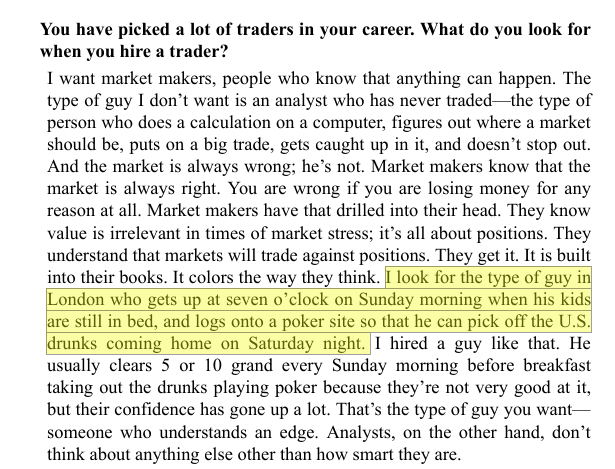
Michael Platt in "Hedge Fund Market Wizards" -- one of the greatest excerpts ever, on why he prefers market makers to analysts:
"I look for the type of guy in London who gets up at seven o’clock on Sunday morning when his kids are still in bed, and logs onto a poker site so that he can pick off the U.S. drunks coming home on Saturday night. I hired a guy like that. He usually clears 5 or 10 grand every Sunday morning before breakfast taking out the drunks playing poker because they’re not very good at it, but their confidence has gone up a lot. That’s the type of guy you want— someone who understands an edge. Analysts, on the other hand, don’t think about anything else other than how smart they are."
Very interesting statement today: $MU CEO predicts a multi-decade memory demand cycle driven by humanoid robots.
"Humanoid robots, he says, will require roughly ten times more memory than today’s Level 2+ autonomous vehicles."
"And that demand wave is set to begin before the decade is out."
Something as well as was "Over time, we expect the value of on-device AI combined with pent-up unit replacement demand to drive memory demand growth"
Which is also another trend (Apple Intelligence is currently dog, but I'm sure we'll see innovations with localized/edge AI).
Feels like all the industry leaders from $TSM Chairman, $TSLA Elon Musk, to $MU CEO see humanoids as the next major trend so physical AI is probably next.
I wonder if the world is going to have enough memory. Or if we'll see enough breakthroughs to shrink memory usage.
The biggest sectors in the market five years from now will be these. Position early and let the decade do the work.
AI Infrastructure. The backbone everything runs on. The data centers, the compute, the owned infrastructure powering every model on earth. Every other sector on this list runs on top of it.
Space. Connectivity and infrastructure moving off the planet and into orbit. Direct to phone networks, launch, and satellite constellations turning space into the next commercial frontier.
Photonics. The plumbing that moves the data. As clusters scale to hundreds of thousands of GPUs, moving information at the speed of light becomes the constraint. A market tripling this decade as 800G goes to 1.6T goes to 3.2T.
Nuclear Energy. The only power source that can actually feed AI at scale. Data centers need enormous, constant, carbon free baseload, and the grid cannot deliver it fast enough. Nuclear is the answer the entire industry is racing toward.
Memory. The bottleneck nobody can build fast enough. Every AI server needs 8 to 10 times the memory of a normal one, the makers are sold out, and the shortage runs for years. No memory, no AI.
Humanoid Robotics. AI stepping out of the screen and into the physical world. A market going from under $2 billion today to $38 billion by 2035. The companies making the brains, eyes, and sensors win no matter which robot wins.
Quantum Computing. The frontier that breaks the limits of classical computing entirely. Still early, still small, but governments and the biggest tech companies on earth are pouring billions in. The most asymmetric bet of the group.
Seven sectors. One direction. This is where the wealth of the next decade gets created, and we are early in every single one.
🔥 "Market Intraday Momentum" Los primeros 30 minutos del día predicen los últimos 30. Operando solo esa media hora final, Sharpe 1.08 contra 0.29 del comprar y aguantar. Si abre fuerte cerrás comprado, si abre flojo cerrás vendido
Lei Gao, Yufeng Han, Sophia Li y Guofu Zhou agarraron datos de alta frecuencia del ETF del S&P 500 entre 1993 y 2013 y encontraron un patrón que se repite todos los días: el retorno de la primera media hora, medido desde el cierre del día anterior, predice el de la última media hora
La estrategia es así de simple: si la primera media hora fue positiva, comprás en la última. Si fue negativa, shorteás. El resto del día estás afuera. Operás 30 minutos y listo
Sobre toda la muestra:
- La primera media hora predice la última con una pendiente de 6.94, significativa al 1%
- El R cuadrado es 1.6%, que para predecir retornos es altísimo
- Sumando la penúltima media hora sube a 2.6%, y en días volátiles llega a 3.3%
- La estrategia da un Sharpe de 1.08, contra 0.29 de comprar y aguantar
Y acá está lo lindo:
- Estar siempre comprado en la última media hora da un Sharpe de menos 0.18, o sea pierde
- La señal de la primera media hora es lo que convierte esa misma operación en un Sharpe de 1.08
- Funciona fuera de muestra y aguanta los costos de transacción
Por qué pasa: los grandes fondos rebalancean al cierre, y la información que llegó temprano la terminan operando los rezagados sobre el final. La apertura deja una huella que se completa en el cierre
Y es más fuerte justo cuando más se opera: días volátiles, de alto volumen, de recesión y de datos macro. Cuanto más se mueve el mercado, más predecible es el cierre
Mi conclusión: el día no es ruido aleatorio de punta a punta. Cómo arranca el mercado en los primeros 30 minutos te dice algo de cómo va a cerrar, y la mayoría no lo está mirando
Link al paper en el primer comentario
People keep asking me what the bottleneck is, but I've stopped trying to find the bottleneck in AI.
There isn't one: there's a current one, and it moves the second you solve it.
- we pushed transistor density about as far as it goes
-> the gate moved to how you package the chips together
- we started solving package area by moving to big glass panels
-> the gate moved to keeping the panel flat and drilling clean holes through the glass
- we ran copper interconnects out of headroom
-> the gate moved to optical, which moved it to the lasers, which moved it to the substrate under the lasers, which moved it to a licensing office in Beijing.
Every single time the industry removes a wall, it does not get open road, it gets a new wall, one floor down, almost always somewhere less glamorous and harder to scale than the thing it just fixed.
This is the actual shape of the buildout, and once you see it you read every headline differently. The constraint everyone is talking about is, by definition, the one that's already visible and already being attacked. The money is in the next one, the layer that is about to bind while everyone's still celebrating the last fix.
So I don't look for the bottleneck anymore. I look for the handoff, the place the pressure is about to move to, because that's where the supply is thinnest and the pricing power is highest right before the crowd arrives.
There is no bottleneck, there's a relay race of them, and the trade is always the next runner.
(image credits to @renstocks_ )
3 years on X. 6 years on Stocktwits.
This week alone:
→ Someone left corporate and now trades for a living - spends 3x more time with family
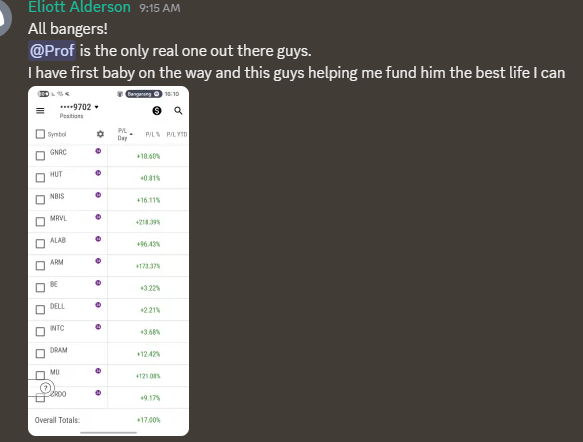
→ Someone expecting their first baby has the funds to give them the best life
→ Someone paid off their parents' mortgage
I get to be part of stories like this every single week.
If I had to give you ONE post to follow to the T - this is it.
The framework that's helped change lives:
A). Technical Analysis
Price action. 2 moving averages (9 EMA and 21 EMA). Volume. Bull flags. Wedges.
Relative strength on red days.
That's it.
B). Allocation
No more than 15% per trade. That's the limit, not the goal. Most trades should be 7-10%.
The 15% is reserved for your highest conviction setups only.
C). Stop Loss
Your SL is NOT optional. If you can't pre-define your loss, you shouldn't be in the trade.
Valid stop loss levels:
→ Horizontal support
→ Swing low
→ Undercut of a moving average
Anything else is a guess.
D). Trade Frequency
Long term investor: 15-20 trades per year
Swing trader: 15-20 trades per month
Day trader: Only when you see an opportunity
Overtrading kills more accounts than bad setups.
E). Sentiment Lows (Where Fortunes Get Built)
VIX at 30 → You buy.
VIX at 50 → You buy more.
VIX at 70 → You buy as much as you can.
(That last one comes once a decade. Don't be one of the people who fumbles it.)
F). Events & Assets to Avoid
→ Bio companies with binary catalysts
→ Stocks heading into earnings (unless that's your edge)
→ Halted stocks
→ Low float pump and dumps
→ Anything you can't explain in one sentence
G). Environment Check
Track sector rotation.
Watch bonds, yields, and the dollar.
Monitor NAAIM, AAII sentiment.
Stocks making new highs vs new lows.
This tells you what kind of market you're in BEFORE you trade it.
H). People to Follow
→ Those who take accountability
→ Those who are open about losses
→ Those who actually share real positions (not just hindsight wins)
→ Those willing to admit when they're wrong
The impact this platform allows me to make is unmatched.
This is the real power of community, humility, and paying it forward.
200,000 people now follow me between two platforms. I'm the only one who hasn't changed. Still read every comment. Still reply to the ones where I can offer real value. Still take losses publicly. Still call my own mistakes out before anyone else does.
That's not going to change at 500K. Not at a million. Not ever.