The Widows Tax Gets Its First Victim.
Today's AFR reports on a woman who inherited a negatively-geared investment property in a divorce settlement. Straightforward transaction. But here's the problem: the budget outlawed negative gearing on established houses—and now she can't refinance.
Treasury promised to fix this. They still haven't.
Banks won't help. She's forced to sell.
This is what happens when policy is rushed. Real people get destroyed. One widow at a time.
Why do I keep banging on about the CGT changes on shares and ETFs?
Because as a millennial, we’ve spent our entire adult lives watching the goalposts move.
Housing out of reach. Cost of living through the roof.
We were told to stop buying lattes. It was the avocado toast. Just work harder. Be responsible, invest for your future. So we did.
We invested in ETFs and shares, one of the very few accessible ways an ordinary PAYG worker could build wealth when property was already out of reach.
Investing became simple, low cost and accessible thanks to technology and apps. Millions of Australians started investing.
Now the rules are changing there too.
It feels like every time our generation finds one of the few ways to get ahead, someone decides that’s the next thing to tax more.
And somehow taxing gains on ETFs and shares more heavily is all packaged up and sold as the solution to housing affordability and intergenerational wealth… yet those who benefited under the old rules are grandfathered. 🙄🫠
In selling the Budget, the Treasurer repeatedly claimed that only “1 in 10” Australians under 35 own shares, including in his interview with @BilliFitzSimons.
That figure appears to come from Treasury modelling (later released under FOI), showing that 11% of taxpayers under 35 received dividend income.
But… if you read the fine print in the emails released under FOI it looks like Treasury ignored both capital gains and foreign trust income. If that’s right, it’s a major omission!
Less than half of ASX listed companies pay dividends, so many young Australians invested in growth shares may not have been counted. Nor, it seems, were investors in assets like crypto that generate capital gains but no dividend income.
It also appears to miss investors in ASX listed international ETFs ($150B), which distribute foreign trust income rather than franked or unfranked dividends.
If so, Treasury may have significantly understated how many young Australians invest, and therefore how many will be negatively affected by these tax changes.
Yet another example of budget modelling that underestimated the policy’s impact on younger Australians?
Treasurer interview: https://t.co/vS4CK6z3h9
FOI documents: https://t.co/GoaVrzJgcp
Question for the Treasurer @JEChalmers Can you clarify whether Treasury’s “1 in 10” figure excluded Australians under 35 whose investment returns came from capital gains or foreign income, and if so, what does Treasury estimate the true number of young investors actually is?
One of the most jarring things about adulthood is the realization of how many truly incompetent people are in the most important jobs. When I was a kid, I just assumed everyone “important” was smart or they wouldn’t be important. Boy, was that fucking wrong.
Spot on Derek
The PBO is right to call out the dodgy modelling in @AlboMP & @JEChalmers ‘s Budget. Australia now has one of the world’s highest effective capital gains tax rates at up to 60%+ pure economic vandalism that punishes aspiration, investment and entrepreneurship.
We must reverse the insane new #CGT before it does permanent damage to our economy.
#AbolishTheCGTTaxHike
The Senate inquiry into the CGT changes is looking more like political theatre than an actual inquiry.
The hearing agenda wasn't released until Friday night… the witness list is stacked with supporters, while the millions of Australians who invest directly in ASX shares and ETFs, thousands of startup founders and employees, and young Australians saving for a home through investment portfolios are effectively without representation. Even @GeoffWilsonWAM was only added at the last minute after media pressure.
Many expert submissions opposing the changes (including mine) still haven't been published.
https://t.co/J7ck8V6eU8
If you're excluding critics from hearings and withholding dissenting submissions from public view, you're not conducting an inquiry… you're just managing a narrative.
For a policy with such significant consequences for investment, innovation and economic growth, this is an astonishingly poor standard of consultation.
Australians deserve better than this!
A couple of weeks ago I wrote about a major flaw in the government's proposed capital gains tax reforms.
Using a four share portfolio, I showed how replacing the current 50% CGT discount with inflation indexation could increase the amount of tax paid by investors by ~61%. The example was deliberately simple because it helped illustrate the mechanics of the problem... but some readers reasonably questioned whether a portfolio containing one extreme winner, two mediocre performers and one complete failure was representative of how Australians actually invest in shares.
So I decided to test the CGT changes using a portfolio based on actual investor behaviour rather than relying on a hypothetical portfolio. I analysed the 20 most popular ASX shares and ETFs purchased six years ago in April 2020.
Despite analysing a completely different portfolio based on actual investor behaviour, I arrived at a similar conclusion. The proposed indexation model increased taxable gains by ~82%.
The government's stated aim is to improve fairness and encourage investment into housing. But if the practical effect is to penalise diversified investors and significantly increase tax on ordinary Australians who invest patiently over decades, the reforms risk creating distortions far greater than those they seek to address.
Policymakers should carefully consider whether a tax system that increases tax for a typical long term investor by more than 80% is really achieving its intended objective.
A related question is why any rational investor would choose to invest in direct shares at all under this regime? If successful portfolios are taxed much more heavily and unsuccessful ones receive less recognition for their losses, the after tax risk adjusted return from direct share investing becomes highly unattractive.
Full analysis is here: https://t.co/hc5vRfz4un
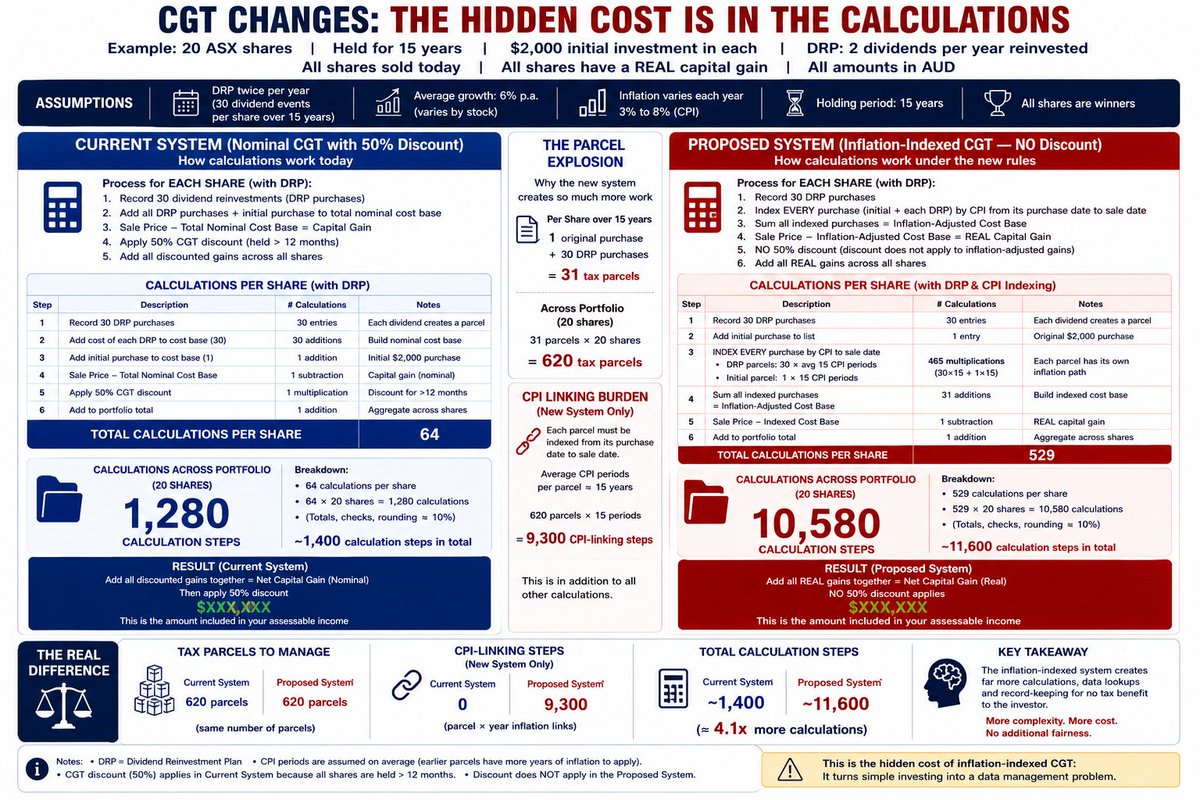
CGT Changes: Over 11,000 calculations to do your Tax
I'm going to explain the administrative and accounting disaster that is our new inflation corrected CGT arrangement.
The new CGT system encourages people to get dividend paying stocks. Many people do dividend reinvestment programs over the lifetime of their holding to try and build wealth. Seems sensible.
Now imagine you have a standard 20 share parcel of shares with dividends twice a year that you put into a dividend reinvestment program. You hold it for 15 years and then sell it, fortunately all have been winners. Well done.
Under the new system you have to do over 11,000 calculations at tax time to satisfy the commissioner. See the image.
And these aren't simple calculations. It's not like you're getting the sale price minus the purchase price and halving the difference as in the existing system. My 6-year-old can do that calculation. No, the new system requires you to do a compounding equation with different start dates and different end dates where you have to ensure that the inflation for that year matches the particular purchase date and take it through to sale. I haven't even gone into whether you use first in first out accounting, it already looked complicated enough. My 16-year-old would struggle with that calculation.
Peter Costello said a major reason for introducing the 50% CGT discount was it's simplicity and compliance costs. He was right.
The new government expects you to have a PhD in mathematics or pay your accountant five times as much for the administrative burden.
I'm pretty sure the Labour Minister for Finance Katie Gallagher is not able to do this calculation. Why doesn't some enterprising journalist put her on the spot?
And of course the ATO will need to expand markedly to ensure compliance. Which you will pay for in your taxes.
This is so incredibly good:
Economist Joseph Schumpeter warned that capitalism weakens when prosperous societies become so comfortable they forget where prosperity came from – and begin resenting the entrepreneurial class that created it.
A country might survive high taxes for periods of time. What becomes dangerous is something deeper: the moral suspicion of ambition itself. The creeping belief that commercial success is inherently exploitative, that profit is morally dubious, or that founders should quietly accept punishment for surviving years of uncertainty.
Prime Minister Anthony Albanese and Treasurer Jim Chalmers should think carefully about the signals embedded in this budget. Tax policy communicates values. This budget signals that founders are not viewed as partners in national prosperity, but simply reservoirs of revenue whose success is viewed with suspicion...
Civilisation advances because some people are willing to bet on tomorrow before tomorrow exists. Australia should be doing everything possible to encourage those people to build businesses here. Because once a society begins treating ambition as something suspect rather than admirable, it eventually discovers that no nation can remain prosperous after teaching its most ambitious people that they are unwelcome.
https://t.co/nxmwyx9aZc
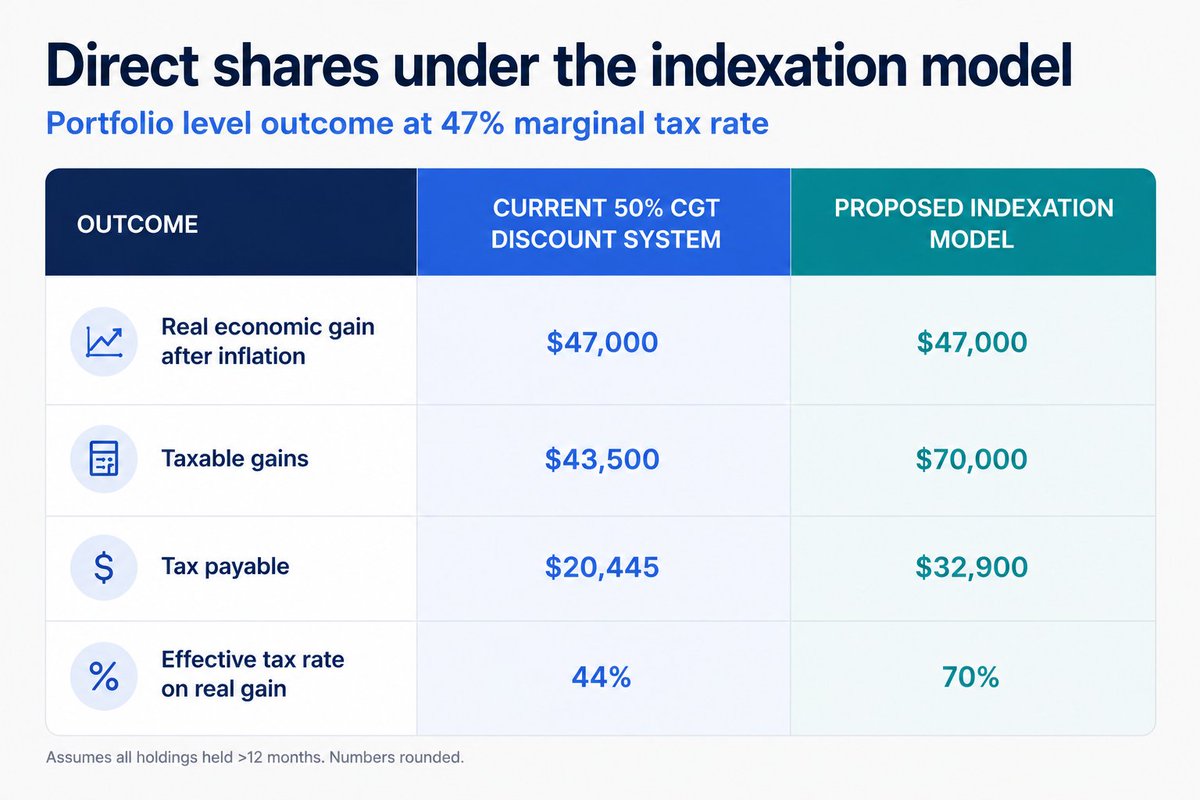
Under the proposed CGT changes, the effective tax rate on a direct share portfolio could rise from 44% to 70% because inflation adjusted losses can’t offset gains unless shares fall in nominal dollar terms.
That means portfolios with a few big winners and lots of average performers (which is how most real world portfolios behave), get hit hardest.
The result is that direct share investing becomes much less attractive than ETFs and pooled investment structures for most Australians, far more so than Treasury’s modelling appears to assume. https://t.co/Efmea0I5oq
Credit @DerekFranc90653@Johnkehoe23 who discovered this impact due to stock return dispersion.
Why the mooted changes to capital gains tax would be terrible for #ASX growth #stocks.
Just published "Why The CGT Change Is Terrible For Growth Stocks" free to read on the homepage or find it just below.
I did not realise they were taxing gross rather than net gains… AFR: Investors with diversified share portfolios making a mix of gains and losses compared to inflation could face tax rates of more than 100 per cent on real gains, due to the Albanese government not compensating investors for underperforming stocks.
A former senior Treasury tax official and a hedge fund manager both warned that people with a diversified portfolio of shares could face tax rates 50 per cent higher than Treasury calculated… Chalmers’ office and Treasury were contacted for comment on Thursday about whether real losses would be indexed to inflation.
Under another example, an investor buys shares in Coles and Woolworths, with one outperforming inflation and the other underperforming inflation.
The overall real return is zero after inflation, but the investor would pay tax on the winning stock.
If an investor instead bought an ETF of supermarkets with the same overall result, they would pay no tax.
https://t.co/4bfhPDychb
@DaveMilbo@suemitchellafr@thebigjohnnyd As a disabled person, I thank you for this article. I rely on a support person to leave my accomodation to get a haircut. I could spend more money to have my hair cut in my accomodation but that trip outside is one of the rare occasions I leave my home. Not a NDIS recipient.
@Filapek@FNArena Much appreciate all the hard work that goes into producing what is a very handy guide to company results each earnings season. Thank you @FNArena.
Very saddened to hear of the passing of Peter Lester. Known and loved by the sailing community.
https://t.co/DNDy9GkIMg Peter Lester, sailing legend and iconic America’s Cup commentator, dies aged 70 - NZ Herald
Do you remember when you joined X? I do! #MyXAnniversary
Today I am using the platform less than ever. If it wasn’t for a handful of users that I follow here, I would delete it.
As we commemorate Anzac Day, we reflect on the sacrifices made by Australians in Gallipoli and beyond. We stand in solidarity with our service members, past and present, and express our deepest gratitude for their dedication to our nation. #LestWeForget#AnzacDay2025