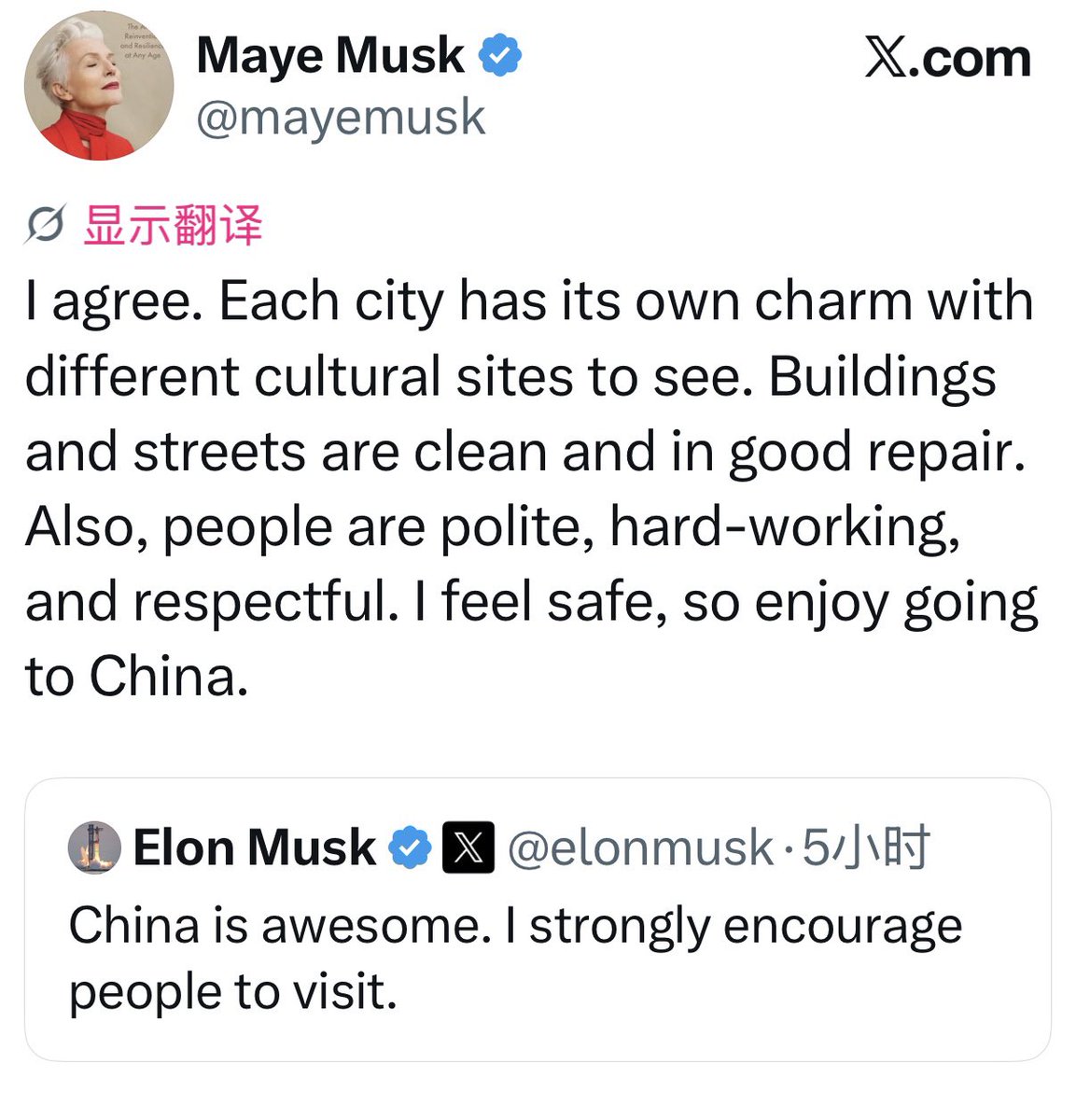
Reexamining the Underlying Logic Behind Elon Musk and His Mother Promoting a U.S.-China Dialogue Narrative
The dialogue between Elon Musk and his mother was clearly a carefully orchestrated scenario. Before the post was published, they obviously would have discussed it and carefully considered the wording, tone, and timing.
In other words, Musk’s business interests in mainland China are subject to the regulatory and political environment of the Chinese government. And with China’s leader preparing to visit the United States, it is highly likely that Musk will meet with him. Ahead of such a visit, there would inevitably be intensive communication and coordination. The Chinese side would want Chinese companies and business figures, including those connected to Musk, to send certain signals and create a favorable atmosphere. That is how this kind of carefully arranged mother-son dialogue could emerge.
In other words, the Chinese side may have wanted to use this opportunity to help showcase a more favorable business environment in China, attract foreign investment, and signal a preferred direction for economic engagement. Such an arrangement was almost certain to provoke strong criticism from people overseas.
Business leaders often prioritize economic interests. There are countless examples of business owners, under the influence of financial incentives, making decisions that can appear to place commercial interests ahead of U.S. national security considerations.
We saw a similar reaction when Trump suddenly moved to eliminate the $7,500 federal EV tax credit. Musk immediately reacted strongly and pushed back publicly. The same underlying dynamic was at play.
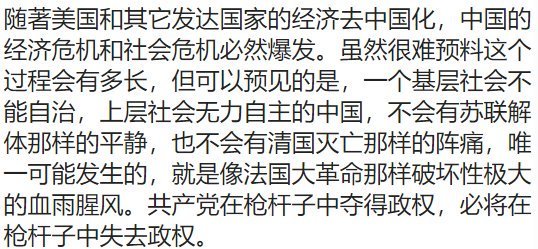
Why did so many Chinese Americans in the United States react with such anger? Because many of them have personally experienced what it means when government policy and politics can profoundly affect people’s lives and futures. Their anger and strong reactions are therefore, in many cases, an immediate and deeply rooted response based on those experiences.
As for Musk and his mother, they clearly failed to fully account for this dimension. One could even argue that they demonstrated a weakness in political awareness and failed to fully understand the relationship between economics and politics.
Just look at what happened to Eileen Gu the last time she became the target of intense public criticism. That episode alone illustrates how explosive this issue can become.
It is worth asking how much anger, frustration, and resentment many immigrants carry beneath the surface after experiencing the political and policy pressures of their past.
From the perspective of the United States, political and national-security considerations should often take priority over short-term commercial interests.