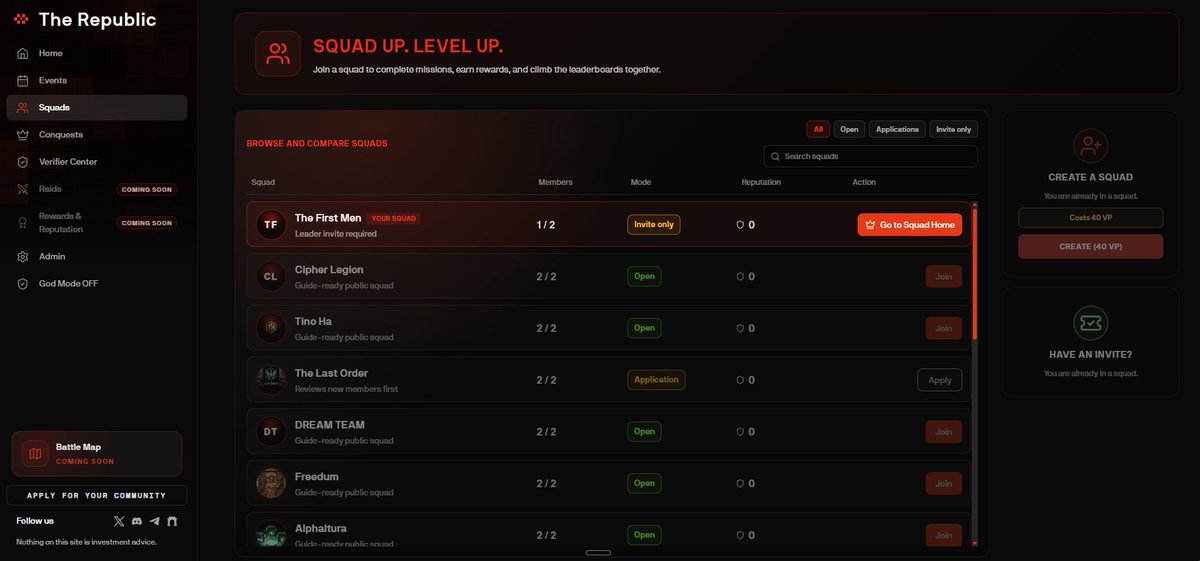
Republic Keeps Expanding.
+ 1 New community onboarded (a few more on the way)
+ Permanent squads fully operational. No more needing to constantly search for people to go on quests with. Squad up. Level up.
This week I will be focusing on streamlining support and functionality for partners on the app...
Much more being built.
Long Live The Republlic!
New Republic updates are live
🎁 Loot Boxes for Partners
Reward your community with on-chain drops.
🤖 AI Community Assistant
Give partners smarter tools to manage communities, track activity, and make member rewards easier.
More tools. More rewards. More growth.
Long Live The Republic.
Recent Republic Updates
- Verifier Center is live → Legionary members can now review quests/raids, earn VP, and help speed up approvals via consensus.
- AI Quest Creation → partners can now create quests, raids, and events faster with our new agent.
More coming soon 👀
Long Live The Republic!
GPT 5.5 + Image 2 is incredible.
New unauthenticated home page for Republic in a matter of minutes (including the generated Image/asset)
We're living in crazy days.
Your Ethos score just got a new use case.
Join the Legion Republic, connect your X account, and get VP based on your Ethos tier. VP gives you chances at guaranteed allocations in sales.
More VP = More chances.
Legion x @ethos_network — more coming.
Supply issues rarely kill tokens on their own.
What kills them is a lack of sustained demand to hold.
@matty_ on @incrypted:
"Sustainable incentives, demand drivers, and value accrual, not just supply policies and token sinks."
🔗 https://t.co/0vRyDGkyJT
April 21st. 1PM UTC. Discord.
@matty_ and @fabrizio_builds are hopping on for the monthly AMA.
Join the Discord + drop your questions here: https://t.co/6LqAfioWwe
The deal VCs get and the deal retail gets are often different.
VCs: equity + tokens
Retail: tokens
When a company sells, one side has a safety net. The other doesn't.
@matty_ explains why this matters and why it needs to change.
Retail buyers want private market exposure… on their own terms
More than $360bn of retail capital is deployed in private markets, and that’s just the start.
Not only is this number growing 60% annually, retail investors currently only allocate about 3%-6% of their portfolios to private markets. Institutional investors are generally closer to 15%-30%, meaning the retail market could easily exceed $1 trillion in the next few years.
And Wall Street has noticed. Seeking to capitalize on this trend, Robinhood and Fundrise have been experimenting with bringing late-stage, preIPO startup exposure to the masses.
Robinhood recently launched $RVI, a publicly traded closed-end fund that trades like an ETF and holds exposure in hot names like Databricks, Ramp, Revolut and others. Fundraise had planned its own fund with an arguably even stronger portfolio including Anduril, Anthropic, SpaceX, and OpenAI.
But as it turns out, retail buyers don’t just want overall exposure - they want to pick names and trade undervalued future breakout startups, the same way they trade public stocks.
$RVI dropped 11% on its first day of trading and Fundrise quietly postponed their fund’s launch.
The main issue seems to be that retail investors interested in private markets either:
a. Want to buy the single names they’re most excited about, not a basket someone else has put together for them; and/or
b. Don’t want to buy companies already trading at $50bn+ valuations, they want to buy the future companies that will reach these valuations.
Robinhood’s users famously prefer to trade single name stocks over funds like ETFs - one study found that just 5% of users’ holdings were in ETFs. And funds carry challenges that don’t apply to trading public single name stocks.
Closed-end funds can have share prices that diverge wildly from their underlying value. DXYZ hit a 2,000% premium to NAV in its first month - investors were paying $77 per share for ~$5 of underlying assets. Interval funds like PRIVX avoid the premium problem by pegging their price to fluctuate with the underlying NAV, but limit redemptions to quarterly windows in order to do so. Neither structure has solved the fundamental tension: private assets are illiquid by nature, and forcing them into liquid wrappers requires engineering tradeoffs.
Enabling a familiar user experience is exactly where tokenized private market infrastructure becomes relevant. Onchain pricing, real-time NAV updates, and continuous secondary liquidity address the exact structural problems these funds products are encountering. With Securitize already managing $4bn in tokenized assets for BlackRock, Apollo, and Hamilton Lane, and the DTC tokenization pilot launching in H2 2026, this is the year of tokenized private markets. The question is which infrastructure delivers the best end user experience.
Republic members, this one's for you.
Valor Points are now on your Legion Score page. You can see:
→ Your activity breakdown
→ Your rank
→ Leaderboard position
→ Raffle alerts when sales are live
Check where you stand https://t.co/sViFt5eyXN
@RealBackus@unaboysweb3 This is exactly why I’ve moved over to The Republic by legiondotcc. Instead of racing snipers, I’m just stacking VP through actual contribution. Those points are the golden ticket to presale access, it’s finally a system that rewards the community instead of the bots
BREAKING: a post you can scroll past without a cortisol spike
Here's what Legion shipped in February:
- New website: faster, cleaner and sleeker https://t.co/5Qmfs1jL7b
- Project pages now have team, backers, docs, video, FAQ all in one scroll
- Portfolio tracker so you can see when your tokens unlock https://t.co/TgYGPYozL0
- Valor Points dashboard to track where you stand https://t.co/e1Sh9upyVd
- Platform reliability fixes: real-time timers, accurate statuses, fixed login, better mobile, claiming errors are gone now
- Smoother token sale ops: legal side of token sales is now faster and less painful
More coming in March.