On our recent research: Google used to warn you when you were seeing low-quality search results. Then, in the weeks leading up to the 2024 election, the company quietly turned that warning off
https://t.co/efqvGV3XzQ
Fundamentally, high-level concepts group into categorical variables---mammal, reptile, fish, bird---with a semantic hierarchy---poodle is a dog is a mammal is an animal.
How do LLMs internally represent this structure?
https://t.co/HK2iFLUpte
Easily the biggest honor and privilege of my career to serve the best research community on Earth @icwsm
I'm grateful beyond words to every single person who attended, to those on the OC who made it all possible.
<3
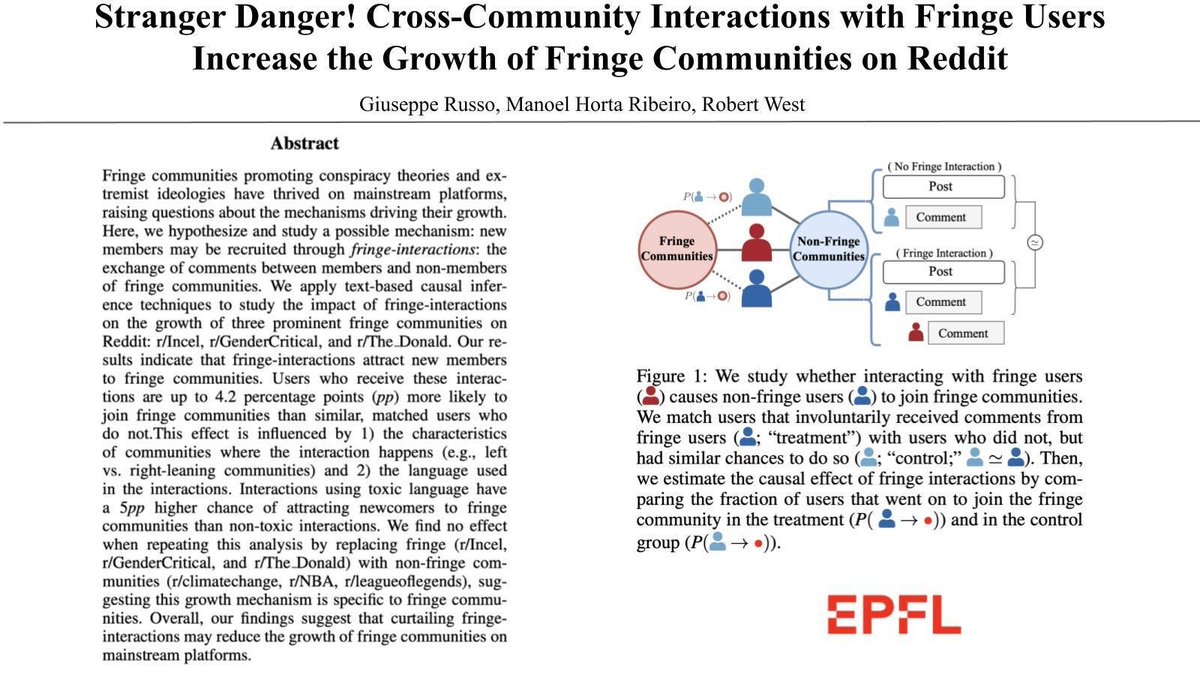
Today with @manoelribeiro and @cervisiarius, we present at @ICWSM our work Stranger Danger! Cross-Community Interactions with Fringe Users Increase the Growth of Fringe Communities
We are the Political Communication session at 11:30
link to the paper: https://t.co/cBb7IfAuqr
Does your work rely on news source credibility and reliability labels? Have you noticed these labels degrading over time?
Check out our recent dataset and detection methods for news source discovery @ICWSM:
https://t.co/zctkJRYIKA
#ICWSM24
***New Paper***
Many of you are familiar with urban scaling, the idea that outcomes such as innovation and crime grow super-linearly with city size. But what if I told you that the "network of cities" was better at explaining some of these outcomes?
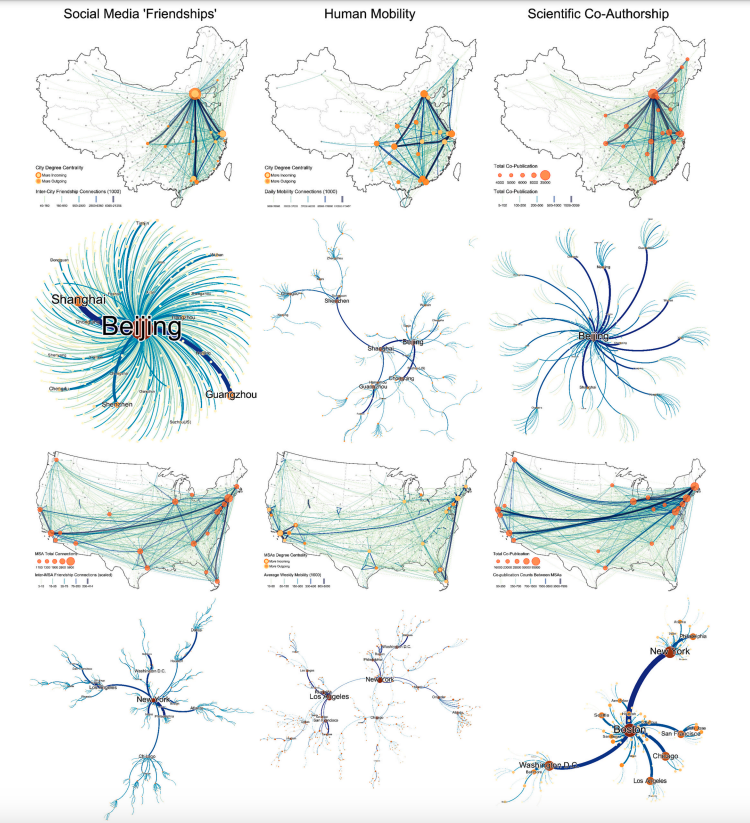
In a new paper led by @xiaofanliang we explore this hypothesis by estimating networks for cities in the United States and China. In these networks, cities are connected based on social media friendships, travel patterns (human mobility), and scientific co-authorship (see figure).
We use these networks to explain the patenting activity of American and Chinese cities, and ask whether a city's patents are better explained by population (urban scaling hypothesis) or by their centrality in these networks. We find that after we take the measures of centrality into account, population is no longer a significant predictor. In China, all three networks help explain innovative activity. In the US, the scientific co-authorship network is the most robust predictor. Network scaling seems to trump urban scaling when it comes to innovation.
To explore this hypothesis further, we compare cities with similar population and different levels of connectivity, such as Corvallis (high connectivity) and Cumberland (low connectivity) in the US, or Shenzhen (high connectivity) and Handan (low connectivity) in China. This reveals that differences in connectivity explain the residuals observed in the urban scaling relationship between population and patenting.
Certainly, this was not easy paper to make. It required collecting network level data for hundreds of cities in two large countries. But the prize was that it helped us explore beyond urban scaling, showing us that when it comes to patenting activity, a city's network connectivity explains more than its population. While our results are not causal, they are consistent with the idea that innovation depends on the flow and recombination of ideas.
The paper also provides some insights about the network geography of China and the United States. China is a diamond (rhombus), with a Beijing-Shenzhen north-south axis and a Shanghai-Chongqing east-west axis (with Wuhan in the middle). But when we remove the geography, we see networks centered on Beijing, at least for the social media and the scientific co-authorship network. The US has more of an arc, or flyover structure, especially when it comes to the co-authorship networks linking the east and west coasts. In the US, social media friendships revolve around New York City, human mobility around N.Y.C and L.A., and science around Boston.
This was a long project (about six years from idea to publication), so I am happy to finally see it published. My congratulations to @xiaofanliang who in the process became an assistant professor at the University of Michigan. Enjoy the networks and what they teach us about the world.
https://t.co/fX3GCJNRmj
https://t.co/mYSm8P7474
Introducing Gemma - a family of lightweight, state-of-the-art open models for their class, built from the same research & technology used to create the Gemini models.
Blog post:
https://t.co/JEhKUsLzXI
Tech report:
https://t.co/MCzyojmDV4
This thread explores some of the performance characteristics of these models.
R2: While the results are impressive, this is a simple combination of diffusion transformer (ICCV 2023) and latent diffusion model (CVPR 2022). Limited novelty. Weak reject.
I have a suggestion for next Turing award winner:
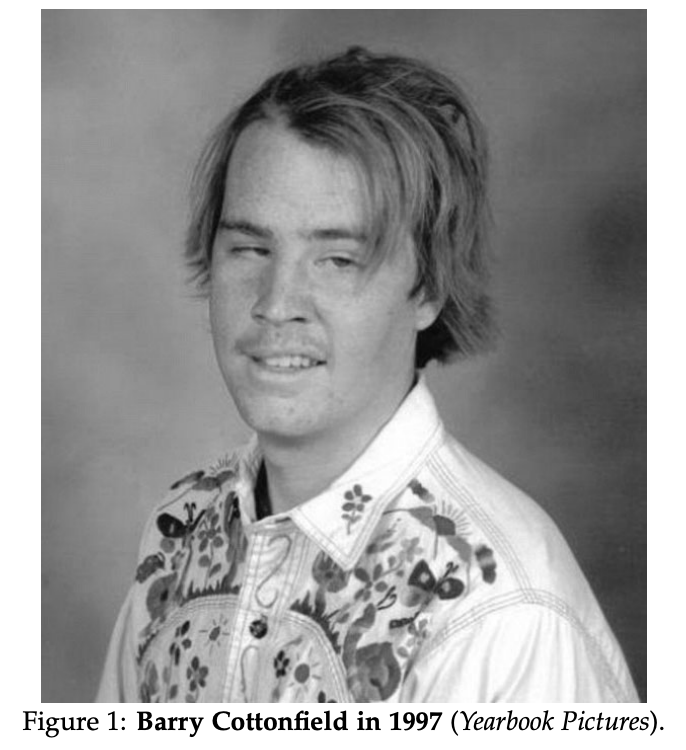
"A Neural Networks Approach to Predicting How Things Might Have Turned Out Had I Mustered the Nerve to Ask Barry Cottonfield to the Junior Prom Back in 1997"
https://t.co/EfW025wfpj
#ML#AI
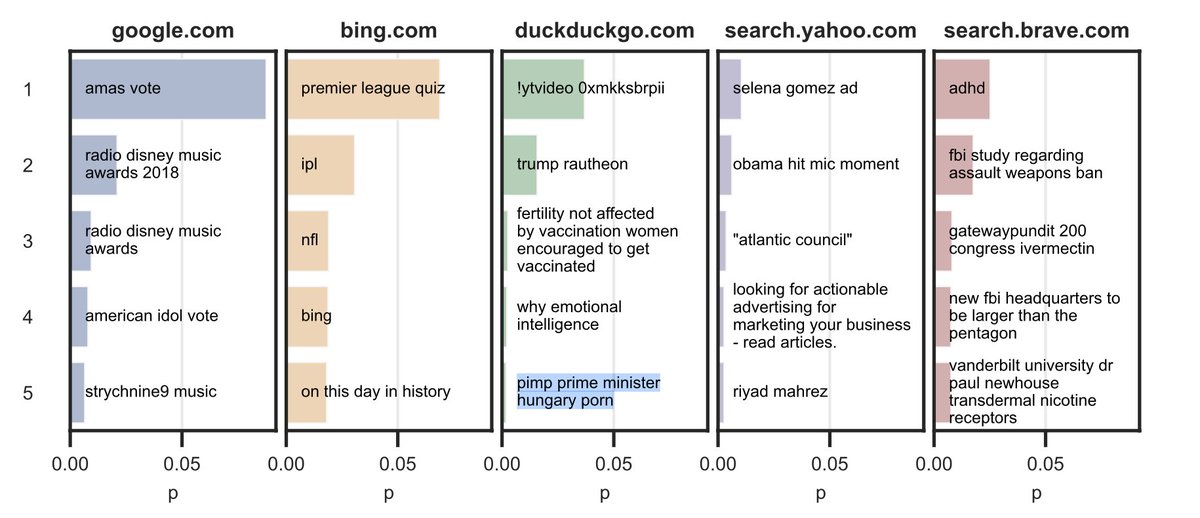
I don't know what's funnier, that the 4th most common thing Bing users told other users to search for on Twitter was "Bing" or that the 5th most common thing duckduckgo users told other users to search was "pimp prime minister hungary porn." Great paper: https://t.co/O9cgGPG8Ox
Sally (a girl) has 3 brothers. Each brother has 2 sisters. How many sisters does Sally have?
Here are 60 LLMs getting it wrong.
https://t.co/SiXJUoKFiY
A Hamiltonian path is a route that passes through every node in a graph exactly once. Finding Hamiltonian paths can overload even the best-known algorithm for the job. Finding Eulerian paths that pass through every edge is computationally simpler. https://t.co/u1SW5sGKCg