Really interesting (and worrying) polling on French pensions
The electorate estimates that for every pensioner we have 6 workers.
In reality it's 1.8/1... Even in 1960s we weren't close to 6/1.
Melenchon's supporters think its 13/1.
EU pays 14M€ to find out why birth rates are collapsing even in countries that did everything "right"?
The 6-year ERC Synergy Grant, EU top research award, went to BIOSFER, led by Mikko Myrskylä at the Max Planck Institute in Rostock.
Here is what they have found so far. 🧵1/19
Rentenniveau nur 48%? Das ist eine Rechengröße.
Nach Steuern und mit allen Einkünften haben Menschen ab 65 in Deutschland 83% vom Einkommen der Jüngeren (Median, Eurostat 2025).
Der Weg von 48% zu 83% in drei Schritten 🧵
People of my generation may be surprised by this, because they incorrectly think of Sweden as Socialist. But after they went through an economic depression, they chose deregulation, competition, low govt debt, & growth. Kept big welfare state. But a competitive private sector.
The longer you postpone the life you want, the more responsibilities accumulate, optionality shrinks, and what once felt temporary becomes your permanent life.
Dos economistas de MIT, ambos Fellows de la Econometric Society y referentes en teoría econométrica, publicaron una nota sobre cómo usaron IAs para resolver un problema técnico que venían laburando desde 2019 (admisibilidad de TSLS con instrumentos débiles) y las implicancias que ven para el campo de la economía.
Vale la pena leer el abstract entero (2 págs). Dejo las frases que más me quedaron x si prefieren:
"Pensamos que los avances recientes en capacidades, y los avances adicionales que parecen probables en el futuro cercano, exigen una reevaluación seria y continua de cómo nuestro campo evalúa los productos de investigación y asigna los recursos de aquí en adelante."
"Antes de pasar a la nota escrita por IA, queremos dejar claro que no vemos este avance en capacidades como una tragedia. Una gran parte de por qué cada uno de nosotros eligió trabajar en econometría es que pensamos que los métodos estadísticos utilizados en la investigación económica importan para la calidad de las respuestas obtenidas, las cuales son a su vez consecuentes para una variedad de decisiones tanto de actores privados como públicos."
Que dos bestias como esta gente salgan a divulgar estas cosas, es una pauta de la potencia actual y potencial que tiene todo esto de los LLMs etc. Creo que seguir creyendo en que los hábitos de acumulación de criterios y conocimientos que hasta el año pasado eran el diferencial en esta y muchas ciencias, son un costo (de oportundiad) subestimado.
Con eso no quiero decir para nada que no haya que seguir aprendiendo, formarse y PENSAR, pero sí me da la sensación que las prioridades y formas van a cambiar mucho.
Cualquier opinión o lo que sea más q bienvenida 👇
https://t.co/Wc287x2rkd
Werner Herzog on psychoanalysis: “If you harshly light every last corner of a house, the house will be uninhabitable. It’s like that with your soul.”
Only Herzog could make a metaphor about darkness sound this profound.
Just to elaborate, while companies like Samsung is famous all over the world, the South Korean semiconductor industry only employs 0.6% of the labor force. Even if we look at the electronic industry as a whole, it still employs only 2% of the labor force.
The retail sector, by contrast, employs almost 7% of the labor force. It's one of the sectors that employs the most people in every country. For instance, in the US, it employs close to 10% of the labor force. But people almost never talk about it and about how productive it is.
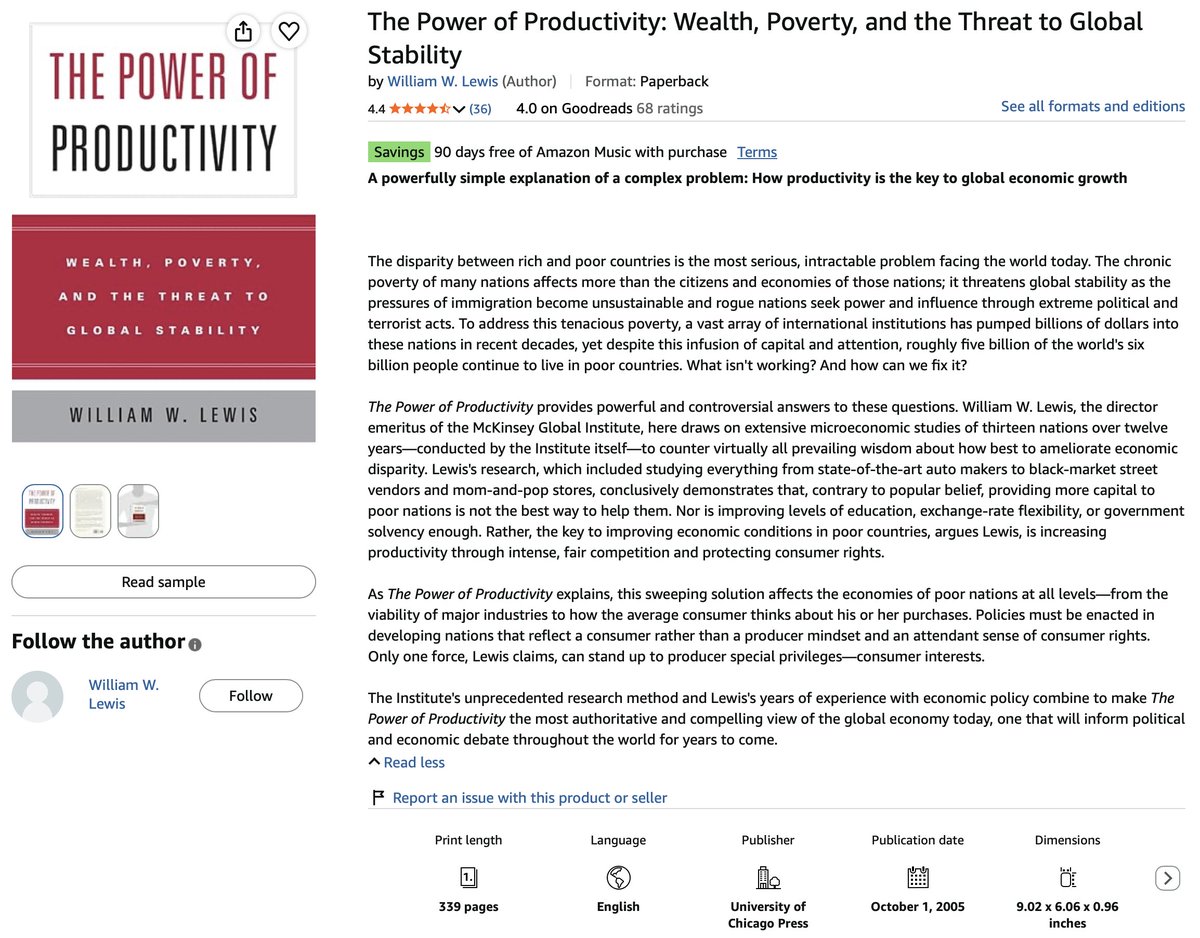
I think there is a good case to be made that people focus too much on the high-tech sector and other shiny objects and not enough about sectors that may not be as sexy but employ far more people. It's a big problem in the discourse about China in my opinion. Lewis's book really drove that point home for me.
Retirees own 60% of the wealth in Feance. Given high life expectancy, when they pass it on, wealth is not inherited by the young, but by the about to be old (those in their 50s). Read the entire thing, an excellent analysis of the pickle our societies find themselves in.
The ugly truth about France and some of the other European countries currently in turmoil - and which none of the politicians want to admit because it'd be political suicide - is that you can't solve the problem by going after immigrants (as the right asserts) or the rich (as the left asserts), but you could solve it by going after the old.
One extraordinary statistic for you: people over 60 in France, a quarter of the population, own 60% of France's wealth, non-financial and financial (https://t.co/IdJ5X7OO12).
And here is another crazy statistic:
that same quarter of the population, those above 60, receive nearly two-thirds of all social spending by the French government (https://t.co/deNRNevIwq) - which is famously among the highest in the world (France's government spending is an insane 57.3% of GDP).
Last statistic: they make up about 40% of voters because they're a third of registered voters (https://t.co/zTa4RnVOmT), and they turn out far more than anyone else (https://t.co/34V2xzs9jH).
Put our 3 statistics together and there's almost a bit of an apartheid situation here: the old own most of the country's wealth, collect most of the social spending and have the political power to keep it that way.
Which makes them a de-facto rentier class, living off assets and transfers paid for by younger generations.
And, of course, at the risk of stating a truism, the future is built by the young. Yet France keeps effectively taking money away from them to give it to those whose working lives are already behind them - and need the money far less since they already own the country's wealth.
What about inheritance, I hear you ask? That's the funniest/saddest aspect: given that life expectancy has kept rising, the French now inherit a home at 54 on average. The most common case is someone in their 80s leaving it to heirs in their 50s, in effect the very old transferring wealth to the about-to-be old (https://t.co/d2RPAqLJGR).
You can add this to our earlier apartheid statement: on top of all the rest, even when the old finally let go of their wealth, it stays within their own "camp".
That's my personal situation, incidentally: I'm 42, my father is 71 and he is starting to look at ways to pass things on to me and my siblings, when our professional lives are already well settled, so it'll arrive when it changes things the least, which is pretty much the French system in a nutshell.
Now, I get that there'd be some unfairness in going after them: they paid into the system their entire working lives, playing by the rules of a social contract that told them if they paid up they'd collect at the end. Changing the rules now means breaking that promise, which is admittedly unfair.
But there's no magic wealth tree in any society: you can only take it where it is. That's the way most major societal transformations end up happening. They're often triggered by a catastrophic event (the so-called "four horsemen": mass-mobilisation war, revolution, state collapse, plague) BUT what really drives change is a transfer: wealth gets pried from the privileged class who've been sitting on it and handed to those who'll build what comes next.
So, in theory and in an ideal world, you can do without the catastrophic event and directly proceed with the transfer...
The fact that in France, and elsewhere in Europe, it's the youth protesting is probably no coincidence - even though they don't frame it as a generational fight. And even though, cruel irony, the left politicians many of them march behind promise to bring the retirement age back to 60 (https://t.co/WrJOhpWqYR), which would make the situation even worse.
Let's say they understand intuitively that the system is stacked against them, even if they haven't yet figured out how. And politicians are obviously doing what politicians do, meaning pandering to the people who actually vote, while pointing the young towards easier - and politically convenient - scapegoats.
To be clear I'm not saying it's the only problem in France, VERY far from it. I'm also not saying that all old people in France live a lavish lifestyle at the expense of younger generations: there are also plenty of very poor retirees who, if anything, would deserve more.
What I am saying is that it's probably the biggest elephant in the room: everyone can see it, nobody dares mention it - no politician, from any side, wants to run on cutting grandma's pension - and it makes every other problem harder to fix.