@ralphilius I think Qodo is pretty good.
Been using it alongside Gemini in my repo. Qodo basically catches everything Gemini finds. And it gives an 'Agent prompts' to copy right away, quite considerate.
Am I just rambling, or does the relaunched Fable 5… not quite like the same model from when it first came out?
Its reasoning and writing style both look noticeably different to me now.
Could it be that Anthropic quietly did some rework during the so-called “ban” period?
Software horror: litellm PyPI supply chain attack.
Simple `pip install litellm` was enough to exfiltrate SSH keys, AWS/GCP/Azure creds, Kubernetes configs, git credentials, env vars (all your API keys), shell history, crypto wallets, SSL private keys, CI/CD secrets, database passwords.
LiteLLM itself has 97 million downloads per month which is already terrible, but much worse, the contagion spreads to any project that depends on litellm. For example, if you did `pip install dspy` (which depended on litellm>=1.64.0), you'd also be pwnd. Same for any other large project that depended on litellm.
Afaict the poisoned version was up for only less than ~1 hour. The attack had a bug which led to its discovery - Callum McMahon was using an MCP plugin inside Cursor that pulled in litellm as a transitive dependency. When litellm 1.82.8 installed, their machine ran out of RAM and crashed. So if the attacker didn't vibe code this attack it could have been undetected for many days or weeks.
Supply chain attacks like this are basically the scariest thing imaginable in modern software. Every time you install any depedency you could be pulling in a poisoned package anywhere deep inside its entire depedency tree. This is especially risky with large projects that might have lots and lots of dependencies. The credentials that do get stolen in each attack can then be used to take over more accounts and compromise more packages.
Classical software engineering would have you believe that dependencies are good (we're building pyramids from bricks), but imo this has to be re-evaluated, and it's why I've been so growingly averse to them, preferring to use LLMs to "yoink" functionality when it's simple enough and possible.
New on the Anthropic Engineering Blog:
How we use a multi-agent harness to push Claude further in frontend design and long-running autonomous software engineering.
Read more: https://t.co/HWvmXk1ykn
in case u don't know, i set up a small team for robotics and embodied ai inside qwen. multimodal foundation models are now being transformed to foundation agents that can leverage tools and memory to perform long-horizon reasoning thanks to reinforcement learning. they should definitely step from virtual world to physical world!
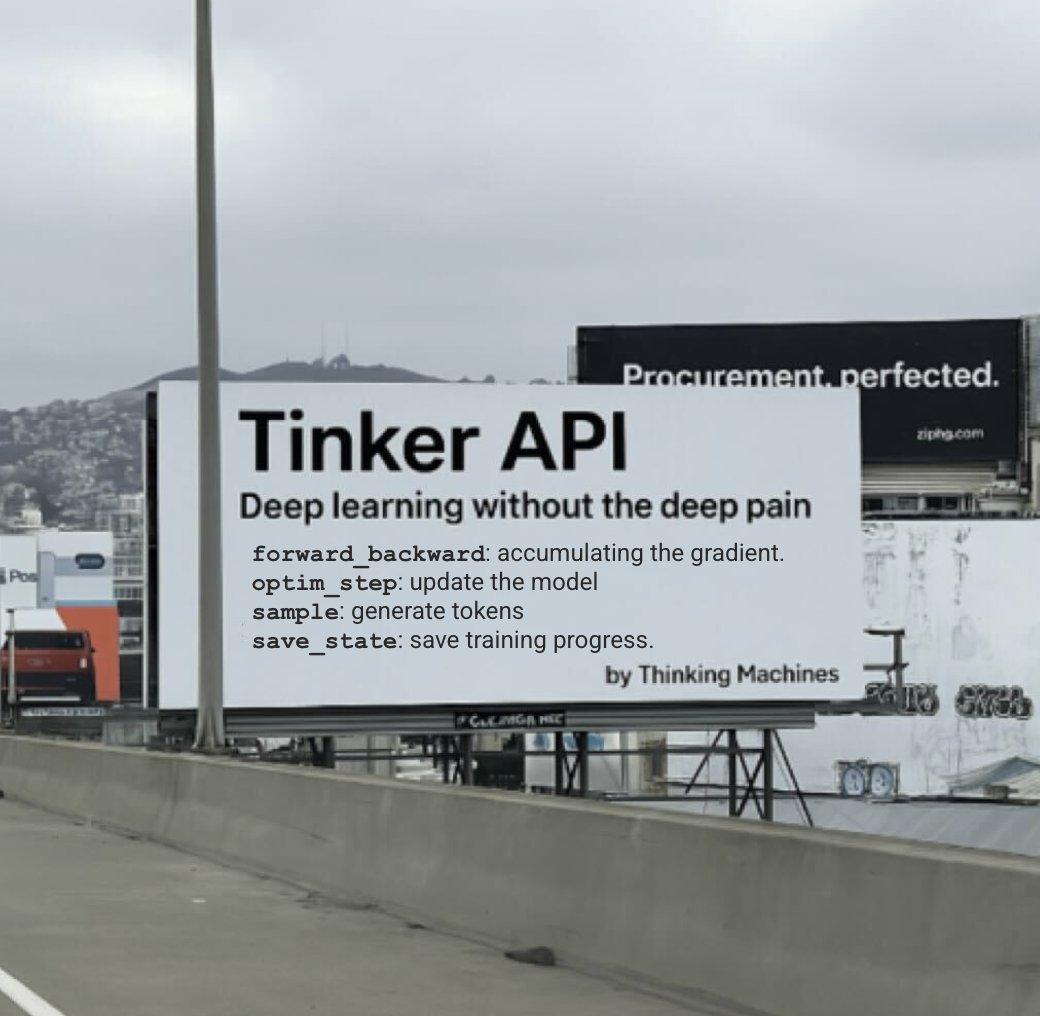
GPUs are expensive and setting up the infrastructure to make GPUs work for you properly is complex, making experimentation on cutting-edge models challenging for researchers and ML practitioners.
Providing high quality research tooling is one of the most effective ways to improve research productivity of the wider community and Tinker API is one step towards our mission there.
Tinker API is built on top of our experimental results on fine-tuning with LoRA: https://t.co/bV00V1cBKG
Beta starts and you can join the waitlist today: https://t.co/AbzVwxYyjm
Today Thinking Machines Lab is launching our research blog, Connectionism. Our first blog post is “Defeating Nondeterminism in LLM Inference”
We believe that science is better when shared. Connectionism will cover topics as varied as our research is: from kernel numerics to prompt engineering. Here we share what we are working on and connect with the research community frequently and openly.
The name Connectionism is a throwback to an earlier era of AI; it was the name of the subfield in the 1980s that studied neural networks and their similarity to biological brains.
https://t.co/lrJioBmpbT