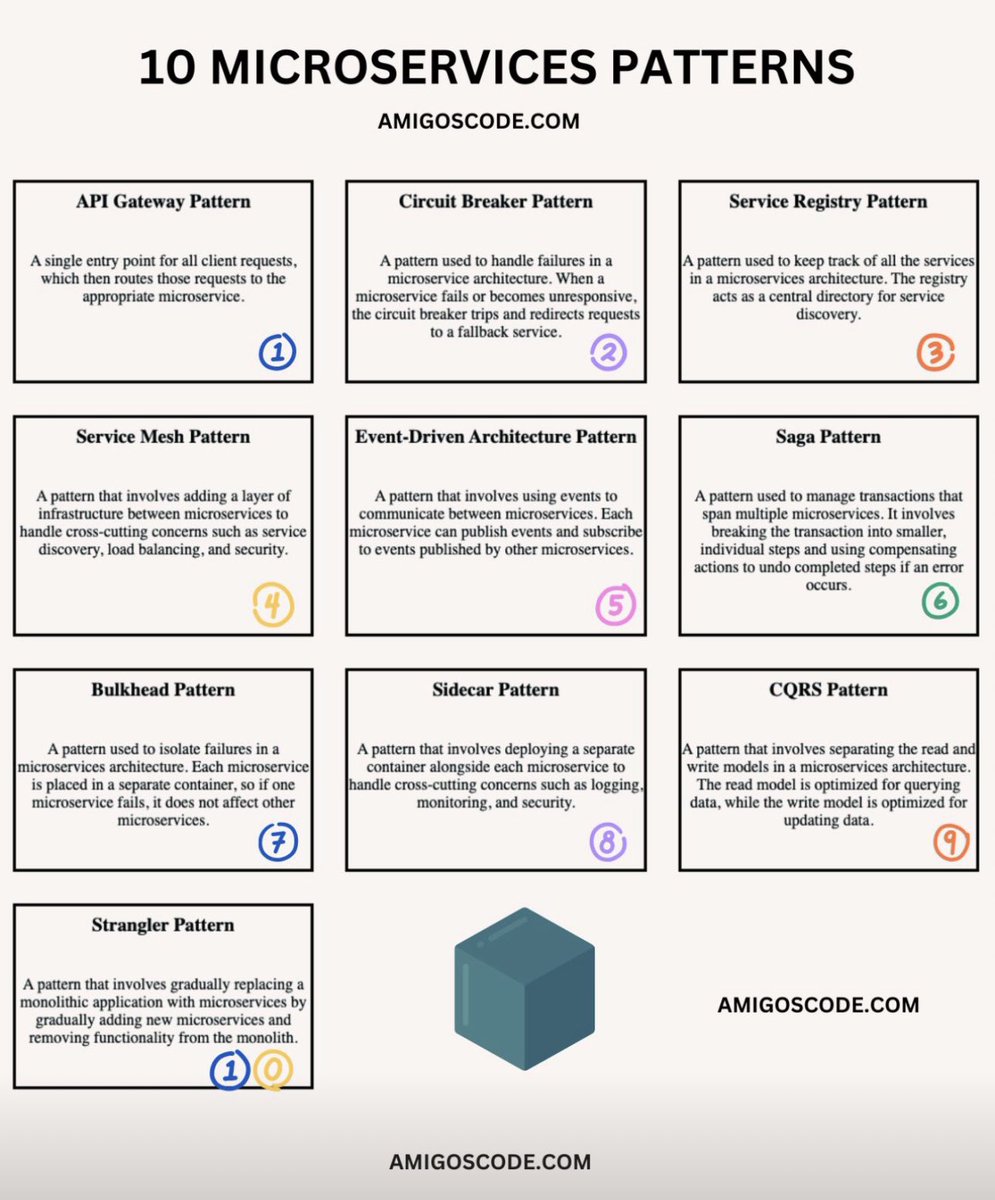
📚10 Microservices Patterns 📚
1. 🔍 Service Registry: This pattern involves managing the locations of services in a distributed system. It maintains a list of all available services and their locations, which can be queried by other services to find and communicate with them.
2. ⚡️ Circuit Breaker: This pattern is used to prevent cascading failures in a distributed system. It monitors the availability of a service and, if it detects a failure, it can quickly isolate the problematic service and prevent other services from being affected.
3. 🚪 API Gateway: This pattern provides a single entry point to a microservices-based system. It acts as a reverse proxy and routes incoming requests to the appropriate microservice. It can also perform authentication, rate limiting, and other security-related tasks.
4. 📝 Event Sourcing: This pattern involves capturing all changes to the state of a system as a series of events. These events can be used to reconstruct the current state of the system at any point in time. This pattern is useful for systems with complex business logic that require auditability, traceability, or compliance.
5. 🎭 Saga: This pattern is used to manage long-running transactions that involve multiple microservices. It ensures that all services involved in a transaction are completed successfully or rolled back in case of failures.
6. 📚 CQRS: This pattern separates the read and writes operations of a system. It uses separate models for reads and writes, which allows for the optimization and scalability of each. This pattern is particularly useful for systems with high read-and-write workloads.
7. 💾 Database per Service: This pattern involves using a separate database for each microservice. This ensures that each microservice has its own data store, which can be optimized for its specific needs. It also helps to prevent coupling between services.
8. 🕺 Saga Choreography: This pattern is similar to the Saga pattern, but instead of having a central orchestrator, each microservice involved in the transaction communicates directly with other services to coordinate the transaction.
9. 🕸️ Service Mesh: This pattern provides a dedicated infrastructure layer for managing communication between microservices. It adds features such as load balancing, service discovery, and security to the network layer, which can be used by any microservice in the system.
10. 🧳 Sidecar: This pattern involves deploying a separate process alongside a microservice, which handles certain tasks such as service discovery, load balancing, or communication with other services. This allows the microservice to focus on its core functionality, while the sidecar handles cross-cutting concerns.
👨💻 Join Amigoscode today for premium programming courses - https://t.co/Y65dNK5bQ6
ps: credits to the respective owner(s).
#programming #coding #webdevelopment #python #javascript #microservices #java #learntocode #beginnerprogramming #techindustry #opensource #developers
ChatGPT is the future.
But most people are stuck on beginner-level.
Here's a thread of 75 ChatGPT threads to make you an expert in 3 days:
(Bookmark this for later)
Git is a must-have skill in programming!
Whether you’re into backend or frontend development, JavaScript, Python or something else, you will need to know Git.
Master Git with these games and resources:
• Study hard.
• What others think of you is none of your business.
• It's OK not to have all the answers.
• Experiment, Fail, Learn and Repeat.
• Knowledge comes from experience.
• Imagination is important.
• Do what interests you the most.
• Stay curious
Reading is not studying
Simply reading and re-reading texts or notes is not actively engaging in the material. It is simply re-reading your notes. Re-reading leads to quick forgetting
Ideas for active studying include : 🧵