Betting beyond generative models in bio.
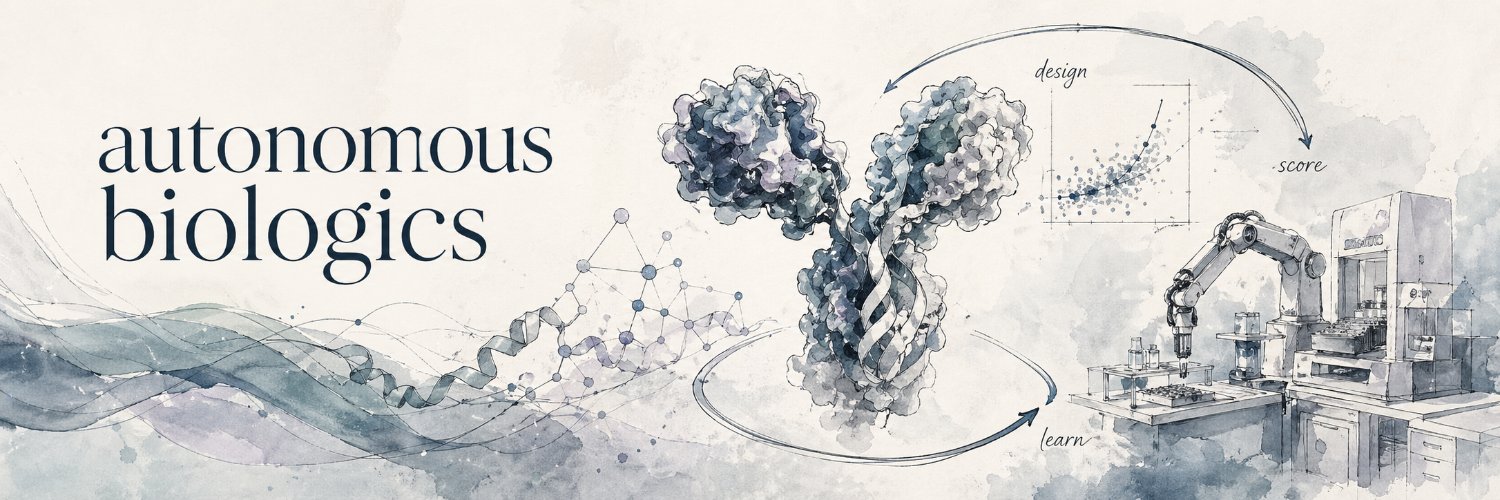
A weekend is all it took for our biological intelligence platform to go from data —> viable antibodies. Fully closed loop design and fully autonomous. I didn’t touch a thing.
If Hantavirus mutated into a global threat, it would unleash AI + biotech unlike anything we've ever seen.
> genome sequenced and public in 4 hours
> AlphaFold maps every protein target
> AI screens 10,000 drugs in 24 hrs
> 50 vaccine candidates designed simultaneously
> AI designed antibodies in days
> risk of death computed instantly
> decentralized trials launch globally
> enroll from home
> 20 countries manufacturing at once
> first doses in three weeks
> real-time dose characterization
> your genome + biomarkers determine your protocol
> variant map updates every hour
No one would wait for governments.
The reaction is somewhat warranted. Wanted my plant to grow better.
- Gave Claude a photo of it
- Found its genome
- Designed a protein to weaken DELLA repression
Guess we'll find out if it will do anything.
https://t.co/JliSfOPYVS
At this point, this biosecurity letter feels like pure theater a repeat of Mythos and Glasswing.
create the issue, then pass the liability
If it’s a real problem, more paperwork isn’t the solution.
@p_maverick_b Feels very performative from AI labs. Same theatre as with mythos and cybersecurity. Genie is out, and now they want to defer liability? They should have pledged to be part of the screening effort.
I’m delighted to announce @chaidiscovery's collaboration with @pfizer. Their scientists will deploy our AI platform to accelerate drug discovery, including early access to our latest frontier model Chai-3.
You can learn more about this partnership and our momentum in @amyfeldman's feature in @Forbes out today
https://t.co/VBoynDgPCz
I’m delighted to announce @chaidiscovery's collaboration with @pfizer. Their scientists will deploy our AI platform to accelerate drug discovery, including early access to our latest frontier model Chai-3.
You can learn more about this partnership and our momentum in @amyfeldman's feature in @Forbes out today
https://t.co/VBoynDgPCz
Today we are announcing our collaboration with Pfizer to put Chai's frontier AI—including our latest model, Chai-3—directly into the hands of one of the world's leading pharmaceutical teams.
Sam Altman, Dario Amodei, Demis Hassabis and many others have signed a letter urging Congress to increase security on orders of synthetic nucleic acids - and the equipment needed to make them - as models continue to become increasingly bio-capable.
Regardless, the genie is already out of the bottle. We’re in the era of advanced biologically-centric AIs, and any open-source LLM can ingest the data.
At this point, this biosecurity letter feels like pure theater a repeat of Mythos and Glasswing.
create the issue, then pass the liability
If it’s a real problem, more paperwork isn’t the solution.
SITUATION DETECTED: Sam Altman, Dario Amodei, and Demis Hassabis have signed a joint open letter calling on Congress to mandate screening of synthetic nucleic acid orders, citing AI’s rapidly improving ability to assist with biological research as an urgent biosecurity risk.
We’re bringing new capabilities to GPT-Rosalind, a model series purpose-built for life sciences research at enterprise scale.
It brings GPT-5.5’s agentic coding and tool use together with stronger intelligence for drug discovery, analysis, design, and experimental workflows.
https://t.co/SrAJ3Mt7ka
The protein AI race is playing out very differently to the LLM race.
A year ago, Chai and Latent were the frontier of antibody and binder design, and the frontier was closed. Within months, Protenix, ESM, and Boltz open-sourced the tools.
Who will win?
Alphafold once represented open science then closed AlphaFold 3 for profit. Code and weights are non-commercial only, and the lone commercial path runs through Isomorphic.
Proteins are the machinery of life. Scientists have cataloged billions of protein sequences—but their biology is still mostly unknown.
ESM Atlas is a new way in.
6.8 billion proteins. 1.1 billion predicted structures—the largest application of AI to protein biology to date. ESM Atlas makes the uncharacterized parts of protein space searchable for the first time. And it's fully open.
Start exploring: https://t.co/n6OWfcWdHe