Idolatry is not defined by a gesture alone, but by misdirected worship. An act's meaning depends on its object, intention, and theological context, not merely its outward form.
The icon therefore does not attempt to portray the divine essence, which remains invisible and uncircumscribable. It depicts the incarnate Word, who was seen, heard, touched, and beheld by His disciples (1 John 1:1).
@epke82@IndianaBrunner@MissNyox If affirming Mary as Theotokos was fundamentally Christological, then the icon controversy was too. Rejecting that connection risks an incomplete understanding of the Incarnation.
@epke82@IndianaBrunner@MissNyox Isaiah 1 condemns corrupt worship, not incense itself. God also commanded incense in the Law (Ex. 30:7–8). The problem was the heart and context of the offering, not the mere act of burning incense.
@epke82@IndianaBrunner@MissNyox The issue in Leviticus 10 was not simply "they used incense without permission." It was offering unauthorized fire in a priestly sacrifice contrary to God’s command. That does not establish that every use of incense outside that specific command is idolatry. The context matters.
@epke82@IndianaBrunner@MissNyox Leviticus 10:1–2 concerns unauthorized fire and priestly disobedience, not whether incense itself is exclusively latria or whether all uses of incense outside worship of God are idolatrous. The passage does not address icons.
@epke82@IndianaBrunner@MissNyox Your conclusion only follows if incense is inherently latria regardless of context, which is the point you still need to prove. The question is not the gesture alone, but what honor is being offered and to whom.
@epke82@IndianaBrunner@MissNyox I said intention alone does not make something acceptable. The object and kind of honor being offered matter. Idolatry is not determined by a gesture alone; it is determined by whether a created thing is given the worship due to God. That's exactly what must be demonstrated.
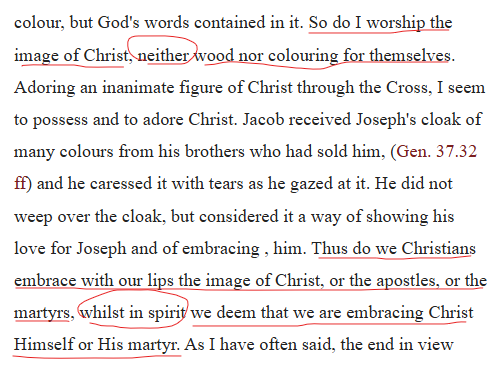
@epke82@IndianaBrunner@MissNyox The context of St. John’s argument substantiates it. He explicitly distinguishes the image from the prototype and rejects worshiping the material itself. His point is that an image can be called by the name of what it represents without being identical in essence to it.
@epke82@IndianaBrunner@MissNyox You're ignoring the context. St. John is not saying wood and paint are literally God. He means the icon is Christ by representation, so the honor given to the image passes to Christ, its prototype. That's his whole argument.
@epke82@IndianaBrunner@MissNyox You're appealing to one scholar's interpretation. That does not prove Theodore contradicted Nicaea II. Theodore explicitly wrote in defense of Nicaea II and its teaching on icons.
@epke82@IndianaBrunner@MissNyox You haven't demonstrated that incense is inherently latria in every context. You've asserted it. The burden is on you to show that the act itself, apart from its object and context, is always divine worship. That is precisely what is in dispute.
@epke82@IndianaBrunner@MissNyox To prove Orthodox worship icons like the bronze serpent, you would need to know the object and intention of our worship. Unless you can read hearts, you cannot assume veneration is idolatry. The gesture alone does not determine the honor being offered; the object and context do.
@epke82@IndianaBrunner@MissNyox The point is that St. John does not say the material image is God. He argues that because Christ truly became visible, His image can be honored in relation to Him. The icon is not the divine nature itself; it refers to the person represented.