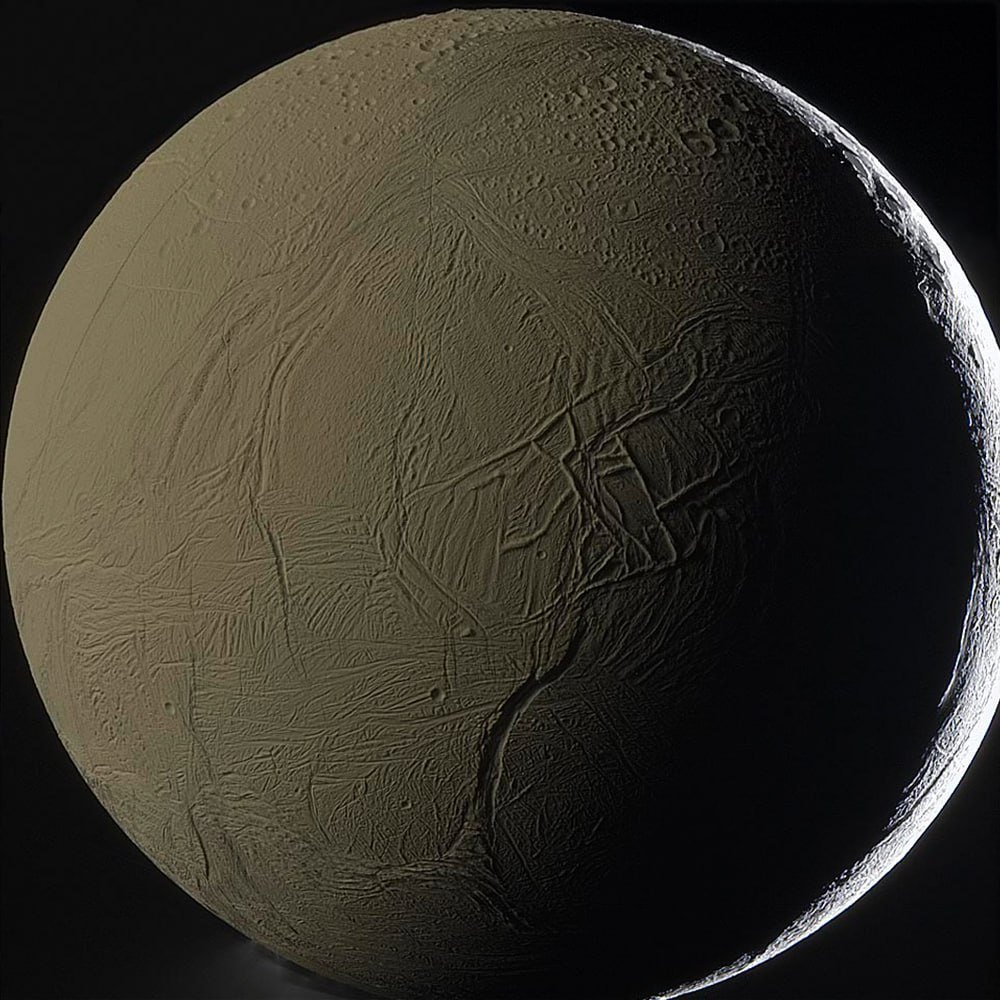
... the most striking Cassini images of Enceladus taken during the close flyby on November 6, 2011 (E-16 encounter):The moon appears as an almost perfectly round, dazzling white sphere, glowing with extraordinary brightness due to its extremely high albedo (one of the most reflective bodies in the Solar System). The surface looks remarkably smooth and clean on the leading hemisphere, almost like polished ice, with very few visible craters in this view.Near the bottom edge of the disk you can just make out the beginning of the south polar region: several long, dark, nearly parallel linear features — the famous "tiger stripes" (Sulci Drepanum, Labtayt Sulci, etc.). These are the active fractures from which enormous plumes of water vapor, ice particles, and organic compounds are continuously erupting into space. In this particular November 2011 image the plumes themselves are not prominently backlit (unlike some earlier or later shots), so the focus remains on the icy, pristine surface itself.The moon's diameter is only about 504 km, making it smaller than many countries on Earth, yet this 2011 close-up revealed its deceptively calm appearance hiding one of the most geologically active worlds we know — a global subsurface ocean and ongoing cryovolcanism.These images from the 2011 flybys were crucial in confirming the direct link between the tiger stripes, the plumes, and the hidden salty ocean beneath the ice shell.
DeepSeek is a crypto money printer 🚨
I wrote a Bot, that's made me $35K from $100 last night.
This isn’t clickbait—just an AI Trading Bot powered by DeepSeek.
FREE for 24 hrs then deleted!
Simply,
1. RT
2. Like
3. Reply "DS" and Follow me and I'll send you a DM.
So, something's up with 3I/ATLAS and JUPITER over at the "Hubble"...
They've started a new observation yesterday for both 3I/ATLAS and JUPITER. Information to be released for both cases in June 22nd 2026. I wonder why..
So same date for their "release" and almost at the same time.. #3IATLAS #JUPITER #COVERUP #NASA #NRL
Perplexity is one of the top AI search tools.
The secret is knowing how to prompt it well.
With clear, structured prompts…
Perplexity becomes:
✓ Your research guide.
✓ Your strategy partner.
✓ Your decision coach.
[ 🔖 bookmark this post for later ]
Here are 15 powerful prompts to try:
1. Market Research – Compare top companies on pricing, features, reviews, and USPs.
2. Trend Analysis – Summarize industry trends, adoption rates, and impact.
3. Competitor Benchmarking – Evaluate tools or companies across pricing, features, and scale.
4. Customer Insights – Spot common complaints, requests, and positive feedback.
5. Case Studies – Share real-world cases showing strategies with measurable results.
6. Industry Reports – Extract stats, challenges, opportunities, and takeaways.
7. Skill Development – Learn a concept with steps, resources, and tips.
8. Expert Opinions – Compare expert views to highlight insights and differences.
9. Content Ideas – Generate 10 LinkedIn post ideas for your niche.
10. Summarizing PDFs – Condense PDFs into clear, bullet-point insights.
11. Product Comparison – Create side-by-side comparisons with use cases.
12. Developing Strategies – List proven methods for goals and outcomes.
13. Event and News Summary – Compile highlights and impact of events.
14. Decision Evaluation – Outline pros and cons of options with cost and scalability.
15. Business Idea Validation – Evaluate ideas with market, risks, and growth.
Try these prompts to get more out of Perplexity.
Use it as an AI partner for work and everyday tasks.
📌 Learn 30 free AI tools in 30 days: https://t.co/7MJCwAPtaQ
👉 Follow me @AndrewBolis for more and 🔄 Repost this to help others use AI
Frontier AI Trends Report - https://t.co/T5wCM6dngg by @AISecurityInst
This report presents our current understanding of AI capability trends based on extensive testing across multiple domains. The data show consistent and significant improvements in model performance, though uncertainties remain about the trajectory and broader implications of these advances.
The capabilities we evaluated have already begun to surpass expert baselines in several areas. This momentum holds promise for breakthroughs in research, healthcare, and productivity. At the same time, they could lower barriers to misuse in areas like cyber offence or sensitive research, while also presenting novel risks. Recognising both sides of this dual-use potential is critical for steering AI’s rapid advance toward public benefit while guarding against their potential for harm.
As AI systems are increasingly integrated into society, the challenge is to anticipate long-term developments, while also ensuring near-term adoption is secure, reliable, and aligned with human intent. This requires safeguards that keep pace with accelerating capabilities, rigorous and independent evaluations to track emerging impacts, and collaboration across government, industry, and academia to develop solutions to pressing open questions in AI safety and security.
Going forward, we aim to publish regular editions of this report to provide up-to-date public visibility into the frontier of AI development. We will continue to refine our methodology and work to resolve gaps in our understanding.
Authors: @AISecurityInst, @alxndrdavies, @AlexandraSouly, @_robertkirk, @jaipatelAISI, @jake_jay_p, @jacobmerizian, @geoffreyirving, @JonasSandbrink, @hannahrosekirk, @ekinomicss, Abby D'Cruz, Jacob Arbeid, Merlin Stein, Alastair Pearson, Michael Schmatz, Alex Anwyl-Irvine, Jade Leung, Nate Burnikell, Aliya Ahmad, Philippa Green, Anna Gausen, Jamie Bernardi, Philippos Giavridis, Barnaby Perkes, James Walpole, Ben Millwood, James Wright, Roddy McNeill, Catherine Fist, Jessica Wang, Ruairi Gildea, Christopher Summerfield, Jerome Wynne, Sam Deverett, Cozmin Ududec, Joe Skinner, Sam Glendenning, Eric Winsor, Jonas Lockett Klein, Sarah Hastings, Sarah Jackson, George Margereson, Jordan Taylor, Geoffrey Irving, Joseph Bloom, Simon Inman, Giles Harper-Donnelly, Karina Kumar, Sophie Bodanis, Hadrien Pouget, Kobi Hackenburg, Sophie Rose, Hannah Rose Kirk, Kola Ayonrinde, Steph Suddell, Harry Coppock, Lennart Luettgau, Steven Kemp, Hashim Khalid, Liya Jin, Timo Flesch, Henry Davidson, Louie Terrill, Tom Reed, Ishan Mishra, Magda Dubois, Will Payne, Xander Davies
Source: https://t.co/UijIlRUcSt
#AI #ArtificialIntelligence #AICapabilities #AIEvaluation #FrontierModels #AITesting #ModelPerformance #AISafety #AISecurity #ResponsibleAI #DualUse #Governance #RiskManagement #PublicBenefit #Cybersecurity
🚨 Canada’s Economic Reality Check: Update
• PRIVATE DEBT: 216% of GDP (was 245% in 2020) - exceeds Japan 1991 bubble (213%), US 1929 (154%), US 2008 (173%)
• HOUSEHOLD DEBT: 175% of disposable income - highest in G7 (US/Germany: 100%)
• GDP per capita: Down 6 of the last 9 quarters, projected WORST growth in OECD through 2060
• Business investment: 50% LESS per worker than the US, down 15% from 2006
• Real estate: 13-15% of GDP directly, but 75% of household debt is mortgages
• Housing: 12.7x median income vs historical 2-3x norm
• 2026 WARNING: $320B mortgage renewals at higher rates
The total private debt picture is even worse than just household - we’re more leveraged than any historical crisis precedent.
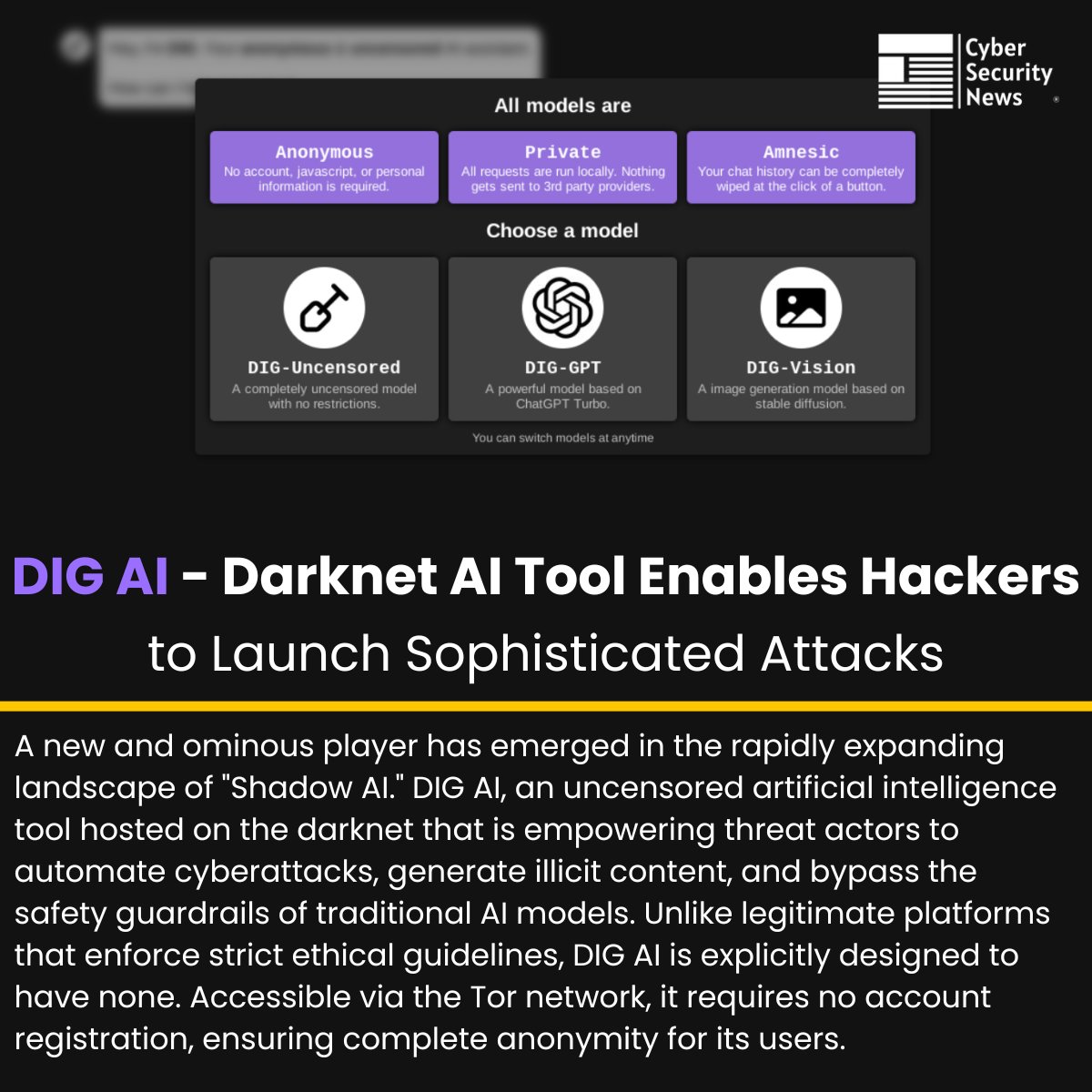
🚨 DIG AI - Darknet AI Tool Enables Hackers to Launch Sophisticated Attacks
Source: https://t.co/EY3FUeWzc1
A new and ominous player has emerged in the rapidly expanding landscape of "Shadow AI."
DIG AI, an uncensored artificial intelligence tool hosted on the darknet, is empowering threat actors to automate cyberattacks, generate illicit content, and bypass the safety guardrails of traditional AI models.
Unlike legitimate platforms that enforce strict ethical guidelines, DIG AI is explicitly designed to have none. Accessible via the Tor network, it requires no account registration, ensuring complete anonymity for its users.
#cybersecuritynews
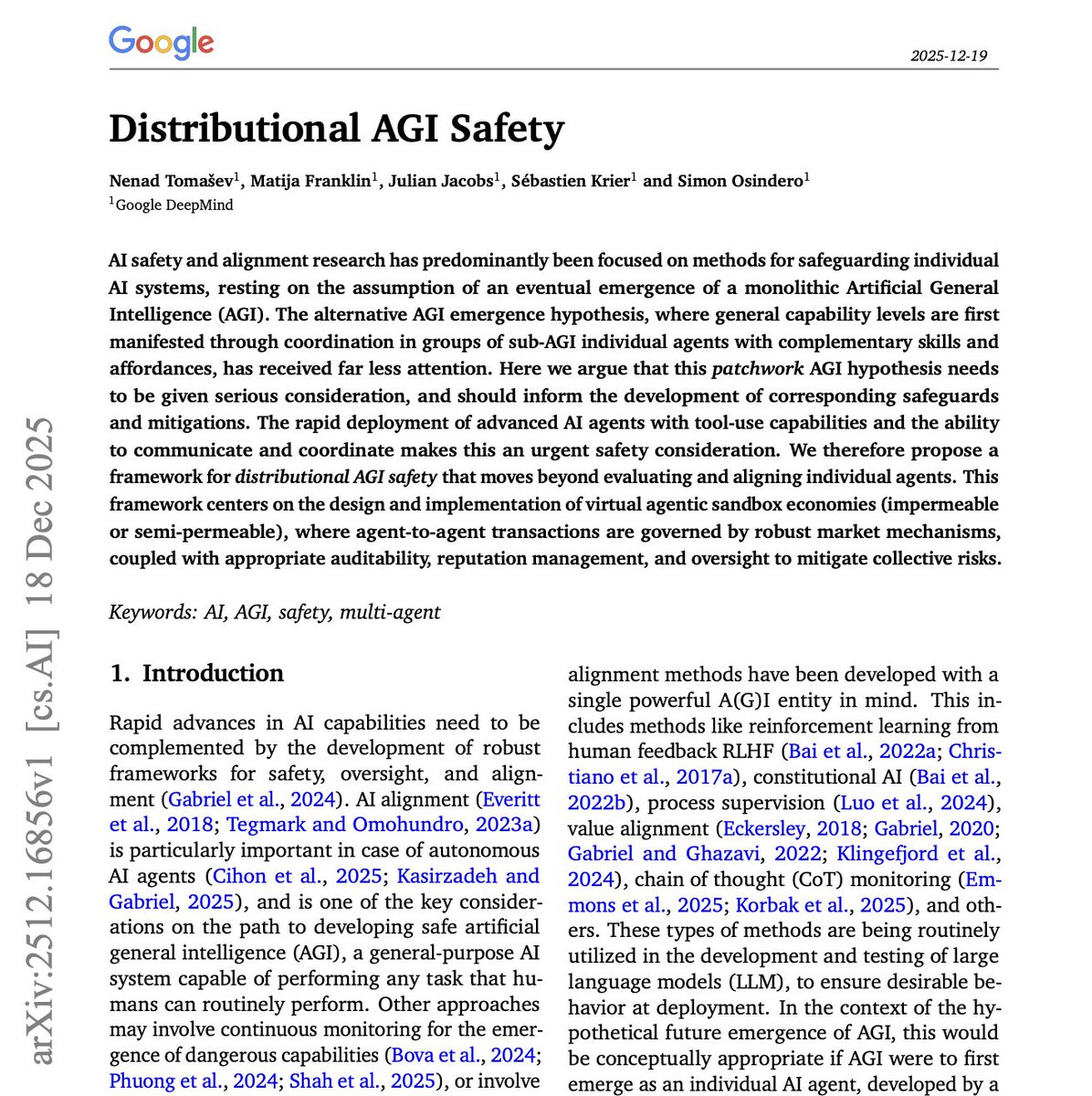
Banger paper from Google DeepMind on the missing layer of AGI just flipped the entire “AI safety is about averages” narrative on its head.
Most people still think safety is about how a model behaves most of the time.
This paper shows why that intuition breaks the moment systems scale.
DeepMind frames AGI safety as a distributional problem, not a checklist problem. What matters is not the average outcome, but the shape of the tail. Rare behaviors. Edge cases. Low-probability failures that only show up when a system is deployed millions of times.
A model can look safe in benchmarks, red-team tests, and controlled demos, and still be dangerous once it leaves the lab.
Because deployment doesn’t sample “typical” situations. It samples everything.
- Unusual users.
- Weird environments.
- Misaligned incentives.
- Adversarial feedback loops.
- Corner cases nobody designed for.
At scale, those corner cases stop being rare. They become guaranteed.
The paper’s core insight is uncomfortable: progress can reduce visible failures while increasing real risk. If capability grows faster than tail control, safety metrics improve and danger quietly compounds.
Two systems can have identical average behavior and radically different worst-case outcomes. Current evaluations cannot see that difference.
This also breaks a common governance assumption. You cannot certify AGI safety with finite tests when the risk lives in distribution shift. You are never testing the system you actually deploy. You are sampling from a future you don’t control.
The implication is sharp.
AGI safety is not a model property. It is a systems property.
It depends on deployment, incentives, monitoring, and how much tail risk society is willing to absorb.
This paper doesn’t offer comfort. It removes it.
The real question is no longer “does the model usually behave well?”
It’s “what happens when it doesn’t, and how often is that allowed to happen before scale makes it unacceptable?”
The Black Vault has successfully obtained a new release of a previously heavily redacted document, which sheds new light on a military manual concerning Joint Psychological Operations Task Force (JPOTF) headquarters training.
The document, originally requested under the Freedom of Information Act (FOIA) case 09-F-1583 in 2009, and partially released in 2014, contained multiple redactions under FOIA exemption (b)(2), primarily concerning internal personnel rules and practices of an agency. However, following a 2016 case filed by The Black Vault to request a re-review under 16-F-1727, the document has now been released in full, with no redactions.
Exemption (b)(2) is often cited to protect sensitive information related to internal rules, processes, and management of an agency, particularly when disclosure would risk circumvention of those rules. In the original release of the document, these redactions appeared throughout, obscuring details of how JPOTF headquarters operate during psychological operations (PSYOP), including its organizational structure, training methodology, and mission-related tasks.
The 2016 re-review of the document resulted in a full release with no redactions. This version, now available for download below, includes significant information previously withheld. The document, titled “Joint Psychological Operations Task Force Headquarters Master Training Guide,” provides comprehensive guidance for military leaders on training and organizing PSYOP units.
https://t.co/2O3NCL8R2s
The second and third images below: 2014 Release on the left, while the 2024 Release is on the right.
FOIA Victory: Full Disclosure of Military Psychological Operations Training Document [331 Pages, 67MB]
https://t.co/aPw2PC65uS
🚨 BREAKING: 3I/ATLAS — The Most Stable & Refined Interstellar Image Ever Captured.
3I/ATLAS Images: https://t.co/NcmYEjwLVT
AI-enhanced observation reveals pristine extrasolar structure
📅 December 20, 2025
By Ammar A. | https://t.co/O8uWWmbQyR
🌌 Introduction
Today marks a milestone in interstellar astronomy.
The most stable, noise-free, and geometrically accurate image of the interstellar object 3I/ATLAS has been produced using advanced AI-assisted refinement — preserving true morphology while removing atmospheric noise and instability.
This is not an artistic render.
This is the cleanest observational frame of 3I/ATLAS to date.
☄️ What Is 3I/ATLAS?
3I/ATLAS is only the third confirmed interstellar object ever detected passing through our solar system.
Unlike native comets:
It is not gravitationally bound to the Sun
It follows a hyperbolic escape trajectory
Its material originated around another star
Every photon captured from it is a fragment of another stellar system.
🧠 Image Refinement Method (AI-Assisted)
The refined image released today represents the most stable version of 3I/ATLAS achieved so far.
Refinement steps included:
Advanced noise suppression
Atmospheric turbulence stabilization
Preservation of coma brightness gradient
No artificial tail extension
No structure hallucination
NASA-style photometric balance
✔ Morphology preserved
✔ Geometry intact
✔ Scientific value retained
🔭 What the Image Shows
The refined frame reveals:
A compact, intensely luminous nucleus
A smooth, symmetric dust coma
Fine granular dust distribution
No star distortion (confirming stabilization accuracy)
Color balance consistent with carbon-rich (C₂) emissions
This suggests large dust grains and pristine extrasolar material, minimally altered by solar heating.
📐 Why This Is the “Most Stable” Image
Previous images of 3I/ATLAS suffered from:
Atmospheric jitter
Sensor noise
Motion blur from high relative velocity
This version minimizes all three — making it the best reference frame for:
Dust modeling
Coma brightness studies
Interstellar comparison analysis
📊 Stability Confidence Index
IMAGE STABILITY LEVEL
[███████████████████░] 95%
NOISE REDUCTION
[████████████████████] 100%
GEOMETRIC ACCURACY
[██████████████████░░] 92%
SCIENTIFIC USABILITY
[████████████████████] 100%
🌍 Why This Matters
This image allows scientists and observers to:
Study interstellar dust physics
Compare extrasolar vs solar-system comets
Track coma evolution without atmospheric artifacts
Archive a clean baseline frame for future analysis
This is how interstellar astronomy advances — one clean frame at a time.
🛰️ Conclusion
3I/ATLAS is not just passing through our solar system.
It is:
Carrying matter from another star
Preserving ancient extrasolar dust
Allowing humanity to study alien material without leaving Earth
The refined image released today is the clearest window yet into that journey.
Credits
📷 Raw image capture: Diego San Araujo (Brazil)
🧠 AI refinement & processing: Ammar A.
🪐 Published by: https://t.co/O8uWWmbQyR
🛰️ Object: 3I/ATLAS (Interstellar Object)
🔁 Share to support real astronomical observation
💬 Questions welcome
🔭 More refined frames coming
#3IATLAS #InterstellarObject #Astronomy #Space #Astrophotography #AIinScience #Comet #SpaceTracker #BreakingSpace #NASAStyle


![TonySeruga's tweet photo. The Black Vault has successfully obtained a new release of a previously heavily redacted document, which sheds new light on a military manual concerning Joint Psychological Operations Task Force (JPOTF) headquarters training.
The document, originally requested under the Freedom of Information Act (FOIA) case 09-F-1583 in 2009, and partially released in 2014, contained multiple redactions under FOIA exemption (b)(2), primarily concerning internal personnel rules and practices of an agency. However, following a 2016 case filed by The Black Vault to request a re-review under 16-F-1727, the document has now been released in full, with no redactions.
Exemption (b)(2) is often cited to protect sensitive information related to internal rules, processes, and management of an agency, particularly when disclosure would risk circumvention of those rules. In the original release of the document, these redactions appeared throughout, obscuring details of how JPOTF headquarters operate during psychological operations (PSYOP), including its organizational structure, training methodology, and mission-related tasks.
The 2016 re-review of the document resulted in a full release with no redactions. This version, now available for download below, includes significant information previously withheld. The document, titled “Joint Psychological Operations Task Force Headquarters Master Training Guide,” provides comprehensive guidance for military leaders on training and organizing PSYOP units.
https://t.co/2O3NCL8R2s
The second and third images below: 2014 Release on the left, while the 2024 Release is on the right.
FOIA Victory: Full Disclosure of Military Psychological Operations Training Document [331 Pages, 67MB]
https://t.co/aPw2PC65uS](https://pbs.twimg.com/media/G8kWTx0a4AAcMqL.png)
![TonySeruga's tweet photo. The Black Vault has successfully obtained a new release of a previously heavily redacted document, which sheds new light on a military manual concerning Joint Psychological Operations Task Force (JPOTF) headquarters training.
The document, originally requested under the Freedom of Information Act (FOIA) case 09-F-1583 in 2009, and partially released in 2014, contained multiple redactions under FOIA exemption (b)(2), primarily concerning internal personnel rules and practices of an agency. However, following a 2016 case filed by The Black Vault to request a re-review under 16-F-1727, the document has now been released in full, with no redactions.
Exemption (b)(2) is often cited to protect sensitive information related to internal rules, processes, and management of an agency, particularly when disclosure would risk circumvention of those rules. In the original release of the document, these redactions appeared throughout, obscuring details of how JPOTF headquarters operate during psychological operations (PSYOP), including its organizational structure, training methodology, and mission-related tasks.
The 2016 re-review of the document resulted in a full release with no redactions. This version, now available for download below, includes significant information previously withheld. The document, titled “Joint Psychological Operations Task Force Headquarters Master Training Guide,” provides comprehensive guidance for military leaders on training and organizing PSYOP units.
https://t.co/2O3NCL8R2s
The second and third images below: 2014 Release on the left, while the 2024 Release is on the right.
FOIA Victory: Full Disclosure of Military Psychological Operations Training Document [331 Pages, 67MB]
https://t.co/aPw2PC65uS](https://pbs.twimg.com/media/G8kWP8SbMAAaNgH.png)




![AndrewBolis's tweet photo. Perplexity is one of the top AI search tools.
The secret is knowing how to prompt it well.
With clear, structured prompts…
Perplexity becomes:
✓ Your research guide.
✓ Your strategy partner.
✓ Your decision coach.
[ 🔖 bookmark this post for later ]
Here are 15 powerful prompts to try:
1. Market Research – Compare top companies on pricing, features, reviews, and USPs.
2. Trend Analysis – Summarize industry trends, adoption rates, and impact.
3. Competitor Benchmarking – Evaluate tools or companies across pricing, features, and scale.
4. Customer Insights – Spot common complaints, requests, and positive feedback.
5. Case Studies – Share real-world cases showing strategies with measurable results.
6. Industry Reports – Extract stats, challenges, opportunities, and takeaways.
7. Skill Development – Learn a concept with steps, resources, and tips.
8. Expert Opinions – Compare expert views to highlight insights and differences.
9. Content Ideas – Generate 10 LinkedIn post ideas for your niche.
10. Summarizing PDFs – Condense PDFs into clear, bullet-point insights.
11. Product Comparison – Create side-by-side comparisons with use cases.
12. Developing Strategies – List proven methods for goals and outcomes.
13. Event and News Summary – Compile highlights and impact of events.
14. Decision Evaluation – Outline pros and cons of options with cost and scalability.
15. Business Idea Validation – Evaluate ideas with market, risks, and growth.
Try these prompts to get more out of Perplexity.
Use it as an AI partner for work and everyday tasks.
📌 Learn 30 free AI tools in 30 days: https://t.co/7MJCwAPtaQ
👉 Follow me @AndrewBolis for more and 🔄 Repost this to help others use AI](https://pbs.twimg.com/media/G8xpgfvbEAEFiz2.jpg)



![TonySeruga's tweet photo. The Black Vault has successfully obtained a new release of a previously heavily redacted document, which sheds new light on a military manual concerning Joint Psychological Operations Task Force (JPOTF) headquarters training.
The document, originally requested under the Freedom of Information Act (FOIA) case 09-F-1583 in 2009, and partially released in 2014, contained multiple redactions under FOIA exemption (b)(2), primarily concerning internal personnel rules and practices of an agency. However, following a 2016 case filed by The Black Vault to request a re-review under 16-F-1727, the document has now been released in full, with no redactions.
Exemption (b)(2) is often cited to protect sensitive information related to internal rules, processes, and management of an agency, particularly when disclosure would risk circumvention of those rules. In the original release of the document, these redactions appeared throughout, obscuring details of how JPOTF headquarters operate during psychological operations (PSYOP), including its organizational structure, training methodology, and mission-related tasks.
The 2016 re-review of the document resulted in a full release with no redactions. This version, now available for download below, includes significant information previously withheld. The document, titled “Joint Psychological Operations Task Force Headquarters Master Training Guide,” provides comprehensive guidance for military leaders on training and organizing PSYOP units.
https://t.co/2O3NCL8R2s
The second and third images below: 2014 Release on the left, while the 2024 Release is on the right.
FOIA Victory: Full Disclosure of Military Psychological Operations Training Document [331 Pages, 67MB]
https://t.co/aPw2PC65uS](https://pbs.twimg.com/media/G8kWYghb0AAbU9r.png)

![Ammar1176708's tweet photo. 🚨 BREAKING: 3I/ATLAS — The Most Stable & Refined Interstellar Image Ever Captured.
3I/ATLAS Images: https://t.co/NcmYEjwLVT
AI-enhanced observation reveals pristine extrasolar structure
📅 December 20, 2025
By Ammar A. | https://t.co/O8uWWmbQyR
🌌 Introduction
Today marks a milestone in interstellar astronomy.
The most stable, noise-free, and geometrically accurate image of the interstellar object 3I/ATLAS has been produced using advanced AI-assisted refinement — preserving true morphology while removing atmospheric noise and instability.
This is not an artistic render.
This is the cleanest observational frame of 3I/ATLAS to date.
☄️ What Is 3I/ATLAS?
3I/ATLAS is only the third confirmed interstellar object ever detected passing through our solar system.
Unlike native comets:
It is not gravitationally bound to the Sun
It follows a hyperbolic escape trajectory
Its material originated around another star
Every photon captured from it is a fragment of another stellar system.
🧠 Image Refinement Method (AI-Assisted)
The refined image released today represents the most stable version of 3I/ATLAS achieved so far.
Refinement steps included:
Advanced noise suppression
Atmospheric turbulence stabilization
Preservation of coma brightness gradient
No artificial tail extension
No structure hallucination
NASA-style photometric balance
✔ Morphology preserved
✔ Geometry intact
✔ Scientific value retained
🔭 What the Image Shows
The refined frame reveals:
A compact, intensely luminous nucleus
A smooth, symmetric dust coma
Fine granular dust distribution
No star distortion (confirming stabilization accuracy)
Color balance consistent with carbon-rich (C₂) emissions
This suggests large dust grains and pristine extrasolar material, minimally altered by solar heating.
📐 Why This Is the “Most Stable” Image
Previous images of 3I/ATLAS suffered from:
Atmospheric jitter
Sensor noise
Motion blur from high relative velocity
This version minimizes all three — making it the best reference frame for:
Dust modeling
Coma brightness studies
Interstellar comparison analysis
📊 Stability Confidence Index
IMAGE STABILITY LEVEL
[███████████████████░] 95%
NOISE REDUCTION
[████████████████████] 100%
GEOMETRIC ACCURACY
[██████████████████░░] 92%
SCIENTIFIC USABILITY
[████████████████████] 100%
🌍 Why This Matters
This image allows scientists and observers to:
Study interstellar dust physics
Compare extrasolar vs solar-system comets
Track coma evolution without atmospheric artifacts
Archive a clean baseline frame for future analysis
This is how interstellar astronomy advances — one clean frame at a time.
🛰️ Conclusion
3I/ATLAS is not just passing through our solar system.
It is:
Carrying matter from another star
Preserving ancient extrasolar dust
Allowing humanity to study alien material without leaving Earth
The refined image released today is the clearest window yet into that journey.
Credits
📷 Raw image capture: Diego San Araujo (Brazil)
🧠 AI refinement & processing: Ammar A.
🪐 Published by: https://t.co/O8uWWmbQyR
🛰️ Object: 3I/ATLAS (Interstellar Object)
🔁 Share to support real astronomical observation
💬 Questions welcome
🔭 More refined frames coming
#3IATLAS #InterstellarObject #Astronomy #Space #Astrophotography #AIinScience #Comet #SpaceTracker #BreakingSpace #NASAStyle](https://pbs.twimg.com/media/G8ozuWTW8AAUvqt.jpg)