Want to learn malware analysis using REAL malware?
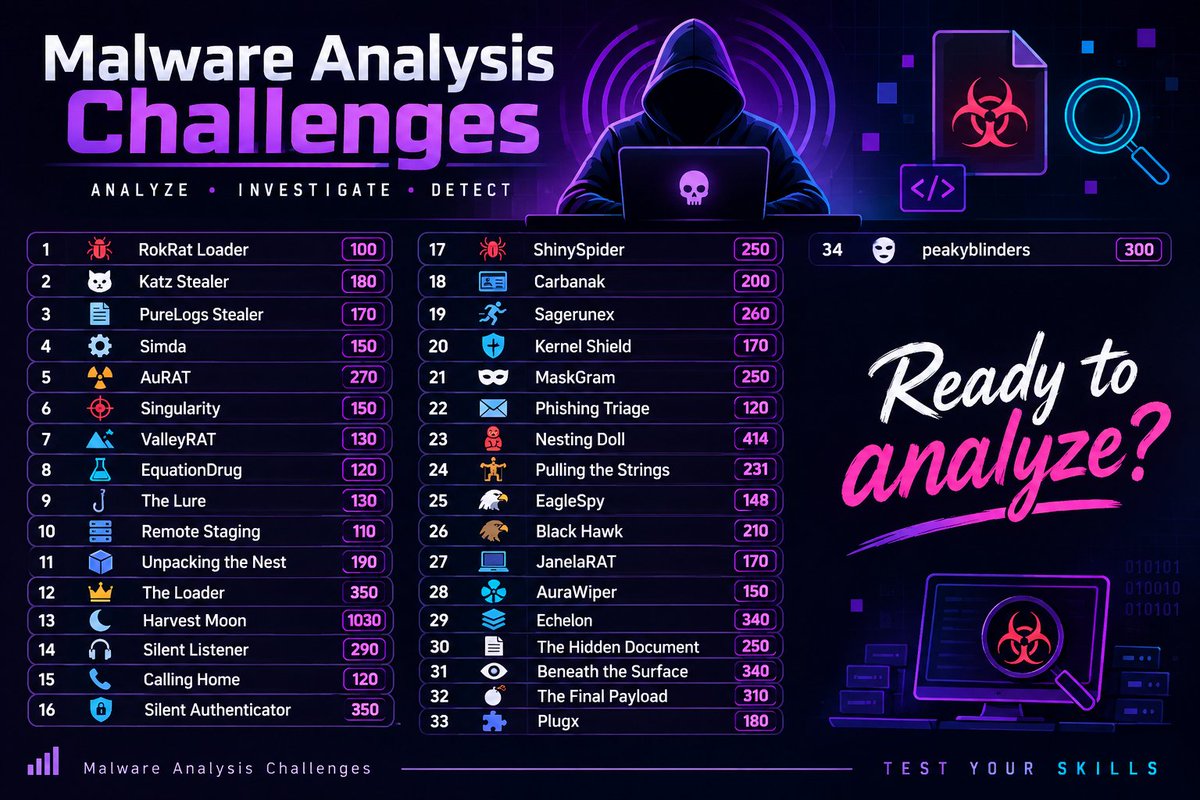
https://t.co/h7ayJ83AKG offers FREE hands-on challenges built around real malware samples.
Analyze real samples, understand how they work, and sharpen your reverse engineering skills.
Join us: https://t.co/18sugnKo4N
Sharing my writeup for the Lab Operation Silent Veil, available on the platform https://t.co/w2qTDR1JAt developed by @MalGamy12
Here we analyze a multistage malware, starting with an excel document, applying techniques like COM Hijacking or Steganography
https://t.co/Ua4vonPTtD
I'm "done" with the first video. I ended up substantially trimming it down and, per some feedback I received, focusing more on the secondary in-memory payload.
It has taken me little over a week to make a video on a malware payload which would normally would only take me like... 30 minutes (or less)
I can't spend over a week discussing a fairly common Malware-as-a-Service payload. I also don't have time to discuss Lumma internals. I initially planned on it, but it's too much for me at the moment.
We have more malware to bonk with a stick.
This is a "demo" run of me bonking malware with a stick videos. I'm weighing on whether or not I want to continue producing videos. It is fun, however it considerably slows me down on other malware thingies I want to look at it.
I dunno.
Here is the final cut:
Most people learning malware analysis are stuck on theory.
That's the problem I'm solving with https://t.co/BabZ0NwkTR. Real samples, working challenges. Hands-on RE practice that mirrors what you'll actually face in the field.
https://t.co/18sugnJQff
Operation Dreamjob:
Writeup for a trojanized Keepass executable, being part of Zero2Auto malware analysis course.
https://t.co/oS6nKS3uPN
@malcat4ever Kesakode and MCP server did a great job to find suspicious functions included, giving a starting point for an in-depth analysis.
Threat Intelligence Analysis: PhantomKiller (BYOVD)
PhantomKiller is a new EDR/AV evasion proof-of-concept that weaponizes a legitimate, fully signed Lenovo kernel driver (BootRepair.sys). It employs a classic Bring Your Own Vulnerable Driver (BYOVD) technique with an exceptionally simple and reliable implementation: it enables any low-privileged user (or after driver loading) to terminate any process on the system, including Protected Process Light (PPL) processes protected by modern EDRs.
Technical Details of the Driver & Vulnerability
•Driver: BootRepair.sys (part of Lenovo PC Manager)
•SHA256: 5ab36c116767eaae53a466fbc2dae7cfd608ed77721f65e83312037fbd57c946
•Signature: Valid Lenovo signature (trusted by Windows; currently 0 detections on VirusTotal)
•Build date: ~2018 (legacy driver still not broadly blocked)
Reverse Engineering Highlights (IDA Pro):
•Creates device object \\Device\\::BootRepair without a secure DACL.
•Exposes symbolic link \\DosDevices\\BootRepair — any user-mode process can open it via CreateFileW("\\\\.\\BootRepair").
•Only one IOCTL is exposed: 0x222014.
•The handler simply validates a 4-byte buffer (DWORD PID) and calls ZwTerminateProcess directly in kernel context with zero checks on caller, PID, or protections.
Result: Ring-0 termination bypasses all EDR objection handling, PPL, minifilter callbacks, and process protections.
Simple PoC
HANDLE h = CreateFileW(L"\\\\.\\BootRepair", GENERIC_READ | GENERIC_WRITE, 0, NULL, OPEN_EXISTING, 0, NULL);
DeviceIoControl(h, 0x222014, &pid, sizeof(pid), NULL, 0, &ret, NULL);
•If the driver is already loaded → direct low-priv exploitation.
•Otherwise → classic BYOVD load via sc.exe.
Successfully tested against CrowdStrike Falcon and claimed to work universally due to the kernel-trusted nature of the driver.
Cross-Checked Intelligence
•Disclosed May 19-21, 2026 by Jehad Abu Dagga (@jehadbudagga).
•Official repo: https://t.co/9Bc7QHUhi3
•Rapidly added to LOLDrivers by the community.
•Part of the ongoing 2026 wave of BYOVD EDR killers (ESET tracked 54+ tools abusing 35 vulnerable drivers this year).
Key IOCs:
•File: BootRepair.sys (SHA256 above)
•Device: \\.\BootRepair / \\Device\\::BootRepair
•IOCTL: 0x222014
•Service name: PhantomKiller (or attacker-chosen)
References: • Full technical write-up: https://t.co/w9U1rlDFFx • PoC Repository: https://t.co/9Bc7QHUhi3
.
#CyberSecurity #ThreatIntelligence #EDR #BYOVD #RedTeaming #InfoSec #WindowsSecurity #Vulnerability #CyberThreats #MalwareAnalysis
After Microsoft fixed BlueHammer, another Windows Defender privesc showed up: RedSun.
What makes this one interesting is that it’s not a classic memory corruption or logic bug. It looks more like Defender doing something… unexpected.
When Defender flags a file as malicious and it has a cloud verdict attached, it can end up writing that file back to its original location instead of removing it. If you can control that file and trigger the right behavior, you basically get Defender to write data for you with its elevated privileges.
The RedSun PoC shows that this can be abused to overwrite system files and escalate privileges to SYSTEM.
We took a closer look at the exploit and built detections. We’re publishing:
- Sigma rules covering different stages of the chain
- a YARA rule for the PoC
All rules are free on GitHub and also included in the free THOR Lite and THOR Lite Cloud scanner.
Sigma rules: https://t.co/w2jtiDzW4f
by @swachchhanda
YARA rule: https://t.co/vBNQkZhele
by @cod3nym
TeamPCP msbuild.exe Malware Analysis
Here is a breakdown of the execution chain, featuring EDR bypasses and steganography.
🛡️ 1. Evasion
• Dynamic SSN Resolution: The malware resolves native API functions (e.g., ZwAllocateVirtualMemory, NtProtectVirtualMemory) by matching their DJB2 hashes to dynamically extract their Syscall Service Numbers (SSNs).
• Trampoline Syscalls: To bypass EDR user-land hooks, it then searches the ntdll.dll .text section for the first occurrence of a clean syscall; ret gadget (0x0f05C3), typically finding it inside NtAccessCheck.
• Custom Syscall Stubs: Finally, it uses the extracted SSNs with custom syscall stubs. These stubs load the appropriate registers and jump to the located ntdll.dll gadget, cleanly executing indirect syscalls from a legitimate memory region.
• ETW Blinding: Neutralizes telemetry by patching the first instruction of EtwEventWrite with 0xC3 (ret).
🖼️ 2. Steganography
• Spawns a suspended dllhost.exe child process.
• Extracts the Adaptix C2 payload (shellcode loader + payload) embedded into the Red, Green, and Blue color channels of the image, while locking the Alpha (transparency) channel to fully opaque (FF).
• Writes the payload directly into an allocated buffer in dllhost.exe.
💉 3. Injection
• Instead of relying on one method, it sequentially tries multiple techniques to execute the payload in dllhost.exe:
1️⃣ APC Injection: NtQueueApcThread, NtResumeThread
2️⃣ Thread Execution Hijacking: ZwGetContextThread, ZwSetContextThread, NtResumeThread
3️⃣ Remote Thread Injection: NtCreateThreadEx, NtResumeThread
(Note: APIs for process hollowing and doppelgänging are also present but remain unused).
📡 4. Adaptix C2 Payload
• C2 URL: checkmarx[.]zone/telemetry/checkmarx.json (Defanged)
• Exfiltration: HTTP POST requests using the X-Content-ID header for encoded/encrypted data.
• User-Agent: Mozilla/5.0 (Windows NT 6.2; rv:20.0) Gecko/20121202 Firefox/20.0
🔬 5. IOCs
• Analyzed Sample: https://t.co/Xq8Jh5ngJq
• Related Sample: https://t.co/W65u77Abec
Overall, a nice mix of methods, but nothing novel.
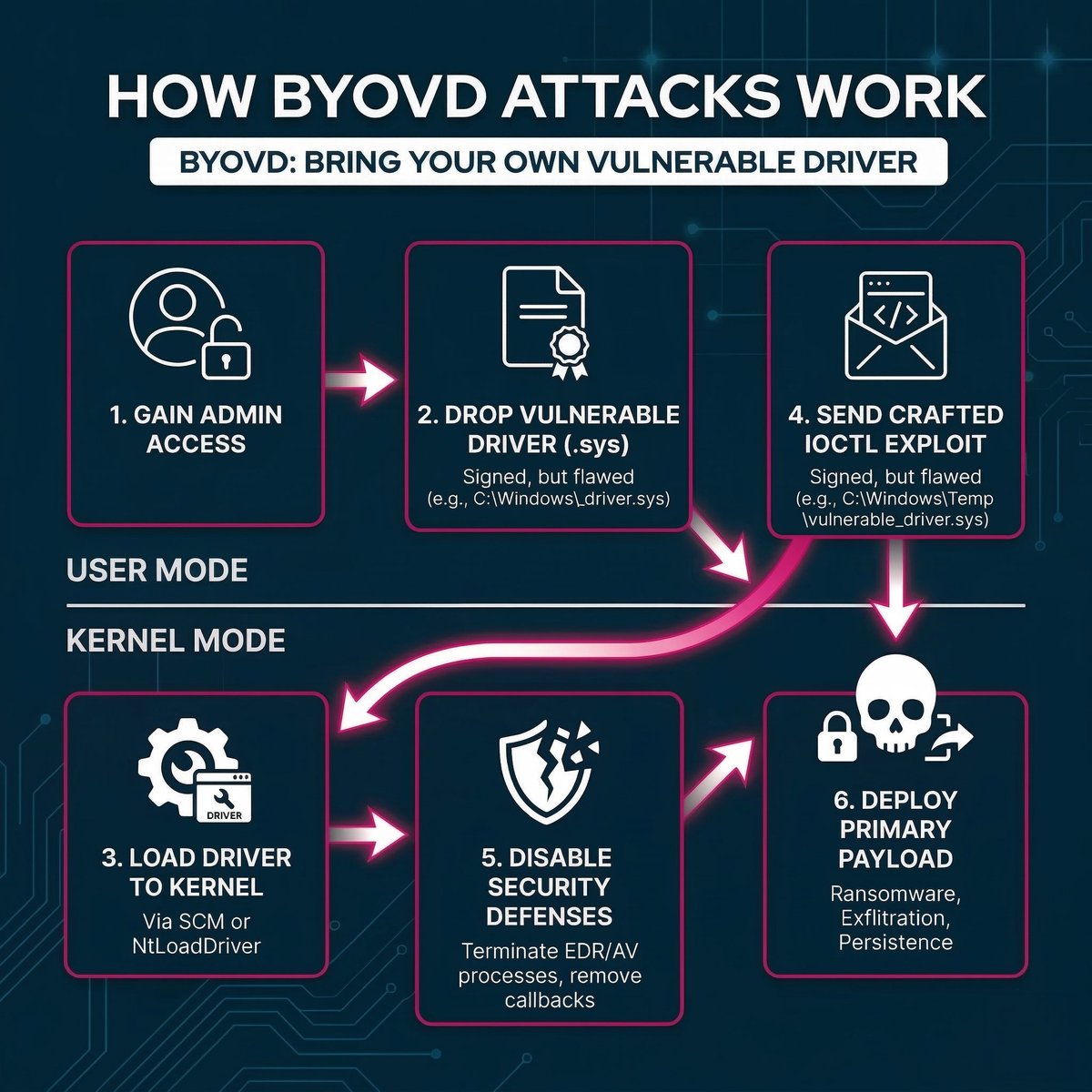
A signed driver from a video game was used to kill enterprise antivirus at the kernel level.
That's not theoretical. That's BYOVD in the wild.
Attackers load a legit, signed, vulnerable driver. Windows trusts it. They exploit it for kernel access. Your EDR goes dark.
We break down the full attack chain 👇
Read more: https://t.co/ka2qit80Uh
@bugfireIO@REMnux Unpacking wasn't successful, but config extraction and Python script creation were very good.
I think more experienced analysts/researchers can get more value of AI because they know where and for what to look for, allowing them to create better prompts and evaluate the results
IcedID Config extraction:
Writeup for a challenge part of Zero2Auto malware analysis course.
https://t.co/XxqLMrs2Vz
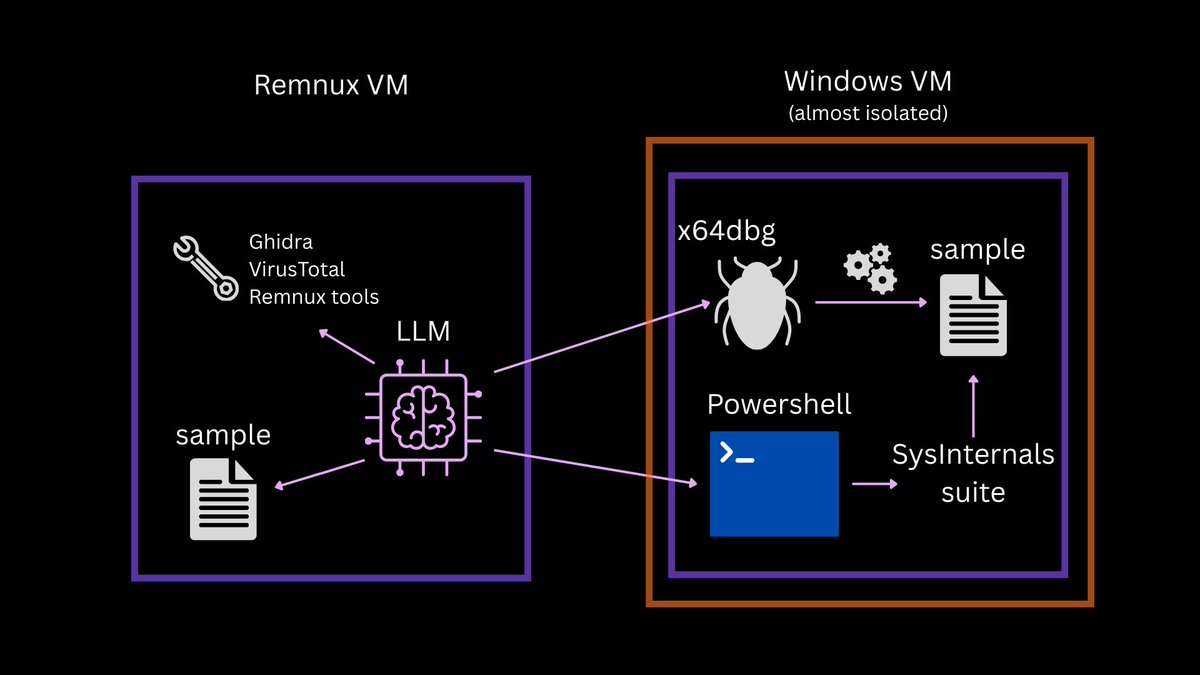
Also tried out the @REMnux MCP server to check out, how AI can support my analysis approaches and learning overall
New blog: Using LLMs the right way for malware analysis
💡Tips for building an autonomous AI analysis lab on a 12 yo laptop and getting stuff done faster without loss of accuracy.
https://t.co/hSd3xwBKGv
Announcing #BinaryRefinery 0.10.0 [BR]. Includes some (hopefully) notable performance improvements and quite a few bug fixes. It also adds a prototype batch parser/emulator which aspires to become a proper batch deobfuscator in future releases.
[BR] https://t.co/UFEAIVxsJx
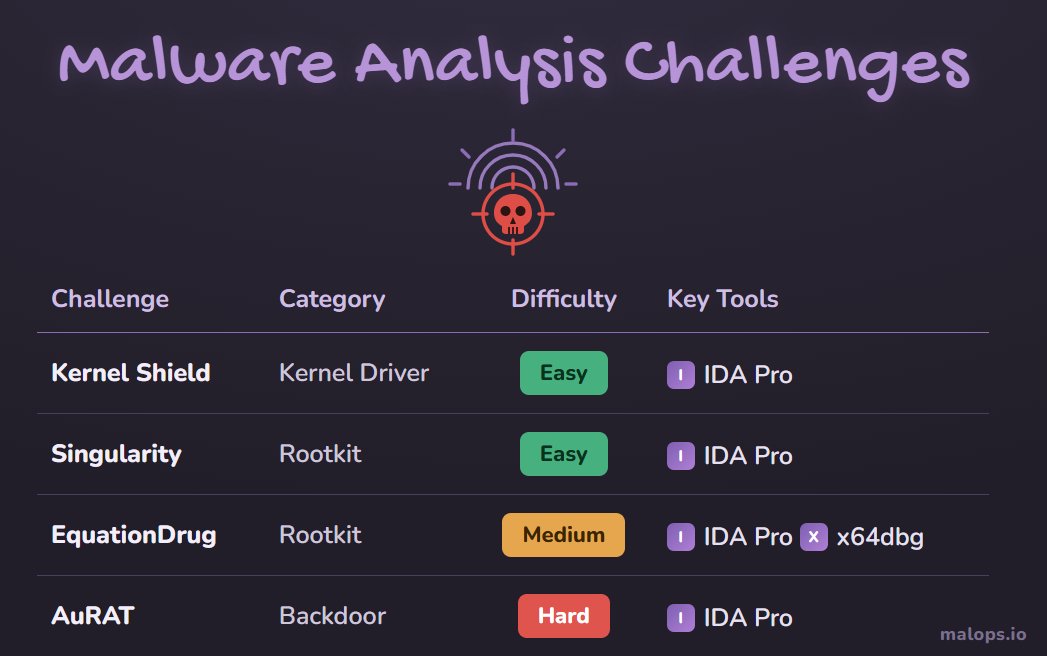
Happy to share my writeup for the challenge 'Kernel Shield' on https://t.co/VjZa958DNA, created by @MalGamy12.
In this challenge we are tasked to analyze a benign kernel driver file, which can be exploited to kill specific processes (CVE-2025-68947).
https://t.co/xNaoz9A1kO
@vxunderground What about the Imphash? If two specimens of the same malware don't have the same hash, wouldn't the Imphash be more useful to compare them?