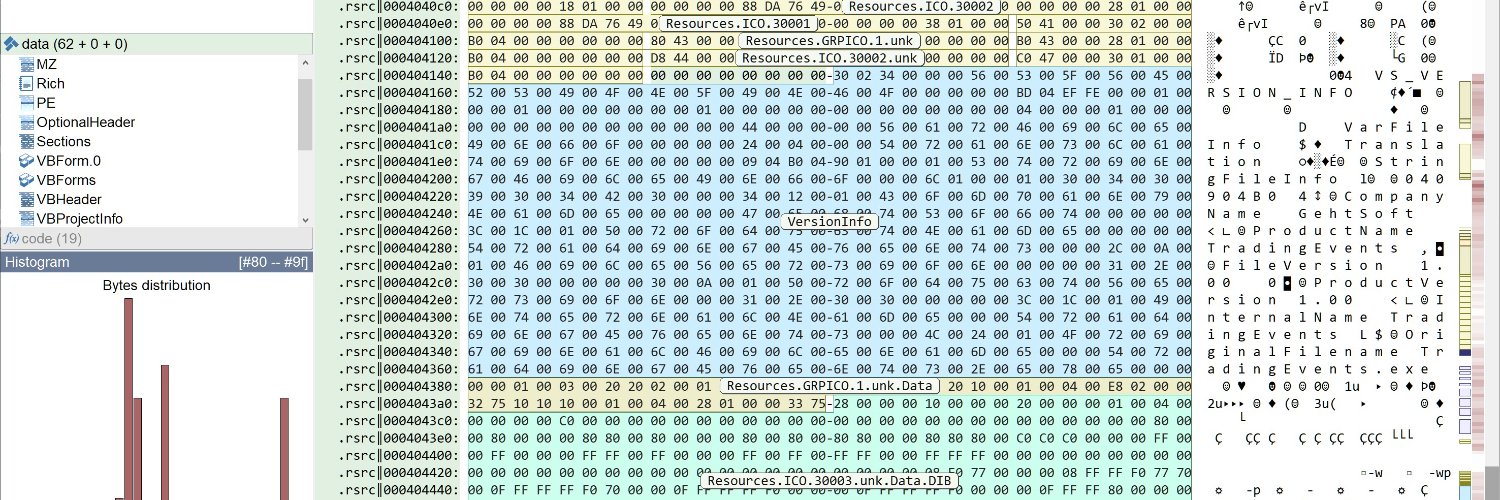
For full and pro users: we've released malcat 1.0.0-alpha3 for you to preview. It ships with:
● many GUI improvements (like side-by-side tabs)
● an even better MCP server with support for sandbox python transforms
● the first usable .NET and PYC decompilers!
Sharing my writeup for the Lab Operation Silent Veil, available on the platform https://t.co/w2qTDR1JAt developed by @MalGamy12
Here we analyze a multistage malware, starting with an excel document, applying techniques like COM Hijacking or Steganography
https://t.co/Ua4vonPTtD
If like me you're curious how well #Mistral's new "le chonk" model performs on reverse engineering tasks:
I compared it against 4 other models on 6 increasingly difficult static unpacking tasks, using only #Malcat's MCP:
https://t.co/fEtnCMMfoy
@MistralAI For an _unpacked_ cobalt strike beacon 12 minutes is actually pretty slow. Like a human would be faster.
It would make more sense to test against obfuscated malware.
First time experimenting with entirely local LLM's and reverse engineering work, and fairly impressed with the initial results.
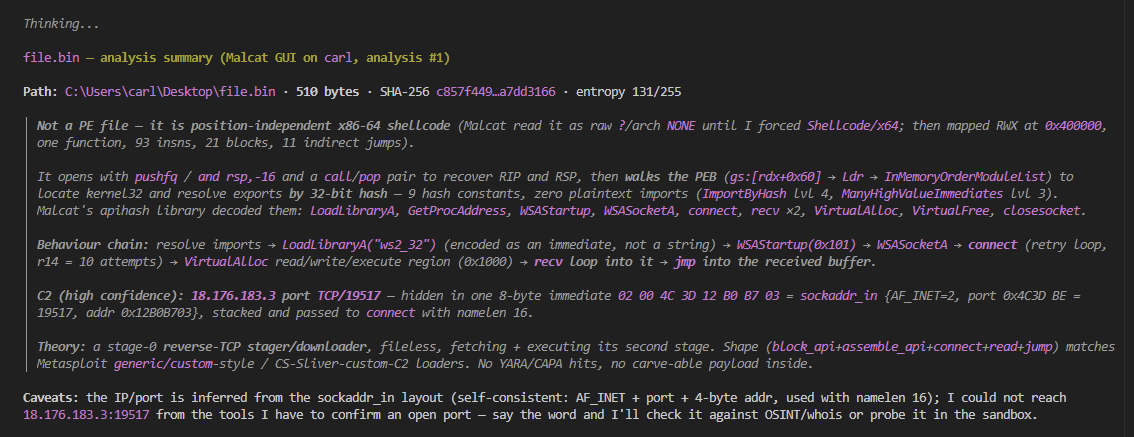
Qwen3.8-Flash-Next (@MiaAI_lab's recent Tensorfold recipe) and the @malcat4ever MCP made short work (~2 minutes on a DGX spark) of an old CS shellcode without any skills or specific prompting.
The sample is admittedly simple, and frontier models handle it with ease, though seeing this all driven entirely locally is a cool experience.
More to come as I work out which harnesses, model recipes and MCP's work best for this kind of thing.
The best way to improve your software is to use it, and #flareon13 is a incredibly valuable benchmark!
As usual, I'll give it a go to see how #malcat performs and how it can be improved.
Thanks @Mandiant for this great challenge!
For full and pro users: we've released malcat 1.0.0-alpha3 for you to preview. It ships with:
● many GUI improvements (like side-by-side tabs)
● an even better MCP server with support for sandbox python transforms
● the first usable .NET and PYC decompilers!
@FelipeFumero663 That's a valid concern!
First it's an opt-in, you have to activate it in the options
Second, it works by whitelisting a very limited subset of python at the AST level, so it's not your typical "I forbid builtins" approach.
We think it's safe, if you don't it's opt-in anyway!
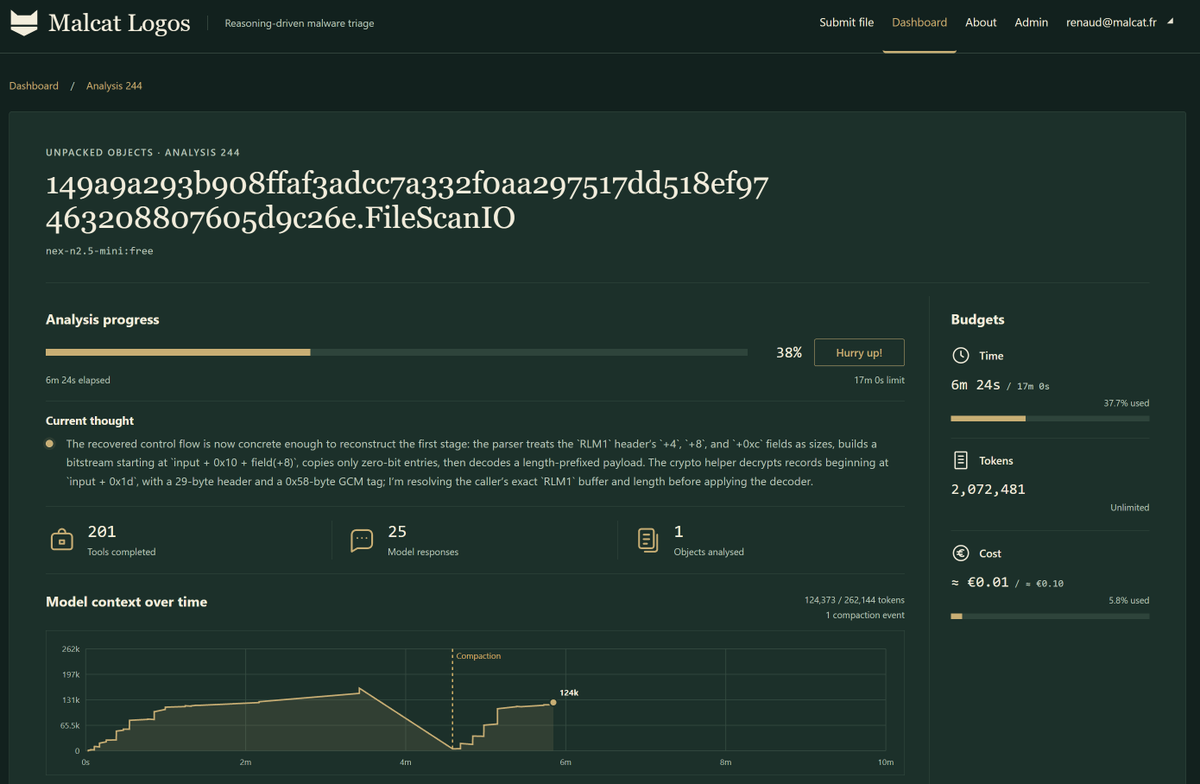
We have added context compaction to #malcat logos, which will allow you to run logos through local models with small context windows. Beta is approaching!
@d4rksystem While this is a good advice in general, I feel that hallucinations aren't really a problem anymore since the latest models. I LLM-reverse A LOT of samples per day, I have yet to see one. Small mistakes sure, but plain hallucinations? no.
In fuzzy matching mode, a set of features is computed for each function (used opcodes, constants, ref. strings, symbols, calls, etc.). This feature sets in then transformed into a 64 bytes hash using the min-hash alg. for efficient comparison.
@CERT_OPL#malware#cybersecurity#clickfix
[2/2]
The C2 Tracker feature is still available! This gives security professionals access to the latest list of malicious domains hosting ClickFix. You'll see cool real-time charts showing infections.
Very nice step-by-step analysis of a simple telegram loader (#Teleshim) by M.Boll.
Good material if you're starting with #malcat:
https://t.co/2ApqYYDVki
@PandaRE__ .csig is our own format for indexed constants signatures. It's compact and enables fast scanning. Cleaning up and releasing the .csig compiler is on our todo list for some time, I'll move it up a bit.