BREAKING: Cloudflare, $NET, is still reporting issues worldwide right now.
ChatGpt, Claude, Twitter, Spotify and many other services are affected.
Unusual Whales is impacted by the disruption as well. We are working to resolve it.
Learn how LLMs introduce unique vulnerabilities, like prompt injection, model denial-of-service (DoS), or data leakage that traditional app security doesn't address.
Free webinar July 15th
https://t.co/pqtTVme9jX
StateFlow is recently integrated into @pyautogen
“The integration of StateFlow has noticeably improved the relevance and accuracy of the generated assessments and feedback...,” says a user of AutoGen. It’s opening a new door with better control of the LLM workflow! Thanks to wonderful collaboration from @Chi_Wang_ and @VyvyenYue, and of course, the hard work from @YiranWu18 🚀
and @ShaokunZhang1! 🚀
Today we're excited to introduce Multi-Model Sessions!
— Load & prompt multiple local LLMs simultaneously
— Use the API to build networks, pipelines of LLMs that can talk with each other
— Use the new JSON Mode to constrain each model's output format
LM Studio 0.2.17 is available for Mac, Windows, and Linux. Get it here: https://t.co/YS5uiRQ7TI
Planning is a key agentic AI design pattern in which we use a large language model (LLM) to autonomously decide on what sequence of steps to execute to accomplish a larger task. For example, if we ask an agent to do online research on a given topic, we might use an LLM to break down the objective into smaller subtasks, such as researching specific subtopics, synthesizing findings, and compiling a report.
Many people had a “ChatGPT moment” shortly after ChatGPT was released, when they played with it and were surprised that it significantly exceeded their expectation of what AI can do. If you have not yet had a similar “AI Agentic moment,” I hope you will soon. I had one several months ago, when I presented a live demo of a research agent I had implemented that had access to various online search tools.
I had tested this agent multiple times privately, during which it consistently used a web search tool to gather information and wrote up a summary. During the live demo, though, the web search API unexpectedly returned with a rate limiting error. I thought my demo was about to fail publicly, and I dreaded what was to come next. To my surprise, the agent pivoted deftly to a Wikipedia search tool — which I had forgotten I’d given it — and completed the task using Wikipedia instead of web search.
This was an AI Agentic moment of surprise for me. I think many people who haven’t experienced such a moment yet will do so in the coming months. It’s a beautiful thing when you see an agent autonomously decide to do things in ways that you had not anticipated, and succeed as a result!
Many tasks can’t be done in a single step or with a single tool invocation, but an agent can decide what steps to take. For example, to simplify an example from the HuggingGPT paper (cited below), if you want an agent to consider a picture of a boy and draw a picture of a girl in the same pose, the task might be decomposed into two distinct steps: (i) detect the pose in the picture of the boy and (ii) render a picture of a girl in the detected pose. An LLM might be fine-tuned or prompted (with few-shot prompting) to specify a plan by outputting a string like "{tool: pose-detection, input: image.jpg, output: temp1 } {tool: pose-to-image, input: temp1, output: final.jpg}".
This structured output, which specifies two steps to take, then triggers software to invoke a pose detection tool followed by a pose-to-image tool to complete the task. (This example is for illustrative purposes only; HuggingGPT uses a different format.)
Admittedly, many agentic workflows do not need planning. For example, you might have an agent reflect on, and improve, its output a fixed number of times. In this case, the sequence of steps the agent takes is fixed and deterministic. But for complex tasks in which you aren’t able to specify a decomposition of the task into a set of steps ahead of time, Planning allows the agent to decide dynamically what steps to take.
On one hand, Planning is a very powerful capability; on the other, it leads to less predictable results. In my experience, while I can get the agentic design patterns of Reflection and Tool use to work reliably and improve my applications’ performance, Planning is a less mature technology, and I find it hard to predict in advance what it will do. But the field continues to evolve rapidly, and I'm confident that Planning abilities will improve quickly.
If you’re interested in learning more about Planning with LLMs, I recommend:
- Chain-of-Thought Prompting Elicits Reasoning in Large Language Models, Wei et al. (2022)
- HuggingGPT: Solving AI Tasks with ChatGPT and its Friends in Hugging Face, Shen et al. (2023)
- Understanding the planning of LLM agents: A survey, by Huang et al. (2024)
[Original text: https://t.co/pWmIR9wEki ]
Do Large Language Models (LLM) have leadership? Together with cognitive scientists Tom Griffiths @cocosci_lab and Natalia Velez @natvelali at @Princeton, we created a multi-LLM-agent system to test if agents work better with a leader. It turns out that LLMs do have leadership, and some is better than others! They can elect their own leader, and optimize themselves via Reflect and Critic! We are closer to the #Westworld~ Check out: https://t.co/4nPGMwbNYk
Credits to team members @_traceur__, Jiale, @KaixuanHuang1, @huazheng_wang, @qingyun_wu
Our system is proudly based on AutoGen @pyautogen.
#AI #Agent #GPT #LLMs
This is mind blowing.
This AI can make single image sing, talk, and rap from any audio file expressively! 🤯
Introducing EMO: Emote Portrait Alive by Alibaba.
10 wild examples: 🧵👇
1. AI Lady from Sora singing Dua Lipa
Another great music video by Kirill Nong using Move AI Multi-Cam. 🔥
Our motion capture tech uses AI to make the creation of lifelike 3D animations super easy with absolutely amazing results. 🚀
Experience the magic of effortless animation today! ⚡️
The NBA unveils a new, LED court for the 2024 All-Star game taking place at Lucas Oil Stadium. Created by German company ASB GlassFloor, the court is literally a glass floor. Comprised of two layers of "laminated safety glass," the court has been in the works for several years.
NOW is the TIME we ALL get the facts behind DEEP FAKE (Next Phase).
In attached video, Chris Umme, the creator of world famous Tom Cruise deep fake shares how to create amazingly believable fake video using AI and Visual Effects.
#الیکشن_کراو_پاکستان_بچاو
You can read this book in a few days.
If you start today, and assuming you take it slow, you'll have a whole new set of skills before winter is over.
Is there anything else you'd rather learn in your free time? Building AI applications will likely be one of the most lucrative skills in the world for years to come.
This book will take you from 0 to 60. Hats off to @benji1a! He made this book easy to digest for anyone, even those starting in the field.
The one-sentence summary of the book:
It will teach you how to build Large Language Model applications using Python, ChatGPT, and other models.
The contents of the 10 chapters, paraphrased by me:
1. How do Large Language Models work?
2. How does LangChain work?
3. Setting up LangChain
4. Building an AI assistant.
5. Building a chatbot like ChatGPT
6. Using Generative AI to write better software
7. Automating Data Science using Generative AI
8. Techniques and best practices to improve LLMs
9. How to deploy Generative AI in production
10. What should we expect from the future?
Hope you enjoy it.
Here is the link: https://t.co/HPztR1kLFP
Robots are not ready to take over the world yet! @zipengfu and I just compiled a video of the dumbest mistakes 𝐌𝐨𝐛𝐢𝐥𝐞 𝐀𝐋𝐎𝐇𝐀🏄 made in the autonomous mode 🤣
We are also planning to organize some live demos after taking a break. Stay tuned!
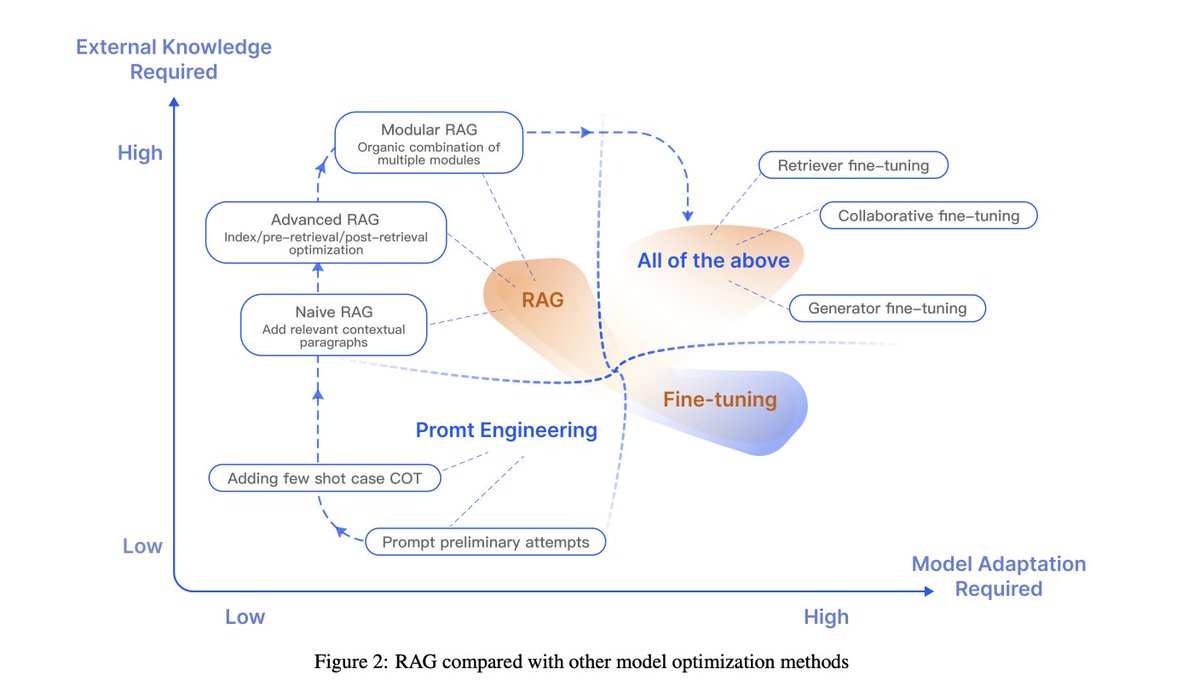
RAG Or Fine-Tuning?
There is a lot of confusion about when to apply which method.
RAG makes sense when you have a custom knowledge base and want a standard ChatGPT-like interface on top of it. RAG has multiple components to it and can be tricky to get right. However, it's definitely easier to implement than fine-tuning.
Fine-tuning makes sense when you have several supervised examples of request responses and are looking for a particular format for your responses. That is if you want the model to adapt to a particular type of response. For example, you can fine-tune a model to be good at a specific type of SQL code generation.
Sometimes, but not often, it makes sense to do both. Using something like Abacus AI makes applying either method on open-source and closed-source LLMs super simple.
Of course, we are particularly partial to open-source, especially if it can do the job!
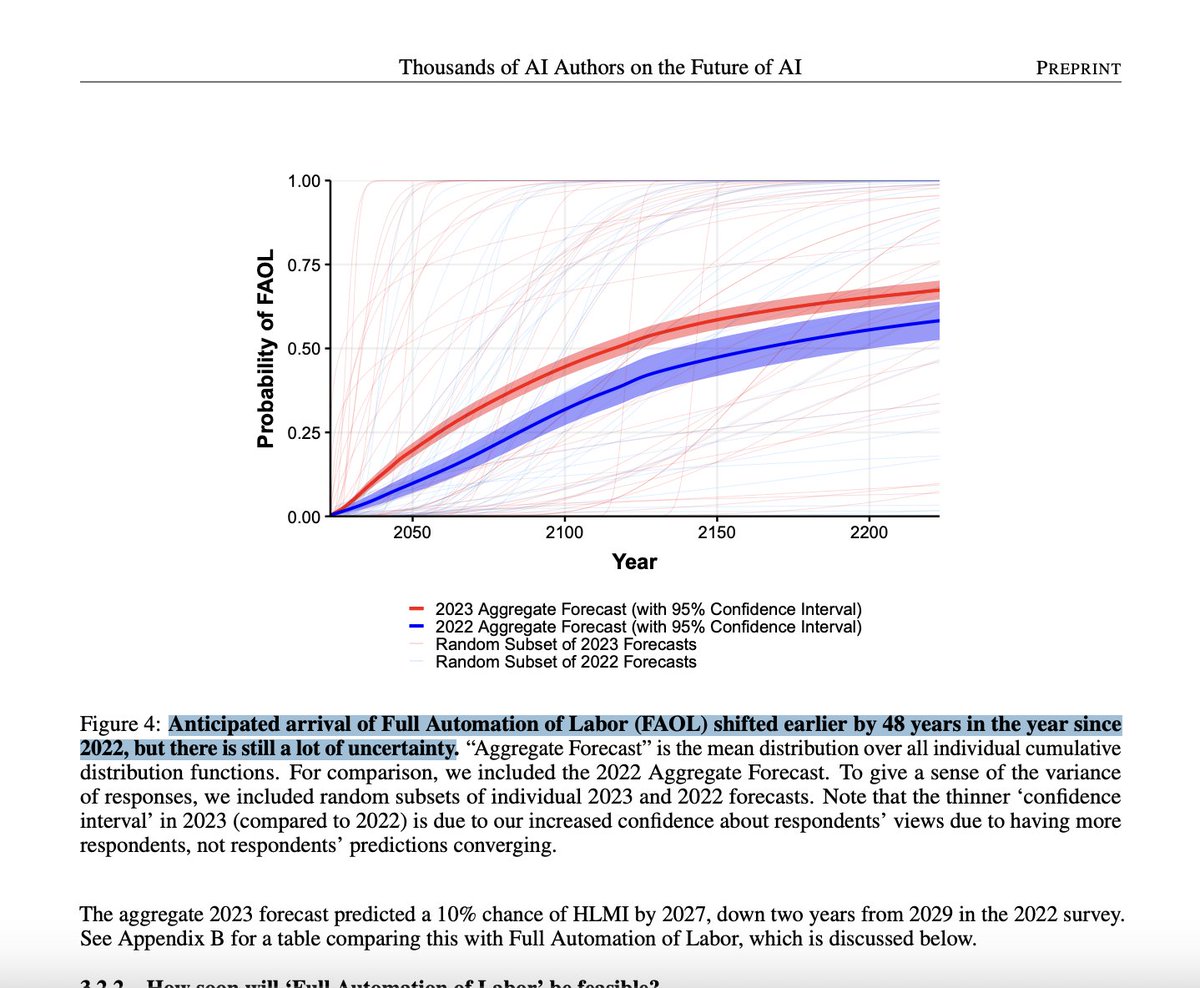
Anticipated arrival of Full Automation of Labor (FAOL) shifted earlier by 48 years in the year since 2022, but there is still a lot of uncertainty
https://t.co/Xlz2vU2r4q
Introducing 𝐌𝐨𝐛𝐢𝐥𝐞 𝐀𝐋𝐎𝐇𝐀🏄 -- Hardware!
A low-cost, open-source, mobile manipulator.
One of the most high-effort projects in my past 5yrs! Not possible without co-lead @zipengfu and @chelseabfinn.
At the end, what's better than cooking yourself a meal with the 🤖🧑🍳