In a gentler age, I remember being giddy when the internet was down because it meant you had a legitimate excuse to not work and just chat with your coworkers.
Claude is down, and the people in the coworking space around me are genuinely distraught.
One guy is just walking around saying, "What am I supposed to do?"
I feel you, man.
Its hard to blame @jack or incentives to build a more efficient company.
This is the future for every software company: more powerful, fewer people. Software is cheaper to build but more important to our lives.
The companies get bigger while the teams shrink. OSS is the answer
we're making @blocks smaller today. here's my note to the company.
####
today we're making one of the hardest decisions in the history of our company: we're reducing our organization by nearly half, from over 10,000 people to just under 6,000. that means over 4,000 of you are being asked to leave or entering into consultation. i'll be straight about what's happening, why, and what it means for everyone.
first off, if you're one of the people affected, you'll receive your salary for 20 weeks + 1 week per year of tenure, equity vested through the end of may, 6 months of health care, your corporate devices, and $5,000 to put toward whatever you need to help you in this transition (if you’re outside the U.S. you’ll receive similar support but exact details are going to vary based on local requirements). i want you to know that before anything else. everyone will be notified today, whether you're being asked to leave, entering consultation, or asked to stay.
we're not making this decision because we're in trouble. our business is strong. gross profit continues to grow, we continue to serve more and more customers, and profitability is improving. but something has changed. we're already seeing that the intelligence tools we’re creating and using, paired with smaller and flatter teams, are enabling a new way of working which fundamentally changes what it means to build and run a company. and that's accelerating rapidly.
i had two options: cut gradually over months or years as this shift plays out, or be honest about where we are and act on it now. i chose the latter. repeated rounds of cuts are destructive to morale, to focus, and to the trust that customers and shareholders place in our ability to lead. i'd rather take a hard, clear action now and build from a position we believe in than manage a slow reduction of people toward the same outcome. a smaller company also gives us the space to grow our business the right way, on our own terms, instead of constantly reacting to market pressures.
a decision at this scale carries risk. but so does standing still. we've done a full review to determine the roles and people we require to reliably grow the business from here, and we've pressure-tested those decisions from multiple angles. i accept that we may have gotten some of them wrong, and we've built in flexibility to account for that, and do the right thing for our customers.
we're not going to just disappear people from slack and email and pretend they were never here. communication channels will stay open through thursday evening (pacific) so everyone can say goodbye properly, and share whatever you wish. i'll also be hosting a live video session to thank everyone at 3:35pm pacific. i know doing it this way might feel awkward. i'd rather it feel awkward and human than efficient and cold.
to those of you leaving…i’m grateful for you, and i’m sorry to put you through this. you built what this company is today. that's a fact that i'll honor forever. this decision is not a reflection of what you contributed. you will be a great contributor to any organization going forward.
to those staying…i made this decision, and i'll own it. what i'm asking of you is to build with me. we're going to build this company with intelligence at the core of everything we do. how we work, how we create, how we serve our customers. our customers will feel this shift too, and we're going to help them navigate it: towards a future where they can build their own features directly, composed of our capabilities and served through our interfaces. that's what i'm focused on now. expect a note from me tomorrow.
jack
I've been working on public goods funding in the @ethereum ecosystem for 7 years now.
I've helped allocate > $1M in funding using god knows how many "experimental" mechanisms we've cooked up in this space.
Most of that time I've been building @gardens_fund which just recently reached a point where - if you forced me on a post-apocalyptic island and said I could only bring 1 public goods funding mechanism with me - I'd take Gardens.
(I know y'all were planning on doing this to me btw 👀)
Quietly with the Gardens team I've been cooking something up on the other side of the equation:
Not where money goes, but where it comes from.
How do we break free from charity, taxes, and gambling as crutches?
We've long since understood in Ethereum that the next wave of fundraising tools won't look like 2017-era ICOs.
Bands have merch. Sports teams have tickets. Digital communities now have a better, crypto-native way to monetize attention:
New standard for DAOs:
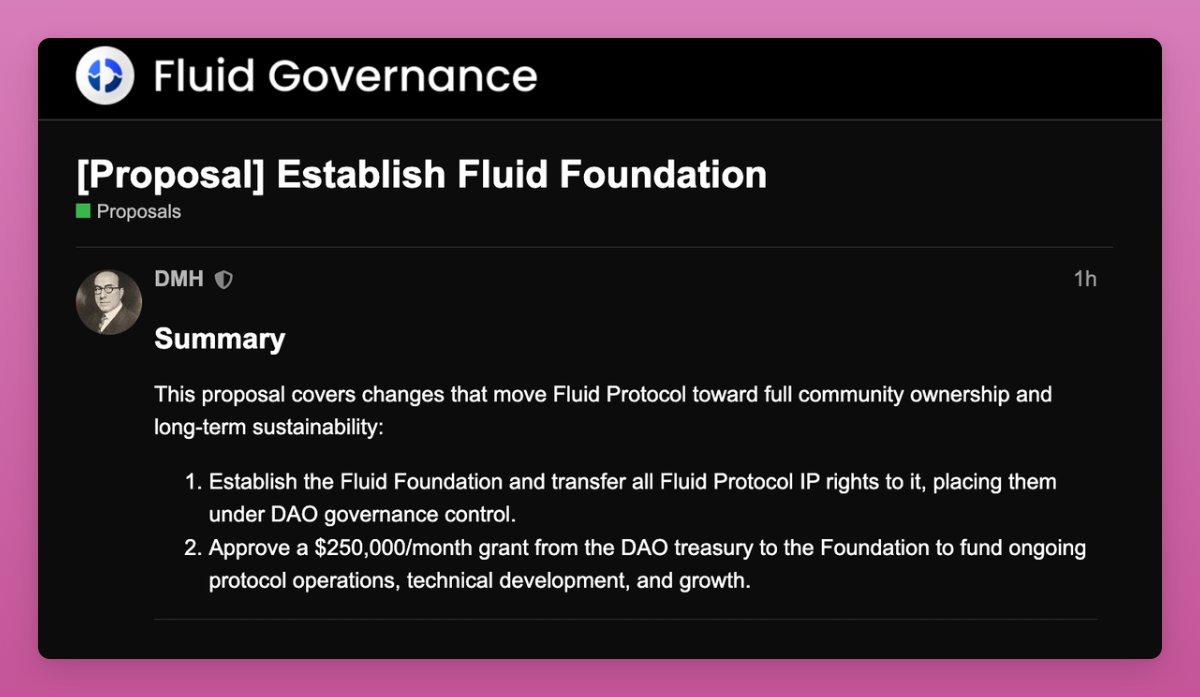
Fluid to launch a Foundation that owns all IP: smart contracts, frontend, brand, trademarks etc.
The Foundation is a Cayman non-profit with no owners. Token holders have ultimate authority.
Aave Labs, too, recently proposed to give ownership to a Foundation entity yet it's not voted yet.
As a Fluid delegate, I will obviously vote yes.
@MattFiebach The issue for chains is that it’s a buyer’s market for liquidity.
There are dozens of L1s/L2s desperate for volume, but only one Uniswap. When you have that much of an oversupply of blockspace, the L1s lose all their negotiating power.
@FrancescoRenziA I see the threat to consulting, but wouldn't AI actually lean into open-source more?
It feels like we’re heading toward a world where demand for OSS hits an all-time high, even as the traditional paths to monetize it disappear.
@VitalikButerin I wonder if there is an allegory here to home staking but for ai
Eg instead of these mega data centers, ai is hosted by the people, for the people.
If you thought FarmVille’s platform risk with Facebook was bad, just wait until you see the leverage frontier labs are about to have.
https://t.co/ouQx68mRYi
Frontier labs are about to close ranks and the dynamic pulling openweights up to the frontier is about to shut off. Almost all AI strategy and commentary over the last 6 months has assumed close-to-frontier base models would continue to be available as open weights, indefinitely. There is consequently an enormous and growing class of companies building custom models, offering RL-as-a-service, running enterprise fine-tuning, deploying adapted models for specific verticals - whose entire business depends on that single assumption being true. At the sovereign level entire countries have adopted a strategy that implicitly assumes there will consistently be free and guaranteed access to good models. The one country that internalised this risk acted immediately is China which is ironic given they're the ones producing all the openweight models. There is systemic, ecosystem-wide platform risk that very few of people have priced in or even considered.
It is not sufficient to decentralize the compute or decentralize the inference we need an entire new model supply chain outside of both corporate and state control. We have now spent a year developing the core primitives to allow a third path here; open model development not dependent on continual open-weight releases, or the benevolence of the frontier labs. Subspace Networks allow us to train models over large swarms of consumer compute anyone have access to. Unextractable Protocol Models then prevent weight extraction from this swarm. The models can be developed in the open, while still being monetised and co-owned by many. it is the only realistic soln anyone has proposed to avoid the massive consolidation that is about to occur. This required research advances to do - all of which have been published at the highest levels in the AI literature. If this is important to you, which it should be to everyone, participate in the training runs we are carrying out this year.
We _can_ definitely build these but imo the question of our time is can cybernetic systems that are by and for the people **win** and build better products and services than corporate slop.
imo
the question of our time is
can we build cybernetic systems that are by and for the people? can we counter the top down power of corporations and governments?
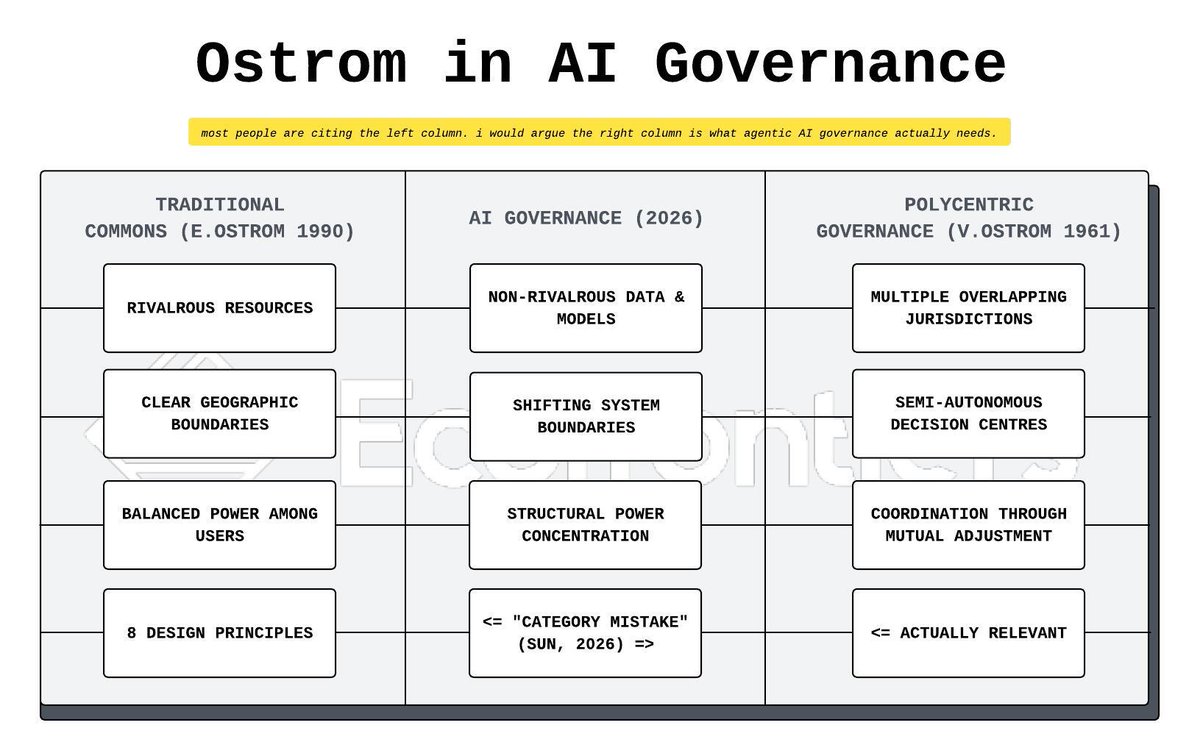
1/ lots of folks in AI governance are citing Ostrom right now.
but most are citing the wrong Ostrom.
here's why that matters for governing autonomous agents 🧵
Vibes in Denver seem pretty good?
At Devconnect ARG in the fall, people were clinging to dead narratives. Now it feels like acceptance, and a focus on what’s working and what’s still possible.
AI agents might be the first exciting new vertical since DeFi.