Look, bro. #Bitcoin is a mathematical inevitability, not a mere investment. You are guaranteed to get rich - barring a black swan like someone breaking BTC encryption. I wouldn’t waste time worrying about that anymore than asteroid collisions. The only real threat? Your own impatience.
You just have to have the iron resolve to HODL beyond a few weeks. I’ve never encountered an easier way to build wealth that doesn’t require deep knowledge & experience in markets. Whether it takes a year or 5 years, you will get filthy rich just holding as much BTC as you can. The difference between $70K & $50K will appear indistinguishable between the way you now perceive the difference between $7 & $5 from the past.
Never quit as a founder. I’m begging you.
It’s 0 for longer than you’ll ever expect. No momentum. Soul-crushing doubts. Nobody seems to care. Even when it looks like it’s working, it’s not. You keep trying new things. You don’t lose hope.
Then it snaps to 100. You finally find the one thing that resonates. You wake up with more customers than you can handle. Everything is breaking. Momentum keeps building even when you’re not pushing. Something changed.
You didn’t get lucky, you just didn’t leave.
Jensen Huang just had the most important argument in tech on Dwarkesh Patel's podcast. The topic: should the US sell Nvidia chips to China?
Jensen says yes. His reasoning is terrifying — not because he's wrong, but because he might be right.
Dwarkesh's argument is intuitive and clean. American export controls limit China's access to advanced chips. Less compute means China trains weaker models. Weaker models mean the US maintains its AI advantage. Don't sell them the tools to beat us.
Jensen's counter demolishes the premise.
"Their AI development is going just fine. The best AI researchers in the world, because they are limited in compute, also come up with extremely smart algorithms. DeepSeek is not an inconsequential advance."
DeepSeek proved the thesis wrong in real time. China, constrained by export controls, didn't fall behind. It innovated around the constraint. Built more efficient architectures. Trained competitive models with less compute. The export controls didn't create a capability gap. They created an efficiency gap — in China's favor.
Jensen's actual fear isn't that China builds good models. It's that China builds an entire tech stack that doesn't include Nvidia.
"The day that DeepSeek comes out on Huawei first, that is a horrible outcome for our nation."
This is the kill line. Jensen isn't worried about China having AI. He's worried about China having AI that runs on Chinese hardware. Because if China's models optimize for Huawei chips instead of Nvidia chips, and those models are open-source, and they diffuse to every country in the Global South — India, the Middle East, Africa, Southeast Asia — then the entire world's AI stack runs on Chinese infrastructure. Not American.
Computing ecosystems are sticky. Jensen compared it to x86 and Arm — architectures that persist for decades because switching costs are enormous. If the developing world builds its AI infrastructure on Chinese chips running Chinese models, that's a lock-in that lasts a generation. America doesn't just lose the Chinese market. It loses every market that China reaches first.
Dwarkesh pushed back: Tesla sold EVs to China and China still built its own. iPhones are sold there and Chinese smartphones dominate. Why would chips be different?
Jensen's response: "We are not a car. Computing is not like that. There's a reason why x86 still exists."
He's right. You can switch car brands overnight. You cannot switch computing architectures without rewriting your entire software stack. The lock-in is structural, not preferential.
"China is the largest contributor to open source software in the world. China's the largest contributor to open models in the world. Today it's built on the American tech stack, Nvidia's. Fact."
Today. Built on Nvidia. But export controls are pushing China to build its own stack. And once that stack exists and open-source models are optimized for it, the migration away from Nvidia becomes irreversible.
Jensen's prediction: "In a few years, when we want American technology diffused around the world — out to India, out to the Middle East, out to Africa — I will tell you exactly about today's conversation, about how your policy caused the United States to concede the second largest market in the world for no good reason at all."
The CEO of the most important semiconductor company on earth is telling US policymakers that export controls are achieving the opposite of their intended effect. Not weakening China's AI. Strengthening China's incentive to build a competing ecosystem that eventually replaces American technology globally.
This is the Renault problem applied to chips. You can't protect your position by refusing to compete. You can only accelerate your competitor's motivation to replace you.
The most dangerous export control isn't the one that fails to stop your adversary. It's the one that succeeds in making them build something better without you.
570 million people trust Tether. Now, we’re putting that global infrastructure directly into your hands. 🌐 Meet Tether Wallet: the fully self-custodial app designed for everyday life.
▪️Universal: 💸 USD₮, USA₮, XAU₮, & Bitcoin (On-chain + Lightning⚡).
▪️Simple: Send to @tether.me username with 1 QR code across all networks.
▪️ Secure: You own your keys, safely backed up to your cloud.
The People’s Wallet is officially live.
Download it now: https://t.co/PV8eUSCwP8
❤️🔥 Just Recorded a 16 min Tutorial on How to use Gemini 3.1 + Seedance 2.0 Build Cinematic $10k Websites (step-by-step)
You can now build stunning marketing sites fully with AI
This 1 hour MIT lecture by Jim Simons (Quant King) will teach you more about quantitative trading than most people learn in their entire career at Wall Street.
Bookmark this & watch, no matter what. It’s the most productive start you can give your week. Then read article below.
High-agency people seem to have this weird immunity to embarrassment.
Getting rejected? Not embarrassing, that’s just data collection.
Looking naive? Not embarrassing, that’s just information asymmetry you’re fixing.
Breaking minor social rules? Not embarrassing, most rules are just Schelling points anyway.
What would be embarrassing to them is not trying. That’s the thing they can’t live with.
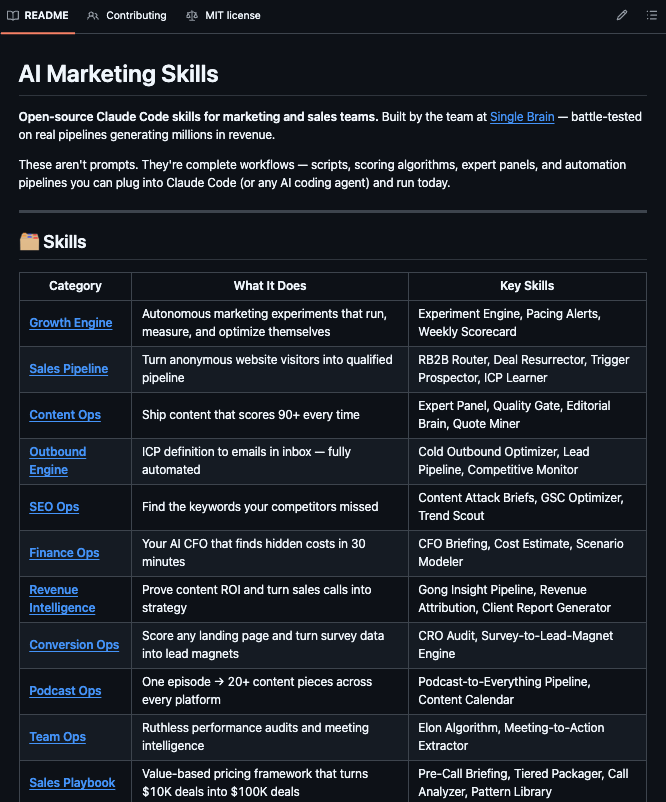
🚨BREAKING: The team behind a marketing agency generating millions in revenue just open sourced their entire Claude Code skill set for growth experiments, sales pipeline, content ops, outbound, SEO, and finance automation.
It's called AI Marketing Skills and these are not prompts or toy demos. They are complete Python workflows with real statistical methods, scoring algorithms, expert panels, and automation pipelines that you drop into Claude Code and run against live business operations today.
The Growth Engine skill uses bootstrap confidence intervals and Mann-Whitney U tests on marketing experiment results, which is actual statistics, not vibes.
The Deal Resurrector tracks contacts who leave companies and routes outreach to their new employers automatically.
→ Expert Panel skill recursively scores content with domain-specific personas until quality hits 90 or above
→ ICP Learner rewrites your ideal customer profile automatically based on actual win and loss data
→ RB2B Router does intent scoring, seniority dedup, and agency classification before routing to outbound sequences
MIT License. 100% Opensource.
Link in comments.
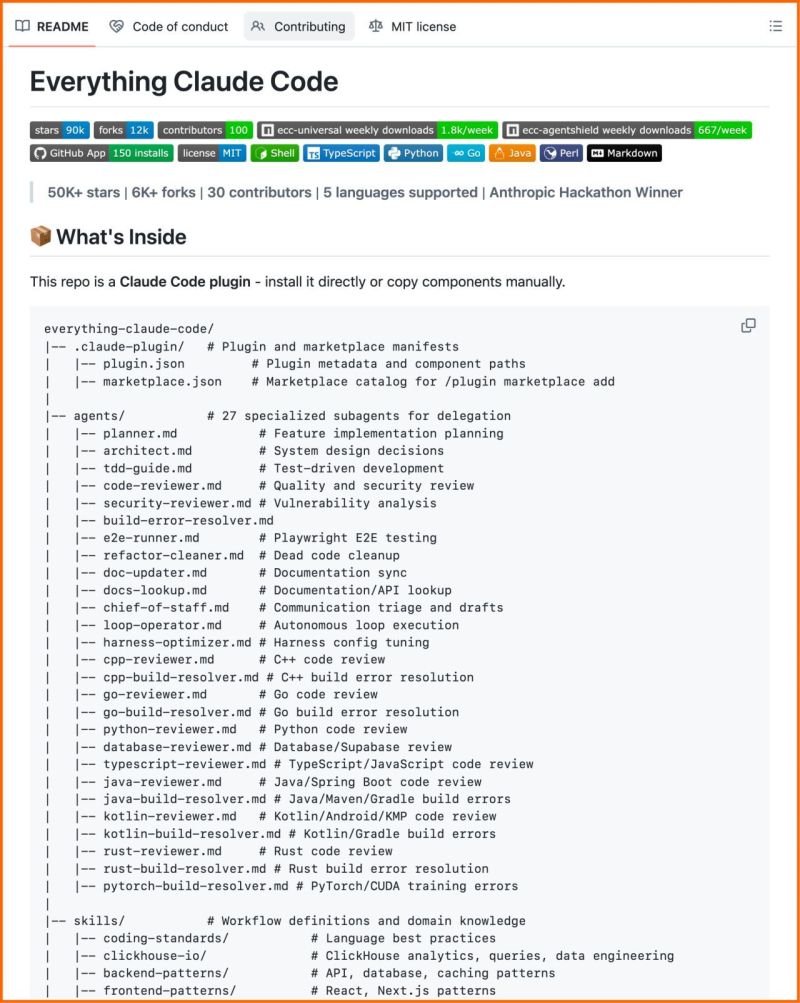
This is the most complete Claude Code setup that exists right now.
27 agents. 64 skills. 33 commands. All open source.
The Anthropic hackathon winner open-sourced his entire system, refined over 10 months of building real products.
What's inside:
→ 27 agents (plan, review, fix builds, security audits)
→ 64 skills (TDD, token optimization, memory persistence)
→ 33 commands (/plan, /tdd, /security-scan, /refactor-clean)
→ AgentShield: 1,282 security tests, 98% coverage
60% documented cost reduction.
Works on Claude Code, Cursor, OpenCode, Codex CLI. 100% open source.
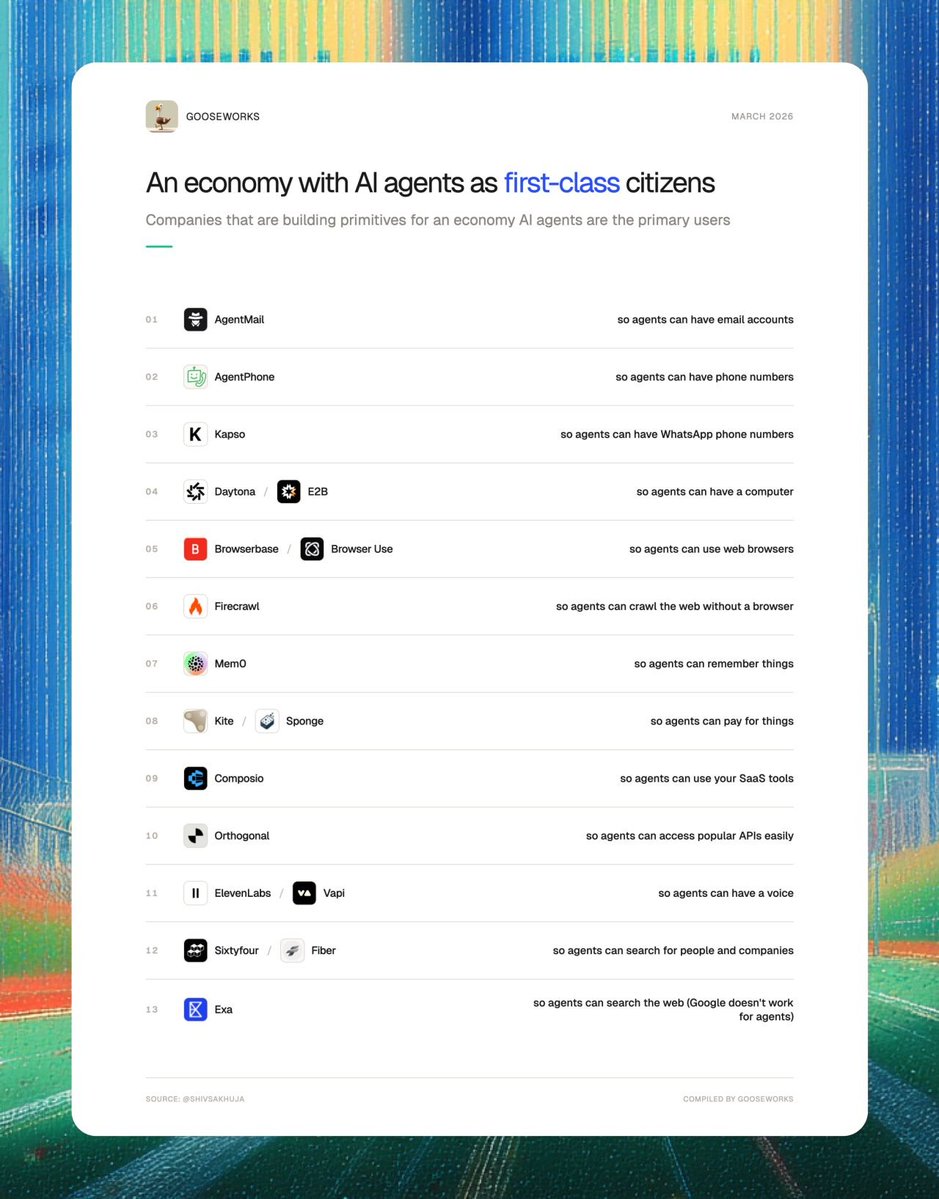
Lots of companies are now building primitives for an economy where AI agents are the primary users instead of humans.
They're betting on an economy of AI coworkers.
1. AgentMail (@agentmail): so agents can have email accounts
2. AgentPhone (@tryagentphone): so agents can have phone numbers
3. Kapso (@andresmatte): so agents can have WhatsApp phone numbers
4. Daytona (@daytonaio) / E2B (@e2b): so agents can have their own computers
5. Browserbase (@browserbase) / Browser Use (@browser_use) / Hyperbrowser (@hyperbrowser): so agents can use web browsers
6. Firecrawl (@firecrawl): so agents can crawl the web without a browser
7. Mem0 (@mem0ai): so agents can remember things
8. Kite (@GoKiteAI) / Sponge (@PayspongeLabs) : so agents can pay for things.
9. Composio (@composio): so agents can use your SaaS tools
10. Orthogonal (@orthogonal_sh) so agents can access APIs easily
11. ElevenLabs (@ElevenLabs) / Vapi (@Vapi_AI) so agents can have a voice
12. Sixtyfour (@sixtyfourai) so agents can search for people and companies.
13. Exa (@ExaAILabs): so agents can search the web (Google doesn’t work for agents)
If you stitch all of these together, you get a digital coworker that looks more human than AI.
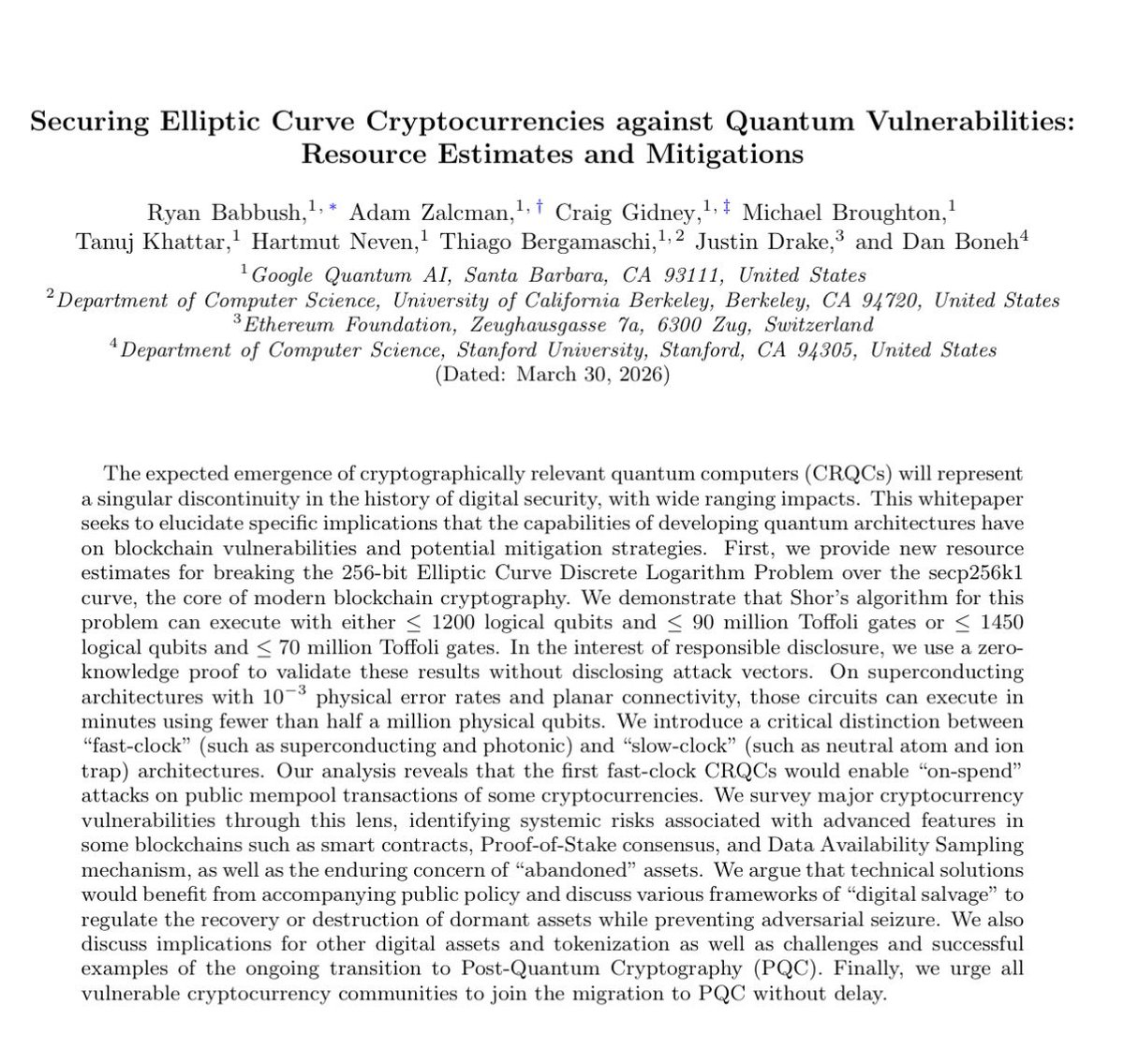
Six years ago it we thought it'd take 10 million qubits to break any Bitcoin public key.
Four years ago it was 2 million qubits.
16 hours ago Google published a paper showing it can be done with 500,000 qubits in 20 minutes.
Race is on. Top prize?
$76 billion: Satoshi wallet
⚡️This is the moment the model gets hands.
That is the real threshold.
Once an AI can see the screen, move the cursor, type, navigate software, and execute workflows across arbitrary apps, the whole game changes. The limiting factor stops being language quality. The limiting factor becomes agency. Can the model actually do the work, not just describe it.
That is why this matters so much. The modern office is already a robot environment. Buttons, forms, dashboards, tabs, permissions, drop-downs, inboxes, calendars, CRMs, spreadsheets, admin portals. Humans were the temporary glue holding all that fragmented software together. The moment an AI can operate the same interfaces, a huge amount of white collar labor becomes directly attackable without waiting for every company in the world to rebuild its stack.
A lot of “knowledge work” was never pure insight. It was operational stitching. Open this. Copy that. Check this field. Schedule that meeting. Move this information between systems. Generate the draft. Update the CRM. Reconcile the report. Upload the file. Follow the workflow. Escalate the exception. Once the model can touch the interface, the human integration layer starts getting erased.
The desktop is becoming the first real robot body for AI.
People keep imagining humanoids as the big labor shock. The real labor shock arrives sooner through screens. The average office worker already lives inside a digital box. If the model can act inside that box, it has entered the worker’s physical domain. That is enough to trigger a major compression wave.
The first wave will be supervised agency. One human overseeing multiple agentic processes. One operator managing ten machine clerks. One analyst managing five machine researchers. One coordinator managing twenty machine admins. That still destroys labor demand because the firm no longer needs one human per workflow. It needs one human per cluster of workflows.
That is where the real cull begins.
The next layer is organizational. Middle management, operations teams, chiefs of staff, coordinators, assistants, junior analysts, support staff, back-office processors, internal service functions, all the roles built around moving information through software become vulnerable. Once the CEO, VP, or manager can directly deploy agentic systems into the stack, the argument for multiple relay layers gets weaker fast.
And deep down, this is how bureaucracy starts dying. Through hundreds of micro-automations that remove the need for human routing, human clicking, human follow-up, human translation, human glue.
The deepest part is that capability is no longer the hardest problem.
Trust is.
Who gets permission.
Who watches the model.
Who is liable when it clicks the wrong button.
Who audits what it did.
Who controls the credentials.
Who stops the model from becoming a security breach with a smile on its face.
That is the next battlefield. The winning AI platform will not just be the one that can act. It will be the one enterprises trust enough to let act at scale. Reliability, auditability, security, permissions, rollback, human override, those become more important than one more bump in benchmark intelligence.
So my real view is simple.
This is one of the most important threshold crossings so far.
AI is moving from cognition into execution.
The computer is becoming its robot body.
The office stack is becoming automatable in place.
A massive slice of white collar labor is now in the blast zone.
Once the model can operate the software, the countdown starts.