Uber’s COO has said that it’s getting “harder to justify” its AI costs because there was no way to show a link between AI spend and any meaningful increase in useful features. This is the first time I’ve seen a company say this directly.
https://t.co/xUhZvtpwah
Investing directly in Anthropic’s primary round
vs.
Investing in a triple-layered SPV claiming they have exposure to Anthropic with a 15% upfront mgmt fee + 25% carry fee structure
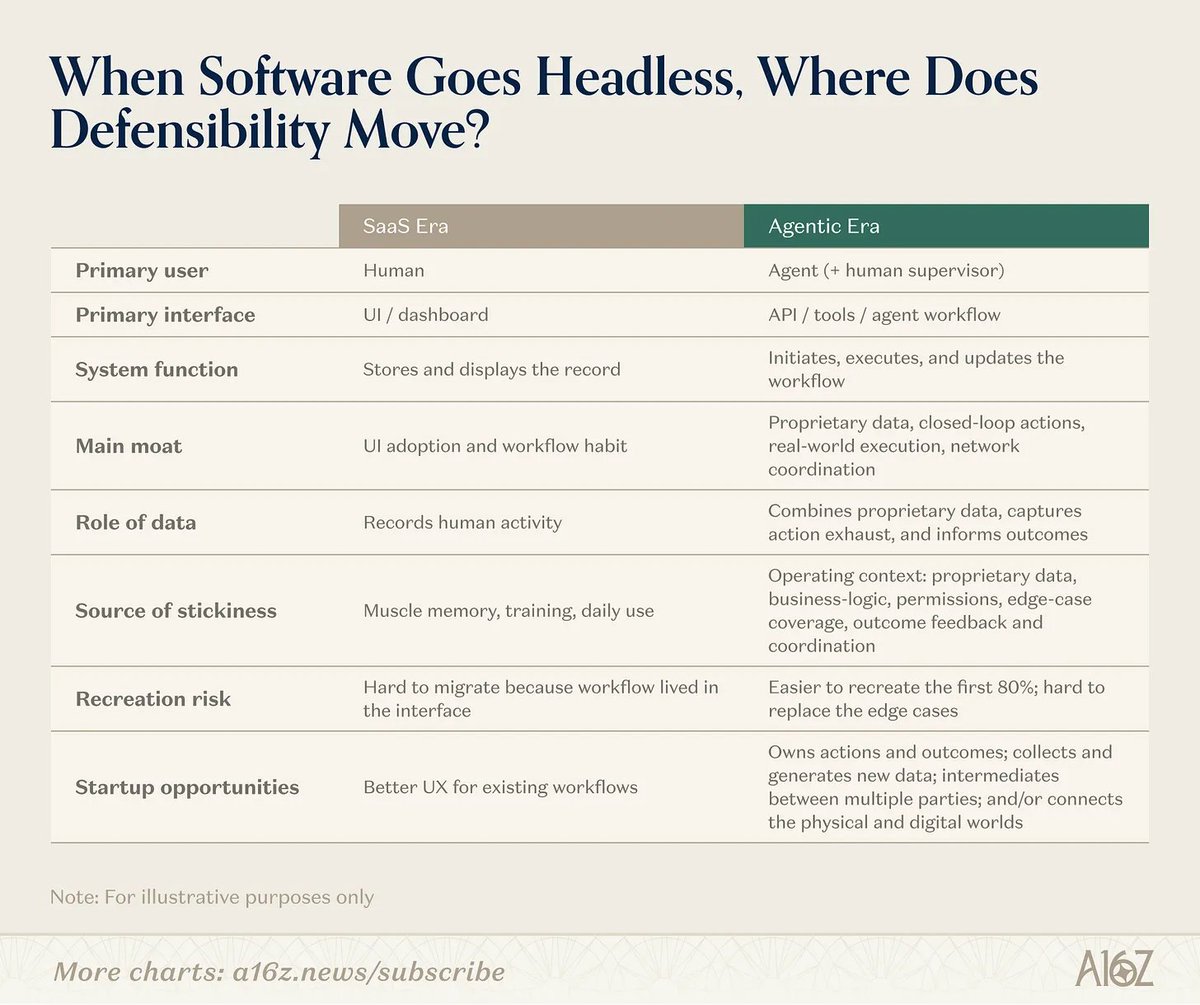
Last month Salesforce announced it would open its APIs and launch a headless product, essentially betting that in an agentic world, its value lies in the data layer, not the UI.
The announcement is a useful prompt for a more interesting question: if you strip away the UI and expose the database, what are you actually left with?
a16z's Seema Amble on where defensibility moves in the agentic era & how businesses will adapt: https://t.co/8hOj26bPuf
This is it.
Everything learned spending millions on longevity.
From: Your Immortal Unc and Auntie.
To: Our Immortal nieces and nephews.
0. Sleep is the world's most powerful drug.
1. Be in your bed for 8 hours
2. Same bedtime every night, any time before midnight
3. Don’t eat right before bed
4. Calm foods for dinner
5. No screens 1 hour before bed
6. Avoid added sugar (be aware it’s in everything)
7. Avoid all things in an American convenience store
8. Avoid fried foods
9. Shoes off at the door
10. Eat whole foods, particularly veggies fruits nuts legumes berries
11. Walk a little after meals or air squats
12. Get your heart rate high routinely
13. Lift heavy things
14. Stretch daily
15. Water pik, floss, brush, tongue scrape, morning and night
16. Make an effort to drink water
17. Get sunlight when you wake up (UV is low)
18. Protect skin in midday sun
19. Stand up straight
20. See at least one friend once a week
21. Avoid plastic where you can (in all things)
22. Circulate air in rooms
23. When stressed, breathe, learn to calm your body
24. Go to the dentist
25. Avoid sitting for long times
26. Protect your hearing, the world is too loud
27. Alcohol is bad for you
28. Finish coffee before noon
29. Avoid bright lights after sunset
30. If obese, look into a GLP
31. Sleep in a cold room
32. Texting while driving is dangerous
33. Turn off all notifications
34. Limit social media use
35. Don’t smoke anything
36. If you struggle to sleep, read a physical book before bed
37. 1 hour before bed have a calm wind down routine: bath, read, light walk, listen to music
38. The body is a clock and loves routine. Have a daily morning and evening schedule.
39. Avoid long distance travel where you can
40. Baby steps first: incorporate new things slowly
41. Do less… most things don’t work.
Bonus points if you get your blood checked.
Start here, it will change your life.
“I’m buying spot Anthropic on the Solana blockchain” has to be one of the funniest phrases I’ve heard this week.
There is nothing spot about this.
Brother you are 4 layers of financial abstraction and broker crime away from touching an actual Anthropic share certificate.
Your “spot” position is a tokenized receipt for possible future economic exposure to a Cayman SPV that owns shares in another Delaware SPV that maybe owns rights to future equity pending transfer approval.
You are approximately Anthropic-adjacent at best
Good Products are Opinionated.
“Every great founder I’ve seen up close, or even from afar, is highly opinionated and they’re almost dictatorial in how they run things.
Also, early-stage teams are opinionated. And the products they build are opinionated. Opinionated means they have a strong vision for what it should and should not do.
If you don’t have a strong vision of what it should and should not do, then you end up with a giant mess of competing features.
@Jack Dorsey has a great phrase: “Limit the number of details and make every detail perfect.” And that’s especially important in consumer products. You have to be extremely opinionated. All the best products in consumer-land get there through simplicity.
You could argue the recent success of ChatGPT and similar AI chatbots is because they’re even simpler than Google.
Google looked like the simplest product you could possibly build. It was just a box. But even that box had limitations in what you could do.
You were trained not to talk to it conversationally. You would enter keywords and you had to be careful with those keywords. You couldn’t just ask a question outright and get a sensible answer. It wouldn’t do proper synonym matching, and then it would spit you back a whole bunch of results. That was complicated. You’d have to sift through and figure out which ones were ads, which ones were real, were they sorted correctly, and then you’d have to click through and read it.
ChatGPT and the chatbot simplified that even further. You just talk to it like a human—use your voice or you type and it gives you back a straight answer.
It might not always be right, but it’s good enough, and it gives you back a straight answer in text or voice or images or whatever you prefer.
So it simplifies what we looked at as the simplest product on the Internet, which was formerly Google, and makes it even simpler. And you just cannot make a product that’s simple enough.
To be simple, you have to be extremely opinionated. You have to remove everything that doesn’t match your opinion of what the product should be doing. You have to meticulously remove every single click, every single extra button, every single setting.
In fact, things in the settings menu are an indication that you’ve abdicated your responsibility to the user. Choices for the user are an abdication of your responsibility. Maybe for legal or important reasons, you can have a few of these, but you should struggle and resist against every single choice the user has to make.
In the age of TikTok and ChatGPT, that’s more obvious than ever. People don’t want to make choices. They don’t want the cognitive load. They want you to figure out what the right defaults are and what they should be doing and looking at, and they want you to present it to them.”
The most efficient distribution is getting users to promote the product as a way of promoting themselves
Especially their (1) achievement, (2) intellect, (3) taste, (4) access, (5) tribe
Examples:
- YouTube play button
- Spotify Wrapped
- Oura sleep score
- GitHub contribution chart
Neuroplasticity looks dull... until it isn't.
Your brain doesn't rewire at networking events, or parties, or instagram. It rewires through boring, repetitive practice. Friday nights spent on "hardcore" problems, repeating, pivoting...
until it clicks.
Had a mentor tell me once: "When you're feeling overwhelmed, there are only two things you should do: get organized and get to work. The rest is just noise. Peace is found in progress."
this is exactly how i’d build wealth with a vertical ai agent startup (without raising VC $$)
step 1: find a boring pain point. something universal, hated, and expensive. think customs paperwork, insurance audits, compliance checklists. the less glamorous, the better.
step 2: map the workflow. don’t brainstorm in a figma file, sit next to the person doing the work. write down every click, every exception, every “this is where it breaks.” the edge cases are the product. gotta be meticulous here.
step 3: do the job as a service. literally run it yourself with a small team. invoice your first customers. this is where you’ll discover what really matters versus what the powerpoint version of the workflow looks like.
step 4: start adding agents to replace the human steps. not all at once obviously, pick one slice of the workflow and automate it. free up hours, prove value, charge more. rinse and repeat until the workflow is mostly agent-driven.
step 5: use the data you collect as the moat. every invoice, form, log, and exception makes your agent sharper. data → better models → stickier product.
and step 0 to be honest, is i'm building an audience along the way. showing my work, sharing the playbook, pulling future customers and talent into my orbit before the product even exists. iterating on 50+ formats and probably doing short-form to start.
the pattern looks the same every time for these types of vertical ai agent startups:
human service → semi-automated service → vertical agent product.
the goal of the agent goes from assisting in the workflow, to owning it.
that’s when you stop being a tool and start being the infrastructure for that industry.
once you own it, you're likely in vc competition territory. but you can compete if your unit economics are solid, audience is cranking and the product is loved.
why build a vertical ai startup now? because the foundation models are good enough (and getting better), the costs are low enough, and the demand for efficiency is high enough.
five years ago the tech wasn’t ready.
five years from now the incumbents will be.
the window is open right now.
it's building season.
Dive into the investment case for Digital Asset Treasury companies (DATs) with Tom Lee (@fundstrat) and @cosmo_jiang!
Learn why DATs may be a more effective vehicle for crypto exposure than owning an ETF or holding the underlying token directly. 🔎📊
Happy Independence Day from the Plume team! 🇺🇸
We had an incredible time last week celebrating our New York office opening at the Empire State Building! The event was a great reminder of our commitment to the US and our mission to bring finance and innovation together. Being headquartered in NYC makes us even more excited and confident about building the future of real-world assets right here in the US.