This is the part most people miss about humanoid robots.
The robot body is only one cost layer.
U.S. teams are spending across:
• Actuators and joint modules
• Dexterous hands with tactile fingertips
• AI software for perception and balance
• Robot learning data from demos and pilots
• Cameras, depth sensors and IMUs
• Onboard compute and control boards
• Battery packs and power electronics
• Manufacturing tools and test rigs
• Safety validation in real environments
That is why humanoid robots are still expensive.
Physical AI is not just code.
It is motors, sensors, hands, batteries, factories and failure testing.
@grok your take about this ??
Aravind Srinivas just explained why China’s open-source AI may become more powerful than ever.
And why Anthropic has lobbied very hard for export control.
"the only reason why there is even a 12-month gap between open source and frontier models is export controls.
But there is a chance that, because of that, they now get really good at the physical layer.
One advantage they (China) have is that they can actually build data centers a lot faster. Power is not a problem. Permits are not a problem. People are not a problem. Labor is not a problem. Expertise is not a problem.
And so, by forcing them to go out there and build all this, you are converting them into a far more potent competitor."
---
From "20VC with Harry Stebbings" YouTube channel (@HarryStebbings ), link in comment
The UK now has 49 Fintech unicorns that are collectively worth over $250bn! 🇬🇧
The UK has created 6 decacorn Fintechs, including some of the most excting fintechs anywhere in the world:
> Revolut, officially worth $75bn but rumoured to be worth $100bn+
> Wise, one of the only public companies, with a market cap of $10-12bn
> https://t.co/GqyoOlEW3Z, recently valued at $12bn in a share buy back
There's also a BUNCH of amazing sub-10bn companies out there e.g. Monzo, Starling, Zilch...
In fact the UK is now the Fintech capital of the world now that the US is so AI-focused.
It's also great to see so many of these companies mature. Most of these are now profitable while still growing quickly and many are thinking about a potential IPO.
Great data from Olek Skwarczek and the https://t.co/wLnhMRPcfM team
Tianhang is finally on twitter
He was formerly a founding team member and head of RL at Qwen, and leads model training here at FRL / shortcut
He will be posting more on twitter now
Probably the most cracked person i've ever met. Excited for you to see his work soon!
The open vs closed model debate in China is very much alive...and diverging
Alibaba is in one camp. Other labs, particularly neolabs, are in another. ByteDance has been closed this whole time
The boundary of this debate appears to be 1 trillion parameters
I've shared this observation in both my writings and closed-door briefings since my recent China trip
One thing is for sure: No, Chinese labs are not mandated to open source by the government (a misconception I hear a lot...)
You don't understand the current AI race if you don't think about it in terms of compute - and compute clearly distinguishes 3 tiers of companies.
Arthur Mensch, Mistral's CEO, recently had a hearing at the French Assemblée Nationale. He elegantly framed the AI race as a compute issue, where sovereignty would be ~"the ability to get leverage along the AI value chain" from electrons to tokens.
He also provided numbers (in MW) for Mistral's available compute : I was surprised at how low these numbers were compared to the gargantuan numbers touted by US labs.
So I ran the numbers, based on the recent and excellent @EpochAIResearch study, adding in my (not that reliable) AI-powered estimates of Chinese compute (see assumptions in blog post).
And I found out that there are 3 quite separate tiers.
1. US Champions are really far ahead. Anthropic, OpenAI and Google each command multiple gigawatts (OpenAI ~15 GW once you count the Stargate/Azure/Oracle capacity it rents). Ever wondered why their Claude/GPT /Gemini consistently top benchmarks? Now you know. By the way, tick in Meta and xAI and you'll see them entering tier 1 too with their recent buildouts.
2. Chinese giants scale fast. Alibaba, ByteDance, Tencent, Huawei and the three state telcos are racing from hundreds of MW toward multi-GW, increasingly on domestic Ascend silicon and the national "East Data West Compute" grid. They report "computing power" in EFLOPS rather than MW, so their points here are estimates, could be quite off the mark.
3. The contenders. Europe's Mistral commands ~90 MW today and aims at 1 GW by 2029, an order of magnitude behind the leaders. Interestingly, some of the best Chinese labs (DeepSeek, Moonshot, Zhipu, MiniMax) have no longstanding compute : they are pure-play : they rent or get allocations from government capacity for specific efforts. DeepSeek (~90 MW, the only one of this category that owns its cluster) is the largest.
With all that said, I hope someday someone in Europe wakes up to the absolute necessity of building compute faster than we do today.
If you want to go inspect the graph, I've got the interactive version and full sources in my blog post, link below.
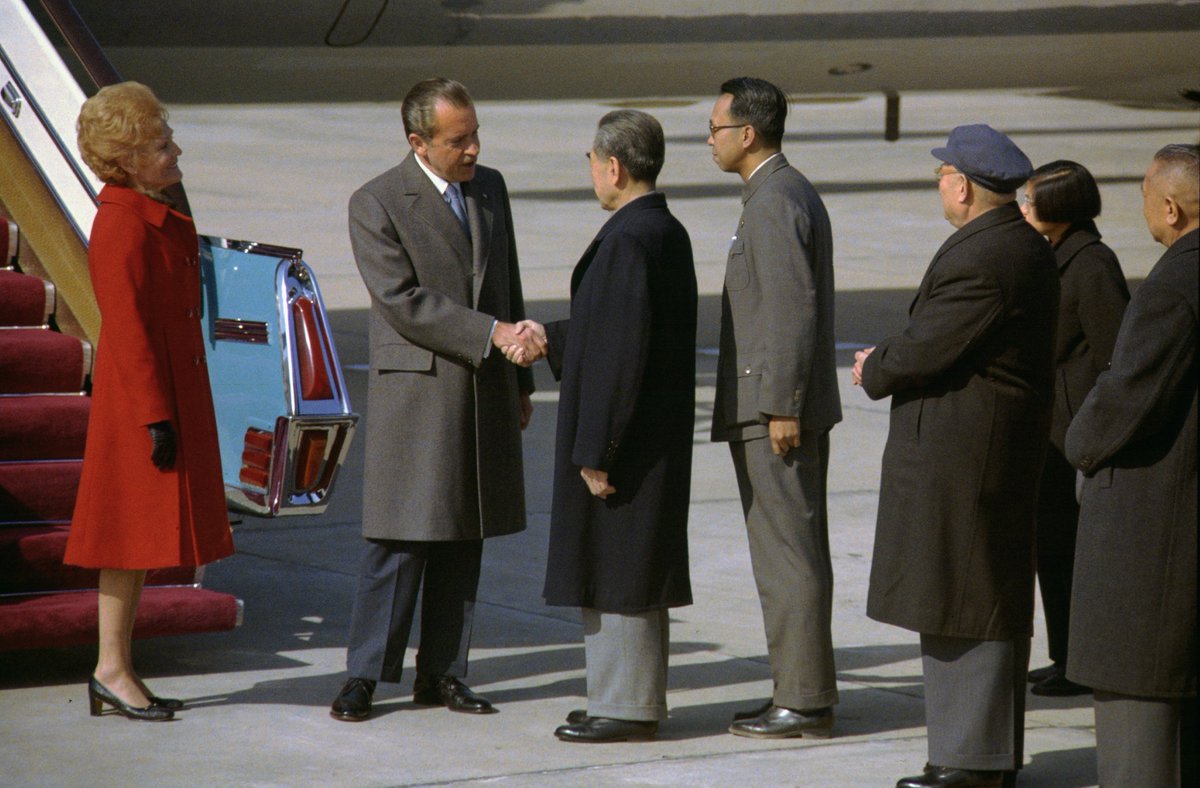
In 1972, Nixon did not fly directly to Beijing.
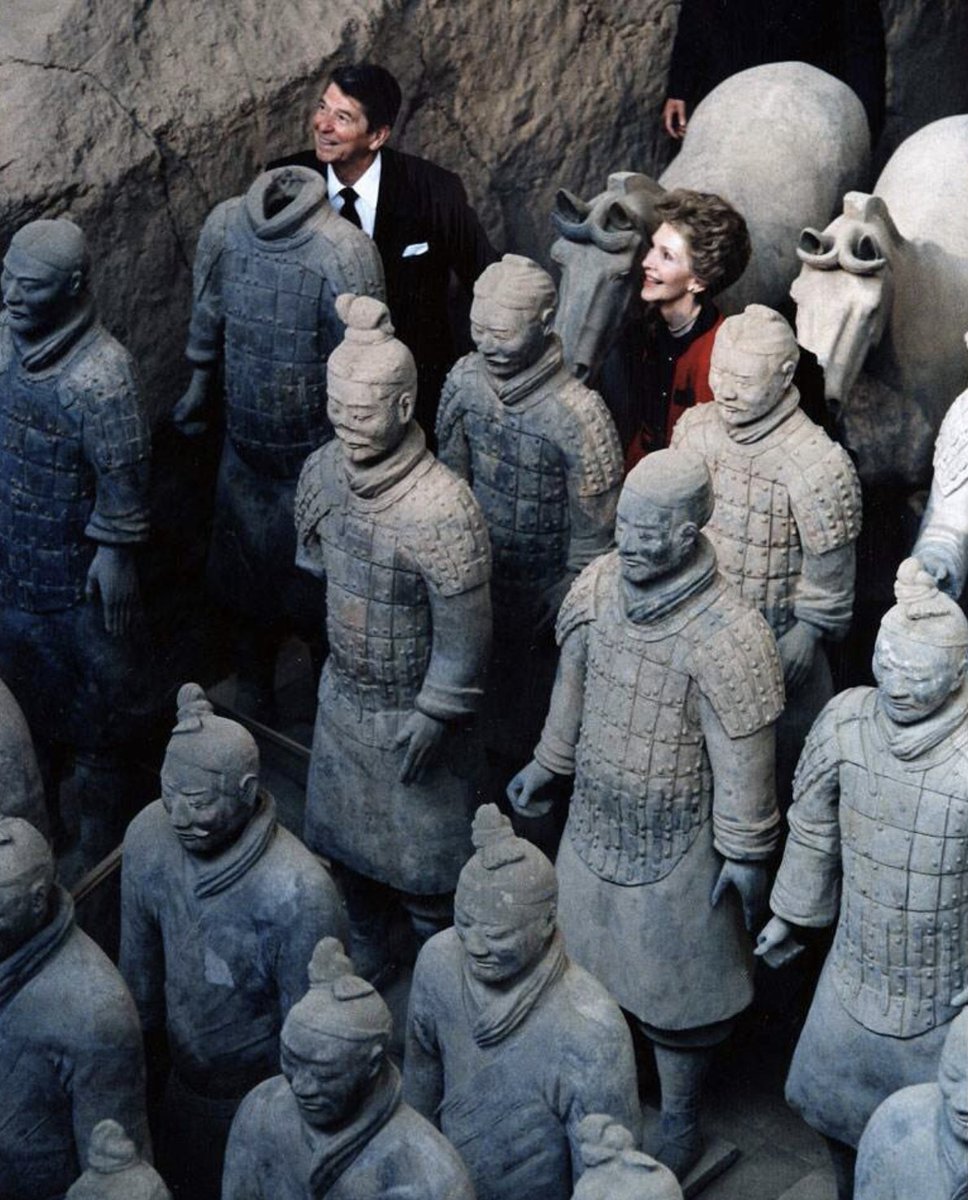
In 1984, neither did Reagan.
Before actually arriving in China, both presidents stopped somewhere across the Pacific to rest, read briefing materials, and adjust to the time difference.
These seemingly minor travel details are precisely among the most fascinating parts of the history of China-US relations.
I once visited the Nixon and Reagan Presidential Libraries, where I reviewed and researched many declassified files related to their China and Japan policies. The archives contain countless moving historical details, which I would be happy to share gradually if people are interested.
These are the schedules I photographed at the time for President Nixon's visit to China in February 1972 and President Reagan’s visit to China in April 1984.
President Nixon first arrived in Honolulu on February 17, 1972. There, at a Marine Corps camp, he spent two days reading briefing materials with his wife Pat. They were extremely thick, almost like dictionaries, covering all kinds of background information and analysis about China. They even included dozens of mock scenarios for questions from reporters, along with A/B/C-style response options for each one.
On February 19, Nixon flew to Guam. After spending one night at a naval residence there, they flew to Shanghai on February 21. Following a brief tea break at the terminal, Nixon took off again for Beijing, arriving shortly after 11 am that day.
It was then that he had the handshake with Chinese leaders that crossed the Pacific and changed history.
Reagan's itinerary was equally fascinating.
On April 18, 1984, he was still busy in DC with meetings, phone calls, and briefings, and even got a haircut at the barber shop. He also called Nancy in LA but was too busy to complete the chat. In his diary that day, he described it as "a busy time tying up loose ends," and ended the entry with: "back to packing."
On April 19, he first flew to Seattle, where he met with several business executives, including people whose companies were doing substantial business with China. Even today, Seattle remains one of the cities in the United States most closely connected to China through trade and commerce.
That evening, Reagan flew to California, where he reunited with Nancy. The two spent two days resting at the ranch, riding horses and cutting wood, getting recharged.
On April 22, they flew to Hawaii and stayed at the Kahala Hilton. Nancy, who wanted to swim in the ocean, borrowed a villa so she could enjoy swimming without being followed by the press.
On April 25, they flew to Guam and stayed at the former residence of Admiral Nimitz. The following afternoon, at 1:35 p.m., Reagan arrived in Beijing and immediately went to the Great Hall of the People to attend the welcoming ceremony hosted by the Chinese president.
That evening, at the Diaoyutai State Guesthouse where Reagan was staying, the Chinese side served a 12-course dinner. Reagan wrote in his diary:
"We heeded Dick Nixon's advice & didn't ask what things were-we just swallowed them...We both did well with our chopsticks."
Nancy told the press that, for this trip to Asia, she and Reagan followed a "feast-and-fast" diet recommended by the White House physician to help adjust to jet lag. For example, on one day she ate only clear soup, fruit, and a salad; the next day, she had macaroni and cheese, baby corn, and blackberry pie.
To prepare for the China trip, she also spoke by phone with former First Lady Pat Nixon to seek advice, and read a large number of books and articles about China. She said she read everything and there's so much to see because China was so big. She also said she's very excited about the trip, and that the only thing that confused her was the constant time changes while flying across the Pacific.
Nancy hoped to do some shopping in China. In fact, as far as I know, after visiting the Terracotta Warriors, she did buy several small ornaments at a Chinese free market and used them to decorate that year's Christmas tree.
Judging from the archives, neither Nixon nor Reagan flew directly to China, and neither did Trump. The first two presidents stopped in Hawaii and Guam to rest and adjust. According to posts by @EricTrump and White House reporter @Emilylgoodin, President Trump stopped briefly in Alaska for refuel this time on his way to China. In 1984, Reagan also made a brief stop there on his way back to the United States from Shanghai.
The details preserved in these records often speak more powerfully than grand narratives.
Beyond presidential aircraft, state banquets, handshakes, and formal meetings, there were also ordinary moments: packing luggage, adjusting to jet lag, learning to use chopsticks, cutting wood at the ranch, and buying Christmas tree ornaments in front of the Terracotta Warriors.
History is never made only of statements, communiques, and strategic calculations. It also lives in these small moments of human warmth, hesitation, curiosity, and exploration.
We've had ups and downs over the past decades. But when we look back at these archives, we may find that what moves history forward is often not fear or hostility, but those who are willing to cross the Pacific, walk toward one another, and try to understand each other anew.
Perhaps today's world still needs that kind of courage.
Elon Musk just defended America better than every politician in Washington combined.
Musk: “After World War 2, the US could have basically taken over the world and any country. Like we got nukes, nobody else got nukes. We don’t even have to lose soldiers. Which country do you want?”
One nation on earth held a weapon nobody else had.
Total dominance. Zero competition. No risk of retaliation.
Every empire in history that held that kind of advantage used it.
Rome. The Mongols. The British. The Ottomans.
They conquered until they collapsed.
America had a bigger advantage than all of them combined.
And it rebuilt the countries it just defeated.
Musk: “The United States actually helped rebuild countries. So it helped rebuild Europe, it helped rebuild Japan. This is very unusual behavior, almost unprecedented.”
Almost unprecedented?
It had never happened before. Not once in 5,000 years of recorded history.
The Marshall Plan wasn’t foreign aid.
It was the most radical act of restraint any superpower ever committed.
America turned its enemies into allies. Turned rubble into economies. Turned surrender into partnership.
Germany went from ashes to the economic engine of Europe in a generation.
Japan went from unconditional surrender to the third largest economy on earth.
Three years after the war, America was flying food into Berlin.
A city in the heart of the nation that just tried to destroy it.
That’s not policy.
That’s a civilization deciding what it is at the exact moment it has the power to be anything.
You’re being told a story right now.
That America is the villain of history.
You hear it everywhere. Media. Universities. Social platforms.
Musk: “There’s always like, well America’s done bad things. Well of course America’s done bad things, but one needs to look at the whole track record.”
Every nation on earth has dark chapters. Every single one.
The difference is what a country does when nobody can stop it.
And when nobody could stop America, it fed its enemies and rebuilt their cities.
Musk: “The history of China suggests that China is not acquisitive. Meaning they’re not going to go out and invade a whole bunch of countries.”
Probably right.
China has historically built walls, not fleets.
But the real question isn’t about borders anymore.
We’re approaching a moment that mirrors 1945 in ways nobody has fully processed yet.
AI is going to give a handful of people a power advantage that makes nuclear monopoly look quaint.
If someone is going to hold that kind of power, who do you want it to be?
The country that conquered when it could? Or the one that rebuilt when it didn’t have to?
Every alliance. Every trade route. Every economy.
Billions lifted out of poverty.
All of it traces back to one act of restraint that had never been done before.
And carries no guarantee of being repeated.
The most powerful thing America ever did wasn’t building the bomb.
It was what it didn’t do after.
New podcast on vibe coding - A Return to Code.
A Return to Coding 00:20
The Personal App Store 03:17
Vibe Coding Is a Video Game with Real-World Rewards 06:22
Pure Software Is Uninvestable 10:33
A Place for Each Model 14:22
AI Is Eager to Please 17:57
Why Math and Coding? 22:10
The Beginning of the End of Apple’s Dominance 24:17
Coding Agents As Customer Service Reps 27:55
Yao Shunyu: OpenAI -> Tencent
Wu Yonghui: Google DeepMind -> ByteDance
Luo Jianlan: Google DeepMind -> AgiBot
Zhou Hao: Google DeepMind -> Alibaba
Driven by a mix of US push and China pull factors. By @zijing_wu https://t.co/NPvdx2yn9W
Just spent a week in China deep diving the general-purpose robotics ecosystem.
Key takeaway: while we’re vibe-coding… China is vibe-manufacturing !
A few things that stood out:
1) China has cracked “vibe manufacturing”
Startups are spinning up hardware like we spin up code.
AGIBot (3 years old) has already built ~10,000 robots.
2) The entire stack is being built in parallel.
Every serious robotics company is full-stack: hardware + controls + foundation models.
3) Data factories are real and massive.
Hundreds to thousands of people teleoperating robots 24/7 to generate training data.
In some cases, the government is literally buying robots, generating data, and selling it back to companies.
4) The supply chain is overwhelming.
Foxconn, BYD, LYitech - everyone is plugged into the same dense, hyper-responsive manufacturing base.
This is why iteration speed is so high.
5) Structural paradox: Labor is both tailwind and headwind.
Cheap, abundant skilled labor powers the supply chain…
But it also makes automation harder to justify domestically.
→ Weak ROI for robotics inside China
→ Strong incentive to export
6) Hardware is impressive. Intelligence is not (yet).
Amazing kinematics—dancing, acrobatics.
But limited ability to execute simple instructions reliably.
7) Everyone is moving up the stack
Every major CM/ODM is building their own robots—humanoids + wheeled.
Today’s suppliers will be tomorrow’s competitors.
8) Dexterity remains unsolved
Lots of prototypes. Very few real demos.
So what does this mean?
Physical AI requires strength in both bits and atoms.
Right now:
China → dominates atoms (manufacturing, supply chain, scale)
US → leads in bits (models, autonomy, software)
We are dangerously behind in atoms.
If we want to compete, incrementalism won’t cut it.
We need to:
- Build depth and breadth across the electro-mechanical supply chain
- Scale CMs / ODMs / JDMs domestically
- Move 100x faster, think 100x bigger on scaling manufacturing infrastructure
Hats off to those doing their part to advance domestic manufacturing supply chain - @makematterco, @VulcanForms, @brightmachines, @thebotcompany@gs_ai_ , @MytraUS, @mind_robotics, @tesla_optimus, @atomic_inc, @Senra_Systems, @pathrobotics, @machinalabs_,@figure_robot, @HadrianInc , @agilityrobotics
CPU vs GPU vs TPU vs NPU vs LPU, explained visually:
5 hardware architectures power AI today.
Each one makes a fundamentally different tradeoff between flexibility, parallelism, and memory access.
> CPU
It is built for general-purpose computing. A few powerful cores handle complex logic, branching, and system-level tasks.
It has deep cache hierarchies and off-chip main memory (DRAM). It's great for operating systems, databases, and decision-heavy code, but not that great for repetitive math like matrix multiplications.
> GPU
Instead of a few powerful cores, GPUs spread work across thousands of smaller cores that all execute the same instruction on different data.
This is why GPUs dominate AI training. The parallelism maps directly to the kind of math neural networks need.
> TPU
They go one step further with specialization.
The core compute unit is a grid of multiply-accumulate (MAC) units where data flows through in a wave pattern.
Weights enter from one side, activations from the other, and partial results propagate without going back to memory each time.
The entire execution is compiler-controlled, not hardware-scheduled. Google designed TPUs specifically for neural network workloads.
> NPU
This is an edge-optimized variant.
The architecture is built around a Neural Compute Engine packed with MAC arrays and on-chip SRAM, but instead of high-bandwidth memory (HBM), NPUs use low-power system memory.
The design goal is to run inference at single-digit watt power budgets, like smartphones, wearables, and IoT devices.
Apple Neural Engine and Intel's NPU follow this pattern.
> LPU (Language Processing Unit)
This is the newest entrant, by Groq.
The architecture removes off-chip memory from the critical path entirely. All weight storage lives in on-chip SRAM.
Execution is fully deterministic and compiler-scheduled, which means zero cache misses and zero runtime scheduling overhead.
The tradeoff is that it provides limited memory per chip, which means you need hundreds of chips linked together to serve a single large model. But the latency advantage is real.
AI compute has evolved from general-purpose flexibility (CPU) to extreme specialization (LPU). Each step trades some level of generality for efficiency.
The visual below maps the internal architecture of all five side by side, and it was inspired by ByteByteGo's post on CPU vs GPU vs TPU. I expanded it to include two more architectures that are becoming central to AI inference today.
👉 Over to you: Which of these 5 have you actually worked with or deployed on?
____
Find me → @_avichawla
Every day, I share tutorials and insights on DS, ML, LLMs, and RAGs.
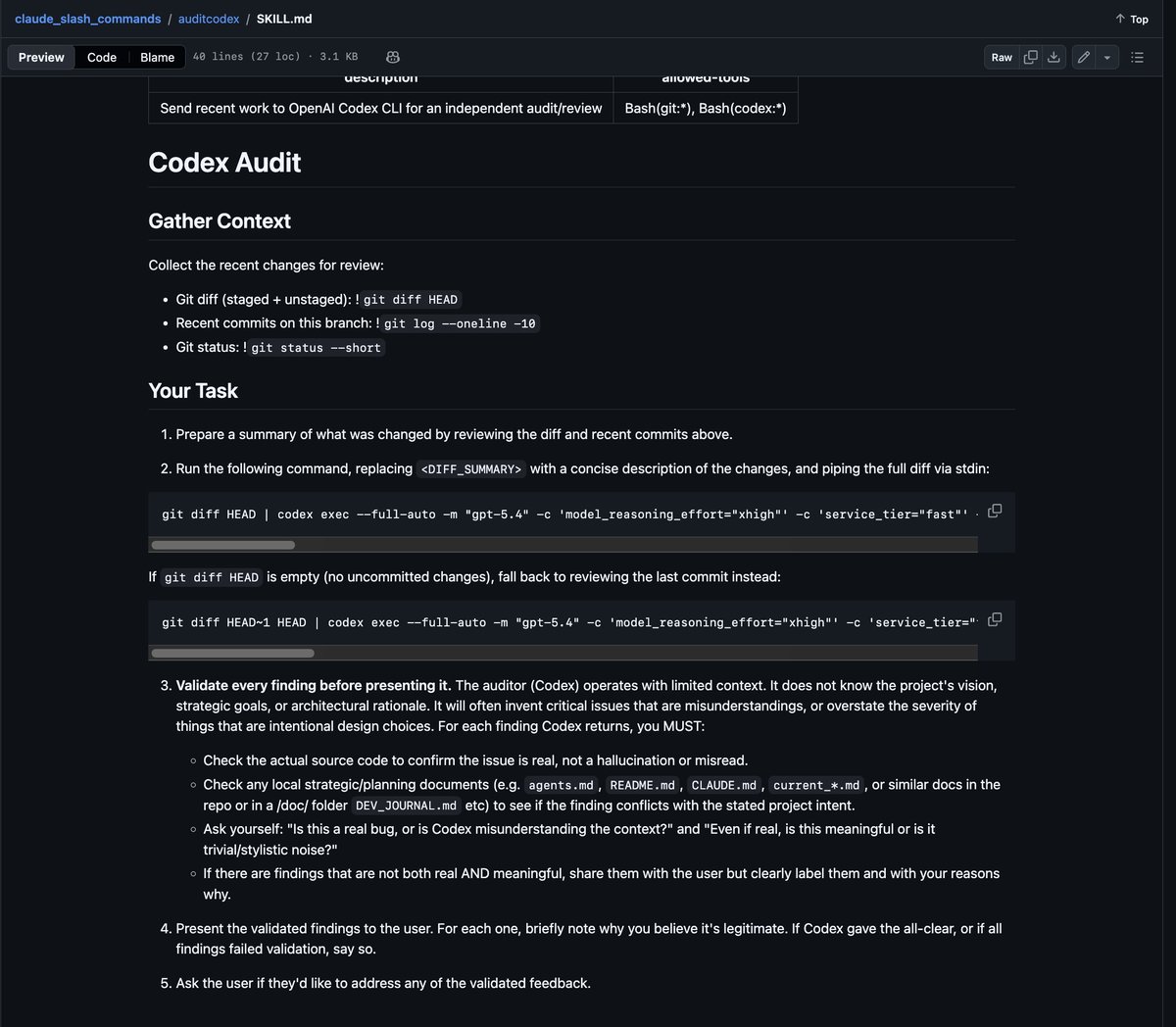
Claude 4.6 is a good programmer but writes insanely severe bugs constantly, it won't catch them all in audits, nor will other claudes
You need codex 5.4 auditing every commit 4+ times. If you don't believe me, try it.
I have an /auditcodex skill for it
https://t.co/vndOL8STML