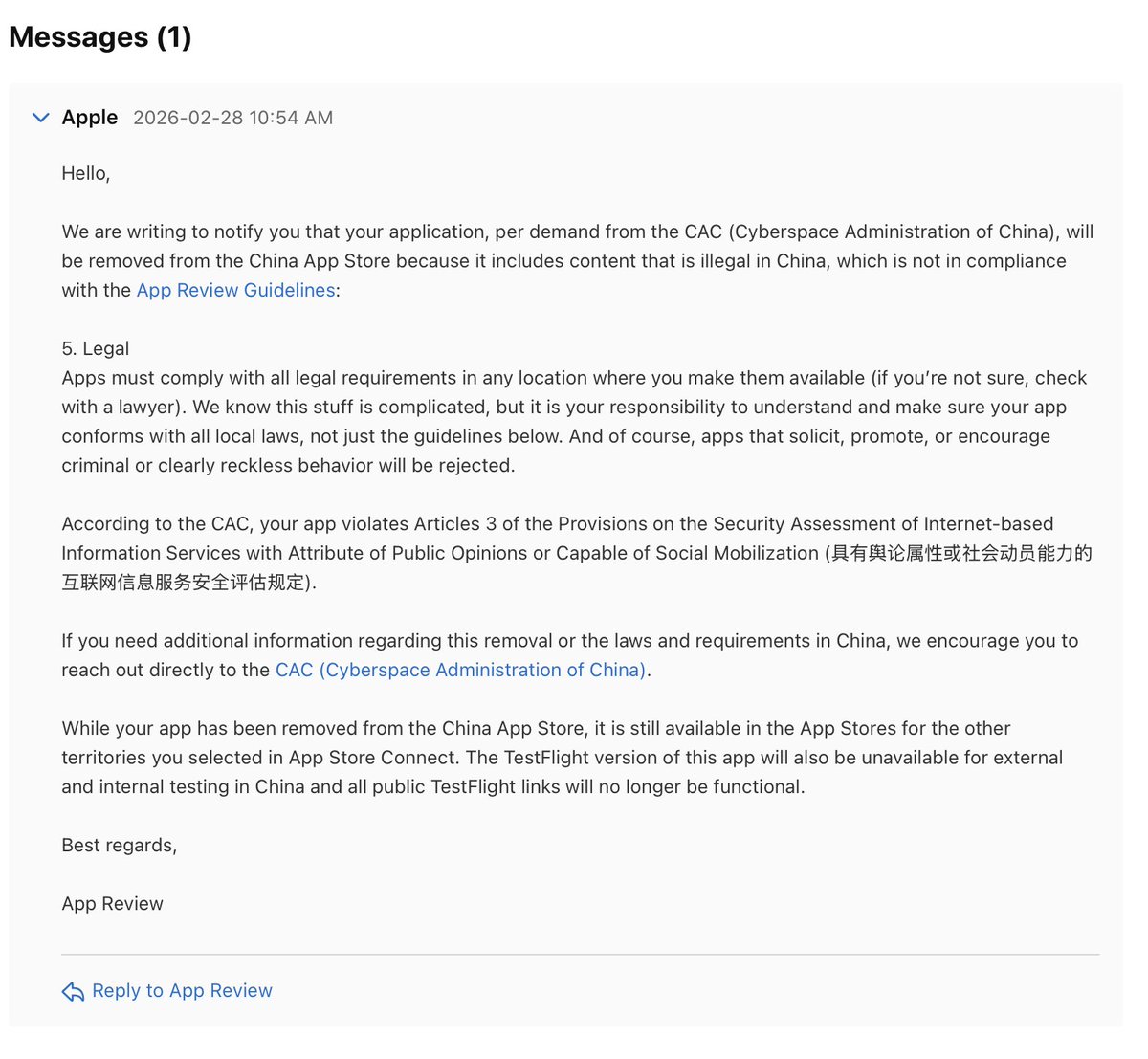
@lekevicius@arcinternet This is cool, been trying it out today. Some of my favorite arc features are “Switch to Tab” and duplicate links opening in the tab I already have open. Do you have any plans to add these?
A French engineer who lives quietly in Paris has spent 30 years writing software that the entire internet now runs on without knowing his name.
He wrote the code that streams every YouTube video, every Netflix show, every TikTok clip. He wrote the code that runs the virtual servers underneath AWS, Google Cloud, and Microsoft Azure. He calculated more digits of pi than anyone in history. He has no Twitter. He has no marketing. He just keeps shipping.
His name is Fabrice Bellard.
Here is the story, because almost nobody outside the systems programming world knows what one man has built.
Fabrice was born in 1972 in Grenoble, France. He studied at École Polytechnique, the top French engineering school. He never went to Silicon Valley. He never built a startup empire. He just wrote code.
In 2000 he started a project called FFmpeg, an open-source multimedia framework for encoding, decoding, and streaming video. He was 28. The project did one thing nobody else had done well. It handled every video and audio format that existed, in one library, on every operating system. He led it himself for years.
Today FFmpeg is the invisible engine of the internet. YouTube uses it. Netflix uses it. VLC uses it. Chrome and Firefox use parts of it. Every Android phone, every iPhone, every smart TV, every video editing tool you have ever touched runs FFmpeg somewhere underneath. If you have watched a video on a screen in the last 20 years, Fabrice's code processed it.
He was not done.
In 2003 he started QEMU, a machine emulator and virtualizer. He wrote it solo until version 0.7.1 in 2005. QEMU lets you run any operating system on any other operating system. It became the foundation of modern virtualization. KVM, the Linux kernel hypervisor, runs on top of QEMU. Every major cloud provider, AWS, Google Cloud, Microsoft Azure, IBM Cloud, runs virtual machines on infrastructure built around it. The Quick Emulator is the most cited piece of cloud infrastructure code on Earth.
He kept going.
In 2001 he won the International Obfuscated C Code Contest with a small C compiler that grew into TCC, the Tiny C Compiler. TCC can compile and boot a Linux kernel from source in under 15 seconds. In 2004 he calculated the most digits of pi ever computed at the time, using a personal desktop computer and an algorithm he derived himself called Bellard's formula. In 2011 he wrote a complete PC emulator in pure JavaScript that runs Linux in your browser, a project called JSLinux that engineers still cannot believe is real.
In 2019 he released QuickJS, a small but complete JavaScript engine that fits where V8 cannot. In 2021 he released NNCP, a neural network based lossless data compressor that immediately took the lead on the Large Text Compression Benchmark.
Then he turned his attention to large language models. He built TextSynth Server, a web server with a REST API for running LLMs locally. He released ts_zip and ts_sms, compression utilities that use language models to compress text and short messages at ratios traditional algorithms cannot reach. He released TSAC, a very low bitrate audio compression system. In December 2025 he released Micro QuickJS, a new JavaScript engine for microcontrollers, separate from QuickJS, designed for environments with almost no memory.
Fabrice co-founded a telecom company called Amarisoft in 2012, where he serves as CTO. Amarisoft builds 4G and 5G base station software used by carriers and labs around the world. He has been running it for over a decade while continuing to ship personal projects from his own home page at bellard dot org
He has no Twitter. He has no Instagram. He gives almost no interviews. His personal website is a flat list of projects with no styling, no fonts, no marketing copy. Just titles and links.
A quiet French engineer who never moved to Silicon Valley wrote the code that quietly runs the internet.
He is still shipping.
I've got an agent in a loop optimizing a renderer with the goal to minimize frame times (and tests to measure). It got times down from 88ms to 2ms and allocations down from ~150K to 500. Sounds good, right? Wrong. This is exactly why agent psychosis is a big fucking problem.
As an experiment, I rewrote the Ghostty core render state in Go, with access to identically laid out data structures as Ghostty and the exact same validation tests. I made a purposely naive renderer (simple, correct, but slow). 88ms per frame with 150,000 allocations (horrendous, lol)!
I then kickstarted a Ralph loop to bring the frame times down. I told it it can't modify input data structures or the public API or tests (they're correct), but it can do anything else it wants. It got to work.
It has worked for about 4 hours. I've spent around $350 on this experiment so far. The results?
88ms => 1.5ms
150K allocs => ~500 allocs
Incredible right? Nope.
My hand-written renderer I ported has frame times (same benchmark) of ~20us (0.020ms) and 0 allocations in the update path.
This is the problem with psychosis and lacking systems understanding. If you don't understand the system, you're going to accept that this is an incredible result. If you understand the system, you'll see better solutions immediately and can do roughly 75x better on throughput.
The people who blindly trust agent output are in the former camp. They're sheeple, overdrinking from a fountain of mediocrity.
Standard disclaimer: I use AI all the time. I like AI. The point I'm making is to not blindly accept results. Think. Analyze. Learn.
@0xQuit In my mind, seems closer to:
A car company sells you a car and the manual says “obey speed limits.” You get in an accident going over the speed limit, and it’s fatal because your seatbelt malfunctions. You shouldn’t have been speeding, but you’d also expect the seatbelt to work
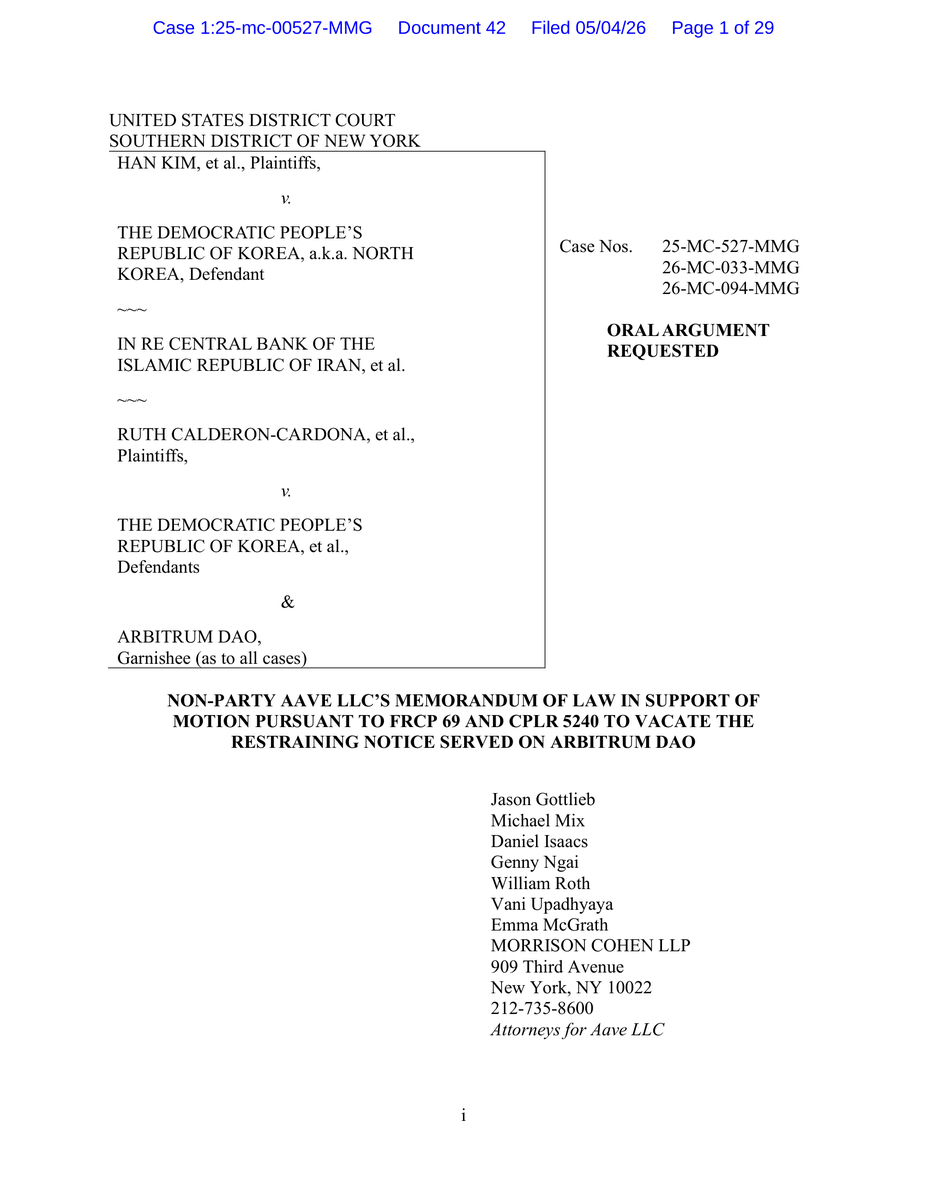
Aave LLC has filed an emergency motion to vacate a restraining notice served on Arbitrum DAO on May 1, 2026 that attempts to seize approximately $71 million in ETH belonging to victims of the April 18 exploit.
A thief does not gain lawful ownership of stolen property simply by taking it, and the law is clear on this. Those assets were recovered to be returned to users victimized in the April 18, 2026 exploit. Freezing them harms the very people this recovery effort is designed to protect.
We’ve asked the court for an expedited hearing and a temporary vacatur, and we are continuing to work alongside the Arbitrum community and DeFi United to make affected users whole.
Wild story unfolding around the KelpDAO hack funds frozen on Arbitrum.
Quick context: in April, Lazarus Group (DPRK-linked) hacked KelpDAO for $292M via a LayerZero bridge bug. Some of the stolen ETH flowed through Arbitrum, and Arbitrum's Security Council froze $71M before the attacker could move it further.
The industry mobilized to recover. Aave, KelpDAO, LayerZero, EtherFi, and Compound co-authored a proposal asking Arbitrum DAO to release the frozen ETH to a multisig that would compensate hack victims. The vote is passing.
Then this week, a plot twist. Lawyers showed up with a restraining order. But not on behalf of the KelpDAO victims.
The plaintiffs are Han Kim and two other groups - family members of people killed in DPRK-backed terrorist attacks years ago. They hold combined ~$877M in unpaid US court judgments against DPRK. North Korea never paid. They have been hunting for any reachable DPRK asset for over a decade.
When Arbitrum's frozen ETH was publicly identified as "DPRK money," they saw a target.
Their argument: this is DPRK property, we have $877M in judgments against DPRK, give us the money.
The counter-argument: DPRK does not actually own this ETH - they stole it. The real owners are the KelpDAO hack victims. The old terrorism creditors are trying to grab money that was never really DPRK's.
Arbitrum is now caught in the middle. The industry wants to release funds for hack recovery. NY court is saying "do not move anything until we resolve this." If multisig signers transfer the ETH while the restraining order is active, they become personally liable.
This is the first real test of DAO funds against competing US court claims. The precedent set here will shape how every future DAO incident response handles legal pressure.
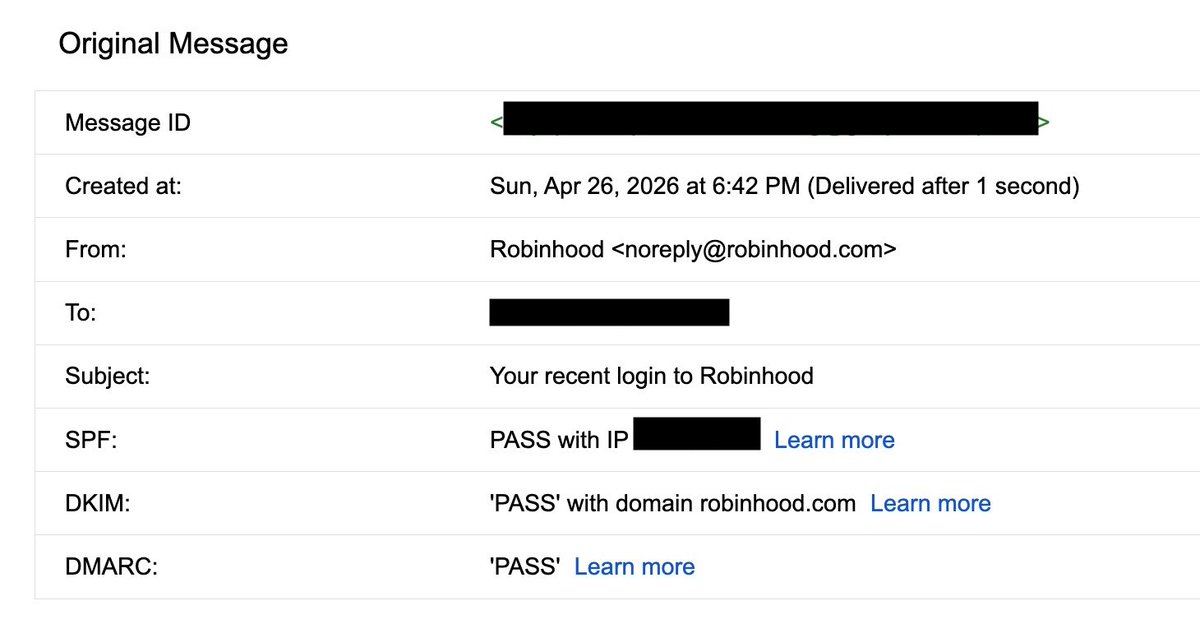
New Robinhood phishing chain that's kinda beautiful:
1. Attacker creates an RH account using the Gmail dot trick of your email (same inbox, different address)
2. Sets device name to HTML
3. RH's "unrecognized activity" email renders the device name unsanitized (html injection)
The result is a real email from [email protected], DKIM pass, SPF pass, DMARC pass, with a phishing CTA
Just because it's real, doesn't mean it's safe... $HOOD
Ghostty is leaving GitHub. I'm GitHub user 1299, joined Feb 2008. I've visited GitHub almost every single day for over 18 years. It's never been a question for me where I'd put my projects: always GitHub. I'm super sad to say this, but its time to go. https://t.co/DQDemHdytV
Your infrastructure was compromised, so own up to it.
"Yeah but we didn't think anyone would RELY on that infrastructure" isn't an excuse
Trust in LZ will tank, and it deserves to, after this.
I feel similarly. We maintain Foundry, which is a fuzzer cosplaying as a day-to-day build tool for EVM smart contracts, primarily used in finance code. Over $100B has been deployed with Foundry. AI means we'll be writing 100x better properties with Foundry. This is very similar to Kleppmann's thesis on AI & the growth of formal verification in the future.
https://t.co/YCbDAt5zwp respect to matplotlib maintainers for their thoughtful engagement here -- but this is one of the most insane interactions i've ever seen