Arc is built for stablecoin-native finance. Chronicle Proof of Asset is live on @Arc from day one to provide the data infrastructure those markets depend on.
Live feeds include CIRBTC/EUR, CIRBTC/USDC, and EURC/USD, with more to come.
I have raised $750M over the last 6 years and my biggest advice to new managers:
The world does not need another fund.
You have to be different.
You have to provide something better or that does not exist.
You are selling a product. Make it stand out.
it honestly makes perfect sense that ct has gone from hating on tradfi (2017) to VCs (2021) to crypto founders themselves (2025).
look around. nearly every found is playing opposite sides in a game, telling VCs how they'll make money from users, and telling users how they'll make money from VC funding.
when you tell users you're giving them value, and then tell VCs that they can extract that value from users, nobody is going to trust you.
because to-date, there have largely been two types of founders.
on the one side, there are the ones who genuinely care about users, and then have to figure out a narrative to sell it to VCs.
and on the other, there are the ones who just want to max token value, and then have to figure out a narrative to sell it to users.
the real issue here isn't the founders forced to play this game. the issue is that this became a game in the first place because token value and utility diverged in such opposite directions. the high-priced tokens have typically benefitted from mimetics, being compared to other products in their category, rather than any intrinsic value. it's gotten to the point that if something is useful, it tends to be worth *less* because it can be valued.
but we also have to understand that the game is changing—rapidly.
the actual winning products and tokens from the past year are the ones that can actually generate revenue. users are so used to having that subsidized by VCs that they call it "extraction"; it feels inconceivable to ct that people would pay for something they like because, well, that's never really been the case in crypto.
but it is the case now. and it means there are exciting things that can be built, that can generate revenue, and that can maybe, just maybe, be fun and interesting and valuable enough that users will actually spend money on them.
which is to say that there is a solution here.
and the solution is apps.
Commerce and the ways brands (have to) engage with their consumers are changing, fast. No one understands this and how to solve for it better than @tyhunnny and the @TYBXYZ team who are enabling community-driven commerce, onchain, today.
https://t.co/tGceRhl7hT
.@maplefinance $SYRUP is a decentralized finance (DeFi) protocol at the intersection of institutional lending and tokenized assets/RWAs.
Learn more about the tokenization of real world assets (RWAs): https://t.co/zE6OgaZNF2
https://t.co/H3PNeallL3
Big congrats to @jai_prasad17, @dennis_qian & the entire @DefinitiveFi on the $EDGE launch today. Powering $bns of trades, and still just the beginning. Positioned to power onchain trading for years to come. Learn more about Definitive and why the alpha is onchain from our team here: https://t.co/Po47NjYWRr
Vlad from Robinhood has me even more hyped on tokenized private companies than I already was.
Got me thinking about the difference between crypto tokens (as incentives on decentralized networks) vs. private company equity.
If you can buy SpaceX secondaries or an L1 token, the L1 might have a tough time competing on cash flow and fundamentals. Or maybe they end up getting valued in totally different ways?
Summary from @vladtenev's conversation with @TrustlessState
1. Vlad is bullish on tokenizing private company equity (e.g., SpaceX, OpenAI).
2. Argues it's crazy that anyone can buy memecoins but not invest in the most important companies of our generation.
3. Tokenizing private securities would:
- Give investors broader access
- Provide liquidity to private companies
- Expand U.S. company dominance globally
4. Robinhood may play a role as a marketplace or issuer for tokenized securities.
5. Tokenization could be an IPO alternative, especially in jurisdictions outside the U.S. first.
DAOs aren't just crypto experiments—they’re the midpoint of AI and crypto.
Bitcoiners introduced the idea, Ethereum scaled it, and AI agents will soon make organizations more autonomous.
The challenge: making sure autonomy stays decentralized, transparent, and human-aligned.
Crypto tokens are a rare tool that lets humans beat social media algorithms.
They align incentives, empower communities, inspire collaboration and create a common purpose and more unified voice for humanity.
They help us fight power centers, together.
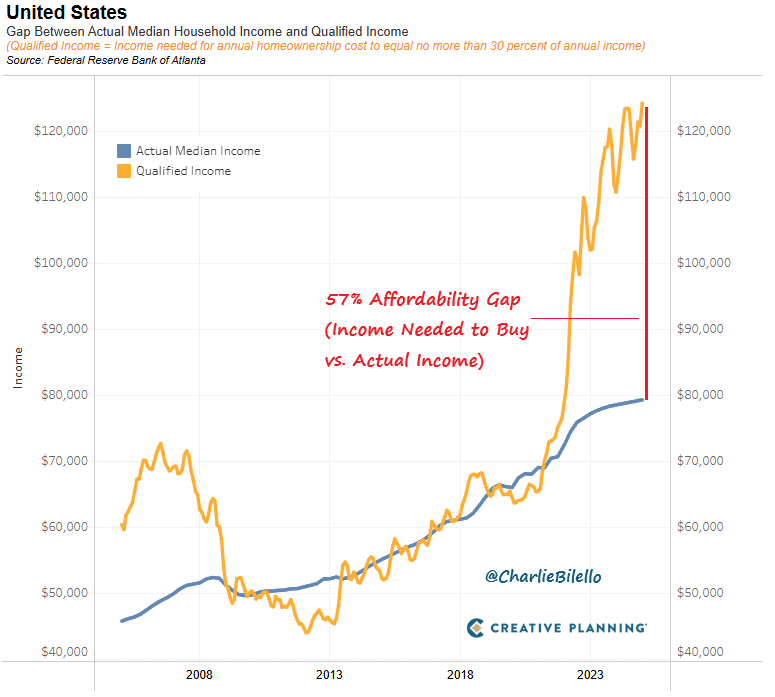
The median household income necessary to purchase the median priced home for sale in the US ($124k) is now 57% higher than the current median household income ($79k). This is the most unaffordable housing market in history.
Video: https://t.co/NvyVPX0NIl
BREAKING NEWS: Global exchange and capital markets giant Intercontinental Exchange (ICE) and Circle moved towards the integration of USDC into their markets products and infrastructure.
In a major development in the stablecoin market, today we announced an agreement with ICE, to explore the integration of USDC and USYC into a broad range of traditional financial markets, exchanges and clearing houses.
The promise of fully reserved digital dollars that can function with the speed and cost efficiency of the Internet has already been realized within digital asset markets, and now, because of increasing regulatory clarity, the same transformative technology is going to find its way into the very heart of the global financial system – – as cash, collateral and settlement infrastructure for the fastest moving markets in the world.
I am so thrilled to be working with Jeff Sprecher and his broader leadership team to drive this innovation.
In many ways, such an industry development would have been unimaginable just a couple of years ago. But today we are seeing this accelerating convergence between the internet financial system, and the traditional financial system.
With the integration of USYC and USDC, we are fostering a world where yield bearing collateral can be instantly converted into cash for margin and derivatives trading. This infrastructure can improve the capital efficiency and safety of capital markets while also unlocking new capabilities only made possible through tokenization and programmable money onchain.
Forthcoming Federal stablecoin legislation will further accelerate these opportunities.
We are excited to get started now with one of the most significant capital markets infrastructure companies in the world.
https://t.co/kSUu5JLtOx
Shower thought: right now, frontends like Uniswap and Phantom charge fees, but the underlying protocols are free. What if this was reversed?
Say the underlying protocol charged a fee, but it was free to use an enshrined frontend? Liquidity would still open, trustless, and indexable, but routers or aggregators would effectively pay for integration at the protocol layer.
This strategy sould ensure that your canonical frontend owns the users and they aren't absorbed a layer up the stack, instead of the current model where users are incentivized to go elsewhere (1inch, Raydium) to avoid the fees. You'd presumably verify this on-chain by checking a signature from the canonical backend.
You could even introduce a dead man switch: if the canonical frontend hasn't signed in two weeks, we assume the frontend has died and the fee is cancelled for everyone, effectively opening the protocol completely.
Thoughts?