Founding Partner @ Ironcore. Investing in applied AI in traditional industries. GP/LP intelligence via Venture Protocol. Prev IR @Yellow, CEO @Marsbaseio
It’s curious how underrated it is that the secret to being liked = genuinely liking other people (gotta ask questions to find something you truly like tho). I remember reading a research on why some kids are more popular at school — turned out, they simply knew & liked more people than most.
What's even more important is that data trapped in those spreadsheets will become widely utilized as a context layer.
The innovation isn't in converting a bad interface (spreadsheets) → into a better one (apps with a pretty frontend).
It's in the intelligence layer that comes from business-specific AI → trained on thousands of .md files. Better – or at least more informed – decisions, faster research.
First to implement wins massively.
The idea is right (giant components are bad), but the rule "150 lines, split automatically"... a nightmare for most solo-founders. Noone wants to navigate a codebase with 200 files to navigate. Solution > split by concern, not by line count, and never refactor existing large files unprompted (breaks things)
"Applied AI" = AI solving real operational problems in existing industries
"AI-native" = built with AI at the core, not bolted on
"AI-enabled" = legacy process with an AI wrapper
"AI" ≠ automation
"Intelligence" ≠ dashboards
"AI-native" ≠ AI-first marketing copy
GPs are throwing these terms around like they're interchangeable.
They're not.
Know what you're backing.
Then own the thesis.
@naval Today, you can start a podcast, launch an app, raise a round.
Still, the metric for success is the same: how many people consistent interact with whatever it is you’ve built in a meaningful way?
Lots of discontinued podcasts. There will be even more dead overnight apps.
This works surprisingly well when combined with auto research.
I built my knowledge database in Obsidian using my iteration on auto research – tree-research. It helps gather real insights from parallel research branches.
Really fascinating outcomes, it basically works like a human brain, remembering and cross referencing its findings.
Spreadsheets are here to stay. Their primary value isn't in solving "view this" problem – its in solving the "input complex, heterogeneous data in a format that's readable for human and machine alike, comparable side-by-side, and functional even when a junior runs it" problem.
For viewing, McKinsey and the likes adopted .pptx long ago. And sure, now .pptx can be an app – interactive, fun even, maybe (although who could ever dare call consulting "fun").
Spreadsheets are here to stay.
The first experimental evidence of recursive self-improvement (RSI).
Autoresearching the autoresearch agent for eight days.
The result beats the harness we hand-tuned for two years, on held-out benchmarks: 🧵(1/7)
when i was younger i kept chasing new. new cities, new people, new ideas. i thought that was where life happened.
took me years to realize the best things are slow. the friend who finally tells you the real story after a decade.
the song you've heard a hundred times that suddenly means everything. the work you almost quit, until one day it opened up.
none of that arrives early. you have to stay.
i'm still learning to stay.
This works surprisingly well when combined with auto research.
I built my knowledge database in Obsidian using my iteration on auto research – tree-research. It helps gather real insights from parallel research branches.
Really fascinating outcomes, it basically works like a human brain, remembering and cross referencing its findings.
I arrived at the same conclusion some weeks ago as a solution to be economical with tokens used for research.
Ended up building a full knowledge base for my vertical in Obsidian. I use it both to store and view data.
But for things that require actions & mobile access (ie task boards) I still use my vibecoded personal dashboard.
I also have some data in Supabase tables – with a script that auto aligns with Obsidian vaults.
Wow, this tweet went very viral!
I wanted share a possibly slightly improved version of the tweet in an "idea file". The idea of the idea file is that in this era of LLM agents, there is less of a point/need of sharing the specific code/app, you just share the idea, then the other person's agent customizes & builds it for your specific needs.
So here's the idea in a gist format: https://t.co/NlAfEJjtJV
You can give this to your agent and it can build you your own LLM wiki and guide you on how to use it etc. It's intentionally kept a little bit abstract/vague because there are so many directions to take this in. And ofc, people can adjust the idea or contribute their own in the Discussion which is cool.
@toddsaunders Back weighting founder vesting will never land. Disproportionate amount of opportunities for talent nowadays – just last year, 300+ AI-companies raised north of $10M as a seed round. The global war for talent > comp packages keep getting better, not worse.
@naval Today, you can start a podcast, launch an app, raise a round.
Still, the metric for success is the same: how many people consistent interact with whatever it is you’ve built in a meaningful way?
Lots of discontinued podcasts. There will be even more dead overnight apps.
It’s curious how underrated it is that the secret to being liked = genuinely liking other people (gotta ask questions to find something you truly like tho). I remember reading a research on why some kids are more popular at school — turned out, they simply knew & liked more people than most.
"Applied AI" = AI solving real operational problems in existing industries
"AI-native" = built with AI at the core, not bolted on
"AI-enabled" = legacy process with an AI wrapper
"AI" ≠ automation
"Intelligence" ≠ dashboards
"AI-native" ≠ AI-first marketing copy
GPs are throwing these terms around like they're interchangeable.
They're not.
Know what you're backing.
Then own the thesis.
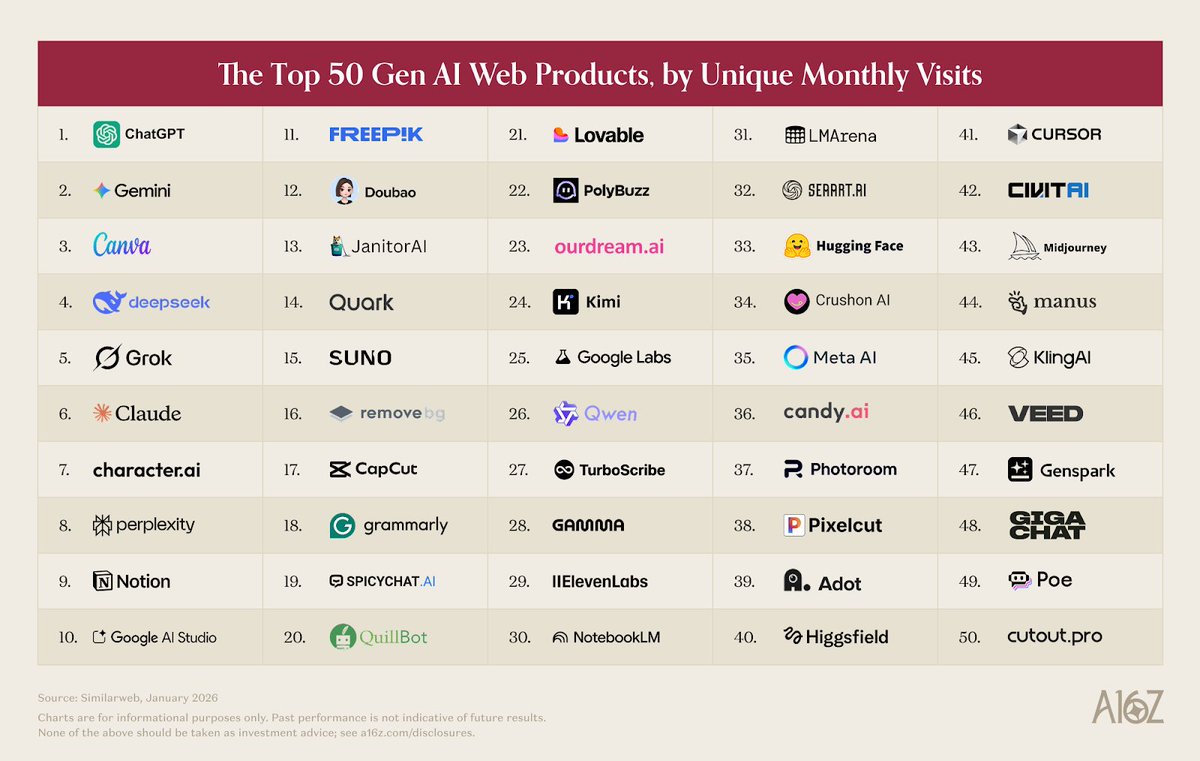
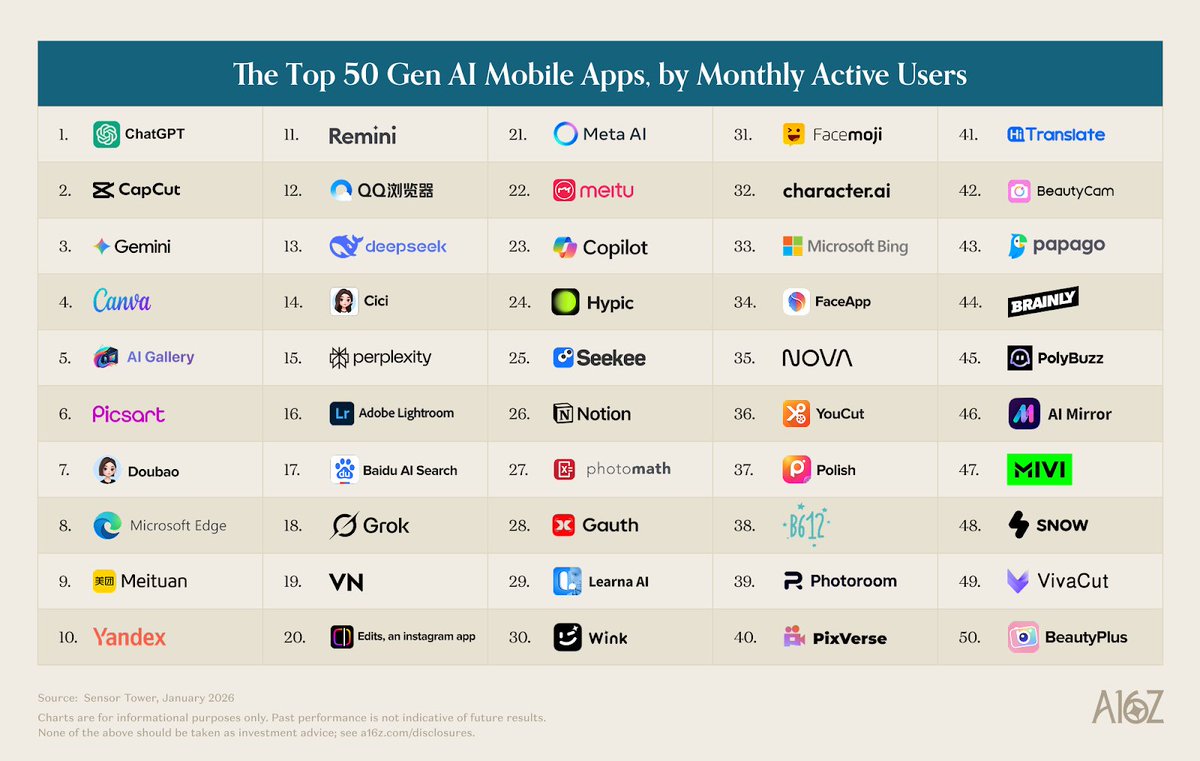
Very satisfying seeing good old @remove_bg in the Top-100 AI Consumer Apps.
Almost 10 years ago, way before @begroe of @AiKaleido sold its studio to Canva, we were using the tool daily – while building up a trading unit at our boutique hedge fund.
Excellent example of a simple product well built and growing year over year.
> 2018: Original web tool launch.
> April 2019: Photoshop Extensionmade available.
> May 2019: Desktop Application for Windows, Mac, and Linux released.
> 2020: Android App and video background remover launched.
> 2020: X2 Version (improved quality and detail) released.
> 2021: Acquired by Canva.
> Feb 2023: Magic Brush feature (edit/restore image parts) released.
> July 2024: Updated Command Line Interface (CLI) tools (v2.1.0). 
Unlike many modern tools, this is ~1 year/feature.
A lack of features is never the limitation for growth. A lack of problem solving – always is.
🚨 The @a16z consumer AI Top 100 is back!
For the sixth time, we ranked consumer AI websites and mobile apps by usage (monthly unique visits and MAUs).
This edition, we changed the rules. Here's why - and what the new list says about where consumer AI is heading 👇