We've seen crypto create some of the most important primitives of the internet era:
Stablecoins, DeFi, NFTs, prediction markets, tokenized RWAs.
Crypto is mature with institutional adoption
AI poses new risks to smart contracts
Capital is getting sucked into AI stocks
Quantum hangs over the horizon
It's easy to look at all this and conclude that the golden age of crypto innovation is over.
That we'll never see another breakthrough primitive.
Maybe.
But every cycle has people who mistake maturity for the end of innovation.
I don't.
My conviction: winning apps of the next decade will be built onchain.
Read my latest piece on @PinkBrains_io 👇
Our case study on collaborative AI through federated learning is spotlighted on @wef’s MINDS, a global programme highlighting real-world AI applications. Its selected cohort includes AMD, Synopsys, CATL, Ant Group, and other global AI leaders.
Read on to see what we've built ↓
Btw, $TRX still trading near ATHs while outperforming BTC and obv $ETH
While all other chains are fighting on which offers the lowest fees, Tron reached PMF and monetized it via HIGH transfer fees (costing up to $3.5 USD)
So, Tron generates more in fees than all other L1s combined ($3b vs $296m for Solana and $291m for Ethereum).
Lesson here.
With all the milestones in Q2, Q3 of @openservai is gonna be big (the Q3 plan is actually interesting)
Bootstrapping liquidity for $SERV is one of the steps to go brr.
@base is clearly the home chain for crypto AI. $VVV $POD have won. $SERV wants to be the next one.
As part of our ongoing plans to integrate with @base ecosystem & Base AI scene, we have migrated protocol assets to Aerodrome incentivized pools.
$SERV pools on Base are now eligible to receive emissions on AERO: deeper liquidity, lower slippage, and better capital efficiency.
(Information for SERV holders: There is no action required for $SERV token holders, there is no new token)
Q2 was the quarter SERV went from thesis to proof. Q3 is where it starts becoming real infrastructure that companies depend on.
What happened in Q2 in a nutshell:
> Private beta went live, bringing SERV Reasoning into real production across network intelligence, robotics, AI verification, and more.
> Greg Ivanov, ex-Google Head of Partnerships, joined as advisor to open enterprise doors and scale our operations globally.
> Neol, using SERV Reasoning hit 100% reliability in production with the UAE government, the highest trust bar in software, cleared.
> SERV-armed models beat Anthropic's flagship Fable at a fraction of the cost - proof that small models enhanced with SERV can top frontier ones.
> Every major model and stack integrated and made enterprise-ready fast: Gemini, Claude, Gemma, GLM, NVIDIA Nemotron, Fusion.
But what's going to come in Q3 is even bigger. We're taking SERV into the markets and industries that need it most. What's coming in Q3:
> Major long-term partnership coming in July - one of the most significant crypto deals any web3 company has ever signed.
> Global banking, financial and neobanking industry expansion across the US, Europe, Singapore, and Africa, backed by the certifications and legal entities each market requires.
> Robotics industry active SERV pilots moving toward completion.
> SERV Reasoning V2 - our biggest upgrade yet, built for the most demanding clients and enterprises. Including: Multipath Reasoning, which lets SERV handle huge, contradictory rulebooks. Shadow Agents that check every decision. And with new benchmarking tooling, any company can see exactly what they'd save before switching - all while their data stays sealed behind the Privacy Stack.
> Community-centric initiatives to propel our message in new channels.
> Attending multiple major AI and finance events, talking and closing deals with big companies that get us closer to the mass adoption.
Q2 proved the technology works. Q3 is where SERV becomes the reasoning layer enterprises and governments build on.
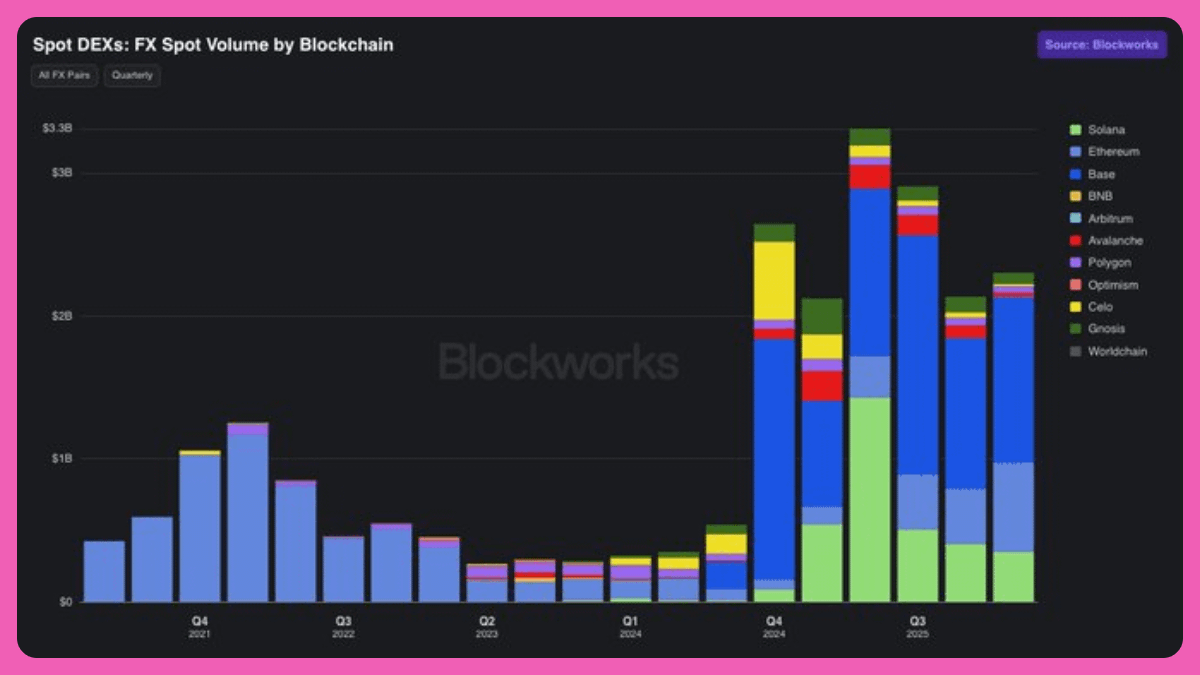
TradFi FX moves $6.6 trillion a day. Onchain FX did $9.5B in all of 2025. Tiny, but non-USD stablecoins 3x'd to $1.1B in supply, with transfer volume up 16x since 2023. That's big.
Top DEXs are competing to be the home of onchain FX.
- @AerodromeFi captures most of the onchain FX volume on @base and bigger than anywhere else, mostly through EURC/USDC.
Aerodrome's ve(3,3) model lets emissions keep funding winning pools, making it harder for other new local currency pools to get bootstrapped without bribes.
The Predictive Allocation can solve this by directing liquidity toward forecasted demand.
- @CurveFinance builds FXSwap, purposely designed for non-USD pairs. Live on @0xPolygon with @fraxfinance frxUSD paired against BRZ, IDRX, tGBP, AUDF, KRWQ.
FXSwap fixes the incentive problem. $frxUSD is backed by tokenized T-bills, and Frax forwards that Treasury yield to LPs.
But volume and traction are not significant.
Some founders build in silence.
Some founders only yap.
The best founders build and share what they're building.
Attention is scarce these days. If your boss says they're too busy to tweet, show them @elonmusk, @cz_binance, @mert, @StaniKulechov.
Lowkey @sparkdotfi is becoming the Stripe of onchain liquidity.
- Building a stablecoin FX layer with @Uniswap with shared FX depth to scale newly launched stablecoins from day one
- Routing USDS yield for USDG in @RobinhoodApp Earn through Spark Savings USDG (spUSDG). Before that, Spark Savings is also live on @BitGo, @Gate
- SparkLend is the biggest $wstETH lending market in DeFi. $wBTC supply, $ETH borrowed on SparkLend hit ATH
- Spark Prime serves institutional crypto borrowers like @Anchorage
Protocol surplus is used to buy back $SPK. So far, 81M $SPK has been bought back at an average price of $0.022.
.@Robinhoodapp's launch is about more than another Earn product. It demonstrates how regulated financial institutions can build native stablecoin savings products without rebuilding every layer from scratch.
It also signals a broader market trend: institutions increasingly combine specialist infrastructure providers with allocation intelligence to power the next generation of stablecoin financial products.
We took a closer look at Spark's role in the USDG ecosystem, and why we think this launch marks an important step in the evolution of stablecoin-powered financial products.
Read more here: https://t.co/eM2Pv4f8FZ
Meet FLock Chat - the private AI chat powered by FLock API Platform.
No login. No chat history on any servers. No backend storing your conversations.
Your chat stays in this browser. Files, context, and data stay yours.
Stay incognito → https://t.co/8aZT65keac
VVV and Capital
Measured by revenue, Venice has become the largest company at the intersection of AI and cryptoeconomics.
Today, we announced Venice’s first round of outside capital, a $65m Series A led by @dragonfly_xyz, valuing Venice’s equity at $1 billion.
Since we are an atypical company, this thread describes how this equity raise relates to the most valuable asset we have on our balance sheet, our capital token base:0xacfe6019ed1a7dc6f7b508c02d1b04ec88cc21bf
AI is no longer just a tool. It's infrastructure now, as load-bearing as electricity, oil, or the internet.
We've all seen what a power cut did to some European countries, or a blocked strait did to oil.
Now Europe faces another strategic dependency: AI.
Saylor's @Strategy just authorized selling Bitcoin.
They owe $1.76B/year in preferred dividends and interest. Their preferred stock $STRC was trading below its $100 stated amount, so they raised the dividend to 12%. And with $MSTR near 1x mNAV, issuing new shares to cover those payments mostly just dilutes.
So the new plan:
→ A $2.55B cash reserve (17 months of coverage), with a policy floor of at least 12 months
→ Up to $1.25B in $BTC sales to fund that reserve and cover dividends when it's cheaper than issuing stock
→ $1B to buy back preferred shares
→ $1B to buy back common stock
The buybacks are optional and don't have to be BTC-funded. Only the $1.25B reserve sale is a committed BTC monetization cap.
If they did fund the full $3.25B program by selling BTC, at 847K BTC held, that's roughly:
@ $60K: 54,167 BTC (6.4% of total held)
@ $80K: 40,625 BTC
@ $100K: 32,500 BTC
@ $126K: 25,794 BTC
The saving grace is that even the max touches under 7% of the treasury.
Still, "never sell Bitcoin" now has a price tag.
The next phase of RWA growth isn't about more tokenized products. What will matter is:
- DeFi utilization:
Only 10% of tokenized RWAs are used in DeFi today, but adoption is accelerating.
Ethereum still leads in RWA value, but ecosystems like @solana, @Mantle_Official, and @HyperliquidX are seeing RWA-backed DeFi grow faster than ever.
- Redemption layer:
This is still a major bottleneck. T+1 assets can take days to unwind while borrowing costs keep accruing.
Projects like RedStone Settle, Upshift Clear, and Grove Basin are built to solve this.
- Legal frameworks:
The CLARITY Act, MiCA, and new rules in Hong Kong and Singapore bring more protection, but also risk fragmenting global RWA markets.
Better regulation may come at the cost of narrower access and limited DeFi utilization.
This is one of the most comprehensive reports on RWA tokenization from @castle_labs and @redstone_defi. A must-read if you want a deeper understanding of the space.
It's official:
Crypto has now erased more than HALF of its value in just 8 months.
On October 6th, 2025, the total market cap of crypto hit a record $4.3 trillion.
Today, 261 days later, crypto is worth just $2.0 trillion, marking a -54% decline in value.
This means crypto markets have erased an average of -$8.8 billion PER DAY for 261 days straight.
Crypto is in desperate need of a new narrative.
. @multicoin predicts $HYPE will hit $319 at a 20x multiply by 2028.
Hyperliquid is already generating high 9-figure annual revenue, with more growth catalysts still ahead.
They think $HYPE is following a path similar to Binance's early years, and the market is still mispricing it.
At $63, they argue $HYPE is reasonably valued at 30-36x earnings.
Their base case projects ~$8B annual earnings by 2028, implying a $319 target.
1/ Multicoin published a full analysis & valuation of Hyperliquid (HYPE).
HYPE is now one of the largest positions in our liquid hedge fund. We've been accumulating aggressively since February.
Here's why we believe HYPE will be one of the best performers over the next cycle:
Tokenization will be up only in the next few years. Top tokenization platforms will eat good, but token holders may not.
Without fee switches, tokens are always the beta play in this trend.
Just a few tokens can stand out.
Tokenized stock is giving the vibes of the 2024 liquid staking season.
Daily DEX volume has grown from roughly $20-50M earlier this year to over $300M in June. Almost all of that growth is happening on @solana.
SpaceX was the catalyst. SpaceX perpetual OI reached $280M.
@xStocksFi is the market leader, with around $1.7B and 60% of the market.
Now, the competition is no longer just about listing stocks onchain. It's about who builds the best ownership model.
In under a week, @Backpack's $SPCX surpassed 10k holders and $350M in volume. Unlike most tokenized stocks, it's redeemable 1:1 for real shares.
The recent listings bring more hype. $MU surged 15% after earnings, while $SNDK gained 10% in a day, all tradable 24/7 on Backpack.
@coinbase can't stay sidelined.
Its upcoming tokenized stocks are designed to be 1:1 backed, include automatic onchain dividends, and are marketed as "not derivatives, not IOUs."
A broader shift is bringing shareholder rights onchain, not just price exposure.
The market is becoming more sophisticated with 3 distinct models:
- Synthetic perps: @HyperliquidX HIP-3 with @tradexyz, @variational_io, @Ostium, @GMX_IO
- Tokenized equities backed by real shares: @OndoFinance, @xStocksFi, bStocks by @binance
- Redeemable tokenized shares: @Backpack, @DinariGlobal, and soon Coinbase.