Smart contracts have been trapped in reactive mode.
The infrastructure endgame needs more.
❖ Introducing Scheduled Transactions ❖
Smart contracts that proactively execute on your behalf—truly autonomous *actually* smart contracts that live onchain.
❖ What is Ritual Chain? ❖
❖ Why is Ritual unique? ❖
❖ How is Ritual the future of AI x Crypto and beyond? ❖
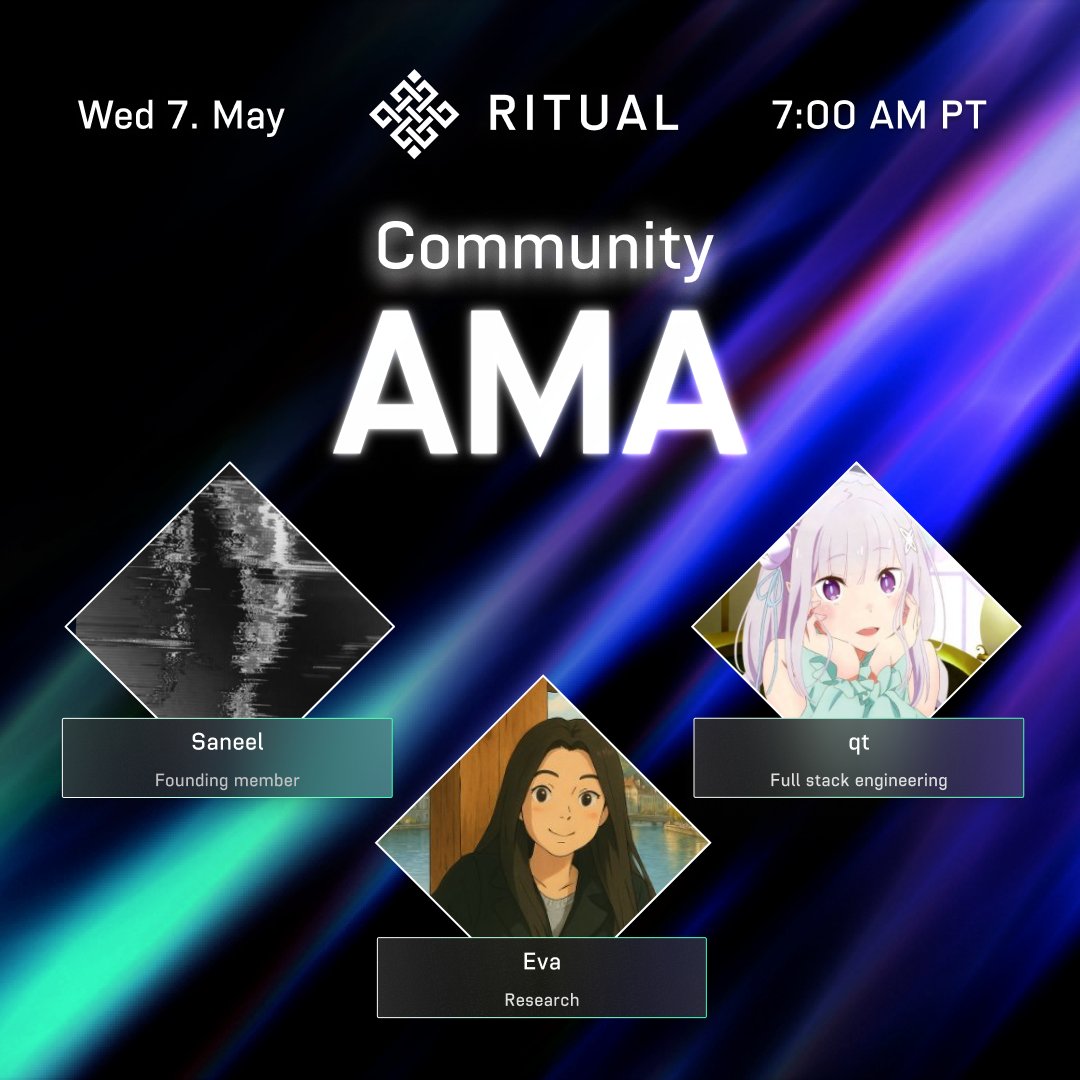
Join an AMA with @sanlsrni@evayzh@0xQTpie to hear how we’re building the most expressive Layer 1 in existence.
→ May 7, 2pm UTC
Join the Discord to submit your questions.
❖ See you there ❖
Do we need a separate blockchain for on-chain AI?
There’s a lot of AI in crypto right now. According to @cbventures, there are over 120+ crypto x AI protocols. There are also as many problems as there are projects.
A lot of protocols are just empty hype without any technological integration simply attaching a token to the name of the AI agent.
The problem isn’t just that people call something decentralized when it’s not: it’s that many of these projects don’t even try to use what crypto can bring to AI.
The real question is: how many projects are actually making progress to combine crypto and AI in a meaningful way?
2. On-chain AI use cases are overlooked.
Blockchains can enable AI compute to operate in a verifiable, transparent environment.
Developers can build credibly neutral AI models with transparent processes by leveraging collective computing power.
Most crypto x AI projects don’t get it right, focusing on token hype instead of running AI directly on a blockchain.
Why is switching to real on-chain AI important?
It prevents AI from being just another tool with a crypto label by relying on simple blockchain rules and focusing on on-chain AI execution over off-chain solutions.
It also offers incentives for developers to build models that enable atomic composability between AI and financial layers, as well as more complex task automation.
3. The L1 blockchain is a suitable solution for true on-chain AI.
Integrating AI on-chain can bring multiple benefits for AI, especially if we can make it trustworthy and resistant to censorship. Here are some ideas that stand out to me:
• Decentralized APIs prevent a single entity from censoring access by eliminating central control
• Inference validation protocols check AI outputs on a decentralized network to block single-party censorship
• Decentralized proof systems verify computations network-wide to resist censorship
Numerous use cases deserve attention, but why rely on a distributed network of nodes, or simply a L1 like @ritualnet?
In such architecture, nodes can manage computation and run models built by various creators. Users can make inference calls to access these models directly from a smart contract with atomic execution.
The L2 wouldn’t work here because most current L2s are highly centralized, relying on a single sequencer, which restricts decentralization and the range of tasks that should be handled by multiple nodes rather than just one.
As I said before, I’ve been looking closely at Ritual. Their solution is complicated and hard to figure out at first.
Their documentation has over 30 sections, and it takes a lot of work to connect all the pieces. But after digging in, I saw that Ritual uses different methods and has great flexibility, even though it’s just a network of nodes at first glance.
This made me want to learn how they do it and why it’s not as tough to understand as it first seems.
Simply put, Ritual is a blockchain that focuses on integrating AI into the blockchain space. The end goal is to ensure that the use of AI or AI data in any form is accessible to dapps and other networks in general.
Which dapps?
Well, I mentioned use cases above, but it can generally be extrapolated to inference networks, agent platforms, IP provenance platforms, DePIN networks, etc.
There are lots of mechanisms like native compute with support for AI inference, ZK proving, TEE execution, flexible verification, and an open fee market for execution, but the most interesting one that I’ve found so far is node specialization.
4. How does Ritual optimize execution?
In Ethereum, computations are fairly limited and basically optimized for the weakest node in the network, where the best performance the chain can achieve is literally equal to the node that performs the best.
This naturally limits the ability and incentive to have a high-performing node in the ecosystem, as there’s no user preference for compute execution.
Node specialization allows one to basically choose which nodes are more optimized to perform particular tasks, whether it’s AI inference, model fine-tuning, or proof execution.
The system basically matches transactions with nodes that are optimized for a particular task, so they can be executed more efficiently compared to just throwing transactions into the mempool.
Eventually, node specialization can enhance network efficiency by allocating the needed nodes for various tasks.
Nodes are compensated according to their distinct computational abilities, where both highly resourceful and smaller nodes can participate and earn their money.
This setup provides users with the flexibility to choose between cost-effectiveness or speed: whichever they prefer more. But obviously, node specialization is not the only part of the infrastructure.
There are 3 main parts of Ritual that are aimed to optimize execution:
1. Resonance
2. Symphony
3. EVM++
5. How does Ritual work?
1. Users initiate different types of transactions depending on the task they want executed.
2. Different transactions are picked up by auctioneers, while auctioneers also receive information from nodes regarding their costs to execute various tasks.
3. Nodes are divided into multiple groups depending on the type of transaction.
4. Brokers receive information from nodes regarding the resources they want to allocate and craft multiple proposals, connecting each transaction with each node.
5. Auctioneers receive proposals and select the most cost-efficient ones, where the transaction will be executed in the best way according to the users' needs.
6. Other proposals are simply discarded, and some nodes are left without a job.
7. After that, transactions are executed, and users receive confirmation that their transactions are finalized.
This mechanism is called Resonance, which is a dual-sided fee market that pairs groups of user transactions with groups of competent nodes for execution.
This is different from EIP-1559, which assigns individual transactions to be processed by all nodes across the network.
An additional way transactions proceed is actually through scheduling.
• Developers can easily schedule smart contract calls using a simple tool that lets them specify the function to call, how often it should run, an optional condition to check if it should proceed, and a fee limit.
• They can also cancel scheduled calls and get a refund of any unused funds.
• Block producers monitor scheduled calls and, when due, add a special transaction to the block’s start to activate the developer’s smart contract, provided it’s valid and has sufficient fees.
Symphony is not a consensus protocol itself, but an enhancement that integrates with an existing consensus design. It uses sharding and distributed verification to scale resource-intensive compute workloads.
Another part of Ritual is its enhanced version of the EVM: EVM++.
It lets users access models and other compute directly from any smart contract on the chain, and tapping into node specialization enabled by Resonance and Symphony.
Together, they allocate tasks efficiently, reward nodes by capability, and let users choose between cost and speed.
There are tons of other optimizations and architecture details that Ritual has. I’ll release a second article soon explaining it in depth, because Ritual has made a product that’s really complex. The goal is to understand the core reasoning behind all of these tech decisions.
6. Why is it so complex?
This was the main question I had at the beginning to understand the idea behind Ritual.
In their first-ever announcement over a year ago, their primary product was Infernet, a decentralized oracle network designed for AI workloads.
Later, Ritual announced their L1 blockchain, with a primary focus on AI and everything related to the intersection of crypto and AI.
However, as I learned more about Ritual, I realized that other potential use cases also include functioning as a compute service for ZK, TEE, chain abstraction, or even operating as prover networks for different rollups, such as @megaeth, to give an example.
Simply said, Ritual is not only for AI. There are many use cases and opportunities where Ritual could be useful, and I feel like Ritual is still discovering new ones.
I believe that node specialization and the overall architecture are a great fit because they can address all the demands you might have for AI-related tasks.
Certain nodes could act as provers or even provide customized precompiles for RaaS providers (Rollup-as-a-Service).
7. Can there be any scalability bottlenecks?
Another concern I have is how truly scalable this model is, particularly in terms of speed and resource demands under peak conditions.
LLMs and other heavy ML models require immense computational resources for both training and inference.
Given that nodes, even with specialization, are tailored to different tasks, I wonder what happens when an especially demanding task arises.
• Would a single node be capable of handling the compute execution?
• And would other nodes be able to verify it multiple times afterward?
• How deep can Ritual’s capabilities go?
Running AI on-chain or verifying it across a decentralized network of nodes could easily lead to bottlenecks or significantly increase costs for users.
I’m deeply curious about how much compute power the chain can handle once it goes live on the mainnet.
8. Is putting AI on-chain worth it?
The answer is definitely yes. There are numerous benefits you gain, starting with verifiability and ending with incentive alignment itself.
Ritual is a truly comprehensive solution that takes some time to understand. Its utility extends beyond AI, offering value to rollups and networks that rely on constant proof generation.
Ritual’s infrastructure can enhance machine learning and AI-driven solutions like AI-pegged stablecoins or basis trading strategies.
You can have any compute based on your needs, any hardware thanks to node specialization, and any constraints.
Moreover, I really want to explore the idea of expressive blockchains and heterogeneous computing in general, but that’s worth an entirely separate series.
I want to say thank you to the Ritual team members for reviewing and providing feedback on this article.
Do we need a separate blockchain for on-chain AI?
There’s a lot of AI in crypto right now. According to @cbventures, there are over 120+ crypto x AI protocols. There are also as many problems as there are projects.
A lot of protocols are just empty hype without any technological integration simply attaching a token to the name of the AI agent.
The problem isn’t just that people call something decentralized when it’s not: it’s that many of these projects don’t even try to use what crypto can bring to AI.
The real question is: how many projects are actually making progress to combine crypto and AI in a meaningful way?
2. On-chain AI use cases are overlooked.
Blockchains can enable AI compute to operate in a verifiable, transparent environment.
Developers can build credibly neutral AI models with transparent processes by leveraging collective computing power.
Most crypto x AI projects don’t get it right, focusing on token hype instead of running AI directly on a blockchain.
Why is switching to real on-chain AI important?
It prevents AI from being just another tool with a crypto label by relying on simple blockchain rules and focusing on on-chain AI execution over off-chain solutions.
It also offers incentives for developers to build models that enable atomic composability between AI and financial layers, as well as more complex task automation.
3. The L1 blockchain is a suitable solution for true on-chain AI.
Integrating AI on-chain can bring multiple benefits for AI, especially if we can make it trustworthy and resistant to censorship. Here are some ideas that stand out to me:
• Decentralized APIs prevent a single entity from censoring access by eliminating central control
• Inference validation protocols check AI outputs on a decentralized network to block single-party censorship
• Decentralized proof systems verify computations network-wide to resist censorship
Numerous use cases deserve attention, but why rely on a distributed network of nodes, or simply a L1 like @ritualnet?
In such architecture, nodes can manage computation and run models built by various creators. Users can make inference calls to access these models directly from a smart contract with atomic execution.
The L2 wouldn’t work here because most current L2s are highly centralized, relying on a single sequencer, which restricts decentralization and the range of tasks that should be handled by multiple nodes rather than just one.
As I said before, I’ve been looking closely at Ritual. Their solution is complicated and hard to figure out at first.
Their documentation has over 30 sections, and it takes a lot of work to connect all the pieces. But after digging in, I saw that Ritual uses different methods and has great flexibility, even though it’s just a network of nodes at first glance.
This made me want to learn how they do it and why it’s not as tough to understand as it first seems.
Simply put, Ritual is a blockchain that focuses on integrating AI into the blockchain space. The end goal is to ensure that the use of AI or AI data in any form is accessible to dapps and other networks in general.
Which dapps?
Well, I mentioned use cases above, but it can generally be extrapolated to inference networks, agent platforms, IP provenance platforms, DePIN networks, etc.
There are lots of mechanisms like native compute with support for AI inference, ZK proving, TEE execution, flexible verification, and an open fee market for execution, but the most interesting one that I’ve found so far is node specialization.
4. How does Ritual optimize execution?
In Ethereum, computations are fairly limited and basically optimized for the weakest node in the network, where the best performance the chain can achieve is literally equal to the node that performs the best.
This naturally limits the ability and incentive to have a high-performing node in the ecosystem, as there’s no user preference for compute execution.
Node specialization allows one to basically choose which nodes are more optimized to perform particular tasks, whether it’s AI inference, model fine-tuning, or proof execution.
The system basically matches transactions with nodes that are optimized for a particular task, so they can be executed more efficiently compared to just throwing transactions into the mempool.
Eventually, node specialization can enhance network efficiency by allocating the needed nodes for various tasks.
Nodes are compensated according to their distinct computational abilities, where both highly resourceful and smaller nodes can participate and earn their money.
This setup provides users with the flexibility to choose between cost-effectiveness or speed: whichever they prefer more. But obviously, node specialization is not the only part of the infrastructure.
There are 3 main parts of Ritual that are aimed to optimize execution:
1. Resonance
2. Symphony
3. EVM++
5. How does Ritual work?
1. Users initiate different types of transactions depending on the task they want executed.
2. Different transactions are picked up by auctioneers, while auctioneers also receive information from nodes regarding their costs to execute various tasks.
3. Nodes are divided into multiple groups depending on the type of transaction.
4. Brokers receive information from nodes regarding the resources they want to allocate and craft multiple proposals, connecting each transaction with each node.
5. Auctioneers receive proposals and select the most cost-efficient ones, where the transaction will be executed in the best way according to the users' needs.
6. Other proposals are simply discarded, and some nodes are left without a job.
7. After that, transactions are executed, and users receive confirmation that their transactions are finalized.
This mechanism is called Resonance, which is a dual-sided fee market that pairs groups of user transactions with groups of competent nodes for execution.
This is different from EIP-1559, which assigns individual transactions to be processed by all nodes across the network.
An additional way transactions proceed is actually through scheduling.
• Developers can easily schedule smart contract calls using a simple tool that lets them specify the function to call, how often it should run, an optional condition to check if it should proceed, and a fee limit.
• They can also cancel scheduled calls and get a refund of any unused funds.
• Block producers monitor scheduled calls and, when due, add a special transaction to the block’s start to activate the developer’s smart contract, provided it’s valid and has sufficient fees.
Symphony is not a consensus protocol itself, but an enhancement that integrates with an existing consensus design. It uses sharding and distributed verification to scale resource-intensive compute workloads.
Another part of Ritual is its enhanced version of the EVM: EVM++.
It lets users access models and other compute directly from any smart contract on the chain, and tapping into node specialization enabled by Resonance and Symphony.
Together, they allocate tasks efficiently, reward nodes by capability, and let users choose between cost and speed.
There are tons of other optimizations and architecture details that Ritual has. I’ll release a second article soon explaining it in depth, because Ritual has made a product that’s really complex. The goal is to understand the core reasoning behind all of these tech decisions.
6. Why is it so complex?
This was the main question I had at the beginning to understand the idea behind Ritual.
In their first-ever announcement over a year ago, their primary product was Infernet, a decentralized oracle network designed for AI workloads.
Later, Ritual announced their L1 blockchain, with a primary focus on AI and everything related to the intersection of crypto and AI.
However, as I learned more about Ritual, I realized that other potential use cases also include functioning as a compute service for ZK, TEE, chain abstraction, or even operating as prover networks for different rollups, such as @megaeth, to give an example.
Simply said, Ritual is not only for AI. There are many use cases and opportunities where Ritual could be useful, and I feel like Ritual is still discovering new ones.
I believe that node specialization and the overall architecture are a great fit because they can address all the demands you might have for AI-related tasks.
Certain nodes could act as provers or even provide customized precompiles for RaaS providers (Rollup-as-a-Service).
7. Can there be any scalability bottlenecks?
Another concern I have is how truly scalable this model is, particularly in terms of speed and resource demands under peak conditions.
LLMs and other heavy ML models require immense computational resources for both training and inference.
Given that nodes, even with specialization, are tailored to different tasks, I wonder what happens when an especially demanding task arises.
• Would a single node be capable of handling the compute execution?
• And would other nodes be able to verify it multiple times afterward?
• How deep can Ritual’s capabilities go?
Running AI on-chain or verifying it across a decentralized network of nodes could easily lead to bottlenecks or significantly increase costs for users.
I’m deeply curious about how much compute power the chain can handle once it goes live on the mainnet.
8. Is putting AI on-chain worth it?
The answer is definitely yes. There are numerous benefits you gain, starting with verifiability and ending with incentive alignment itself.
Ritual is a truly comprehensive solution that takes some time to understand. Its utility extends beyond AI, offering value to rollups and networks that rely on constant proof generation.
Ritual’s infrastructure can enhance machine learning and AI-driven solutions like AI-pegged stablecoins or basis trading strategies.
You can have any compute based on your needs, any hardware thanks to node specialization, and any constraints.
Moreover, I really want to explore the idea of expressive blockchains and heterogeneous computing in general, but that’s worth an entirely separate series.
I want to say thank you to the @ritualfnd team members for reviewing and providing feedback on this article.
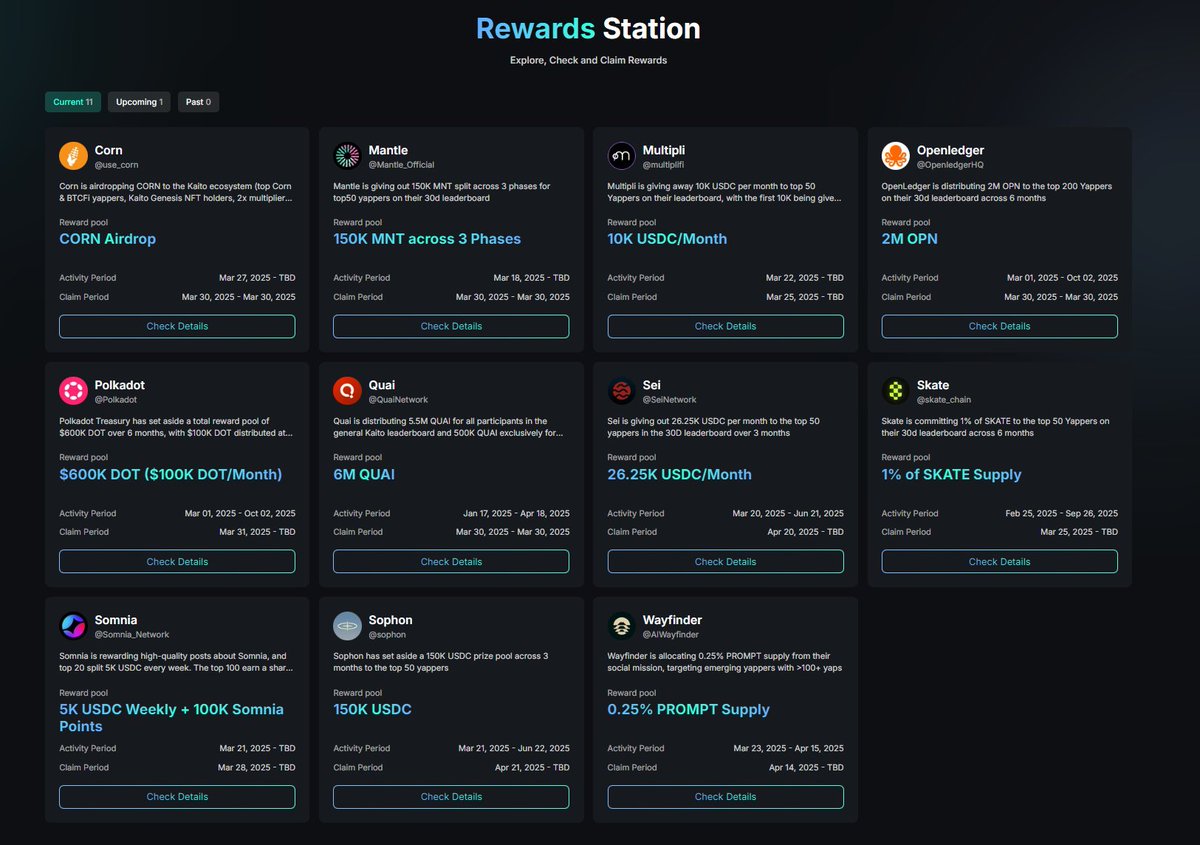
Kaito have released an update introducing Reward Station.
Reward Station <-> @KaitoAI Earn
What does it mean?
1. Making it easier to earn rewards for projects that are in the Kaito Leaderboard.
2. Ensuring the value of Kaito as a platform for projects to post rewards.
How to promote on the leaderboard?
1. Make content about the project that is on the leaderboard.
2. Don't forget to create Connect with other creators.
3. Good luck.
Top projects in Reward Station that I would pay attention to:
1. @skate_chain
2. @Somnia_Network
3. @sophon
4. @AIWayfinder
5. @Polkadot
6. @OpenledgerHQ
In these projects in large cases there is no any competition and you will be able to move up the leaderboard. I doubt about @Somnia_Network , but it's still worth a try.
If this content was helpful to you, then don't forget to get active. 🩵