CEOs are uniquely prone to AI psychosis because they’re sufficiently distant from the last mile of work that still has to happen to generate most value with AI.
So when they play with AI, they see the happy path results, often not considering the next 10 or 20 things that have to happen to get sustainable results from agents.
“Look I made this awesome product prototype”. Yes but you didn’t have to review the code before it went into production and fix a bunch of issues.
“Look I generated a contract”. Yes but you didn’t verify all the terms before it goes out to the counterparty and didn’t have to wire up all the past contracts to work with.
The best thing you can do as a CEO is to use AI a *ton* to figure out the real implications of agents in the enterprise, and come out the other side with an appreciation for both the upside and the real work that goes into them.
US and Iran cease fires are valid during Monday - Friday. 9:30 am to 4:00 pm
Any engagement that happens after trading hours MUST come with an announcement of a peace deal within one hour of markets opening
any escalatory comments should be reserved for weekends
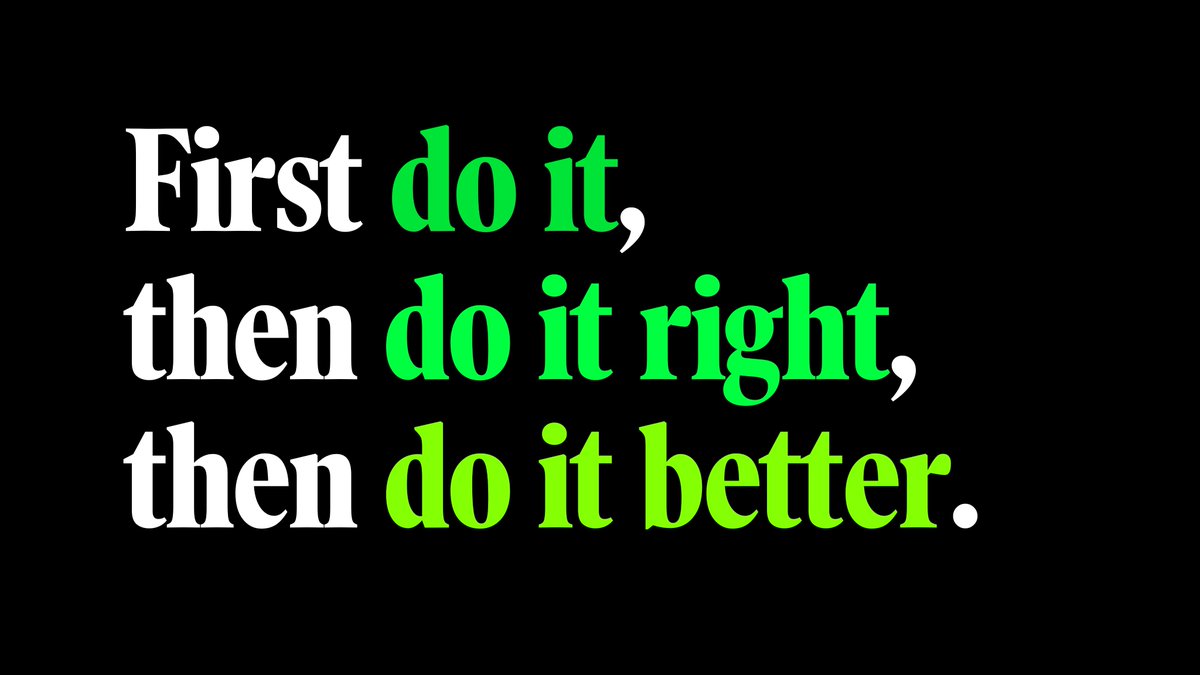
"First do it, then do it right, then do it better."
Just start. The journey to success often begins with a single step, but that first step can be the hardest to take. It's easy to get caught up in the fear of failure or the desire for perfection, but I hope this quote I first shared in 2013 can be a reminder of the importance of simply getting started as we go into 2024.
Just Start Somewhere
"Start slow if you have to. Start small if you have to. Start privately if you have to. Just start." - James Clear
Taking that first step doesn't require perfection or immediate mastery. The key is to overcome inertia and take action, as this action will lead to progress, learning, and (if you’re lucky and consistent) ultimately success.
When you start, you allow yourself the opportunity to grow, adapt, and move forward.
The Power of Starting
Beginning a new project or habit often feels daunting. According to psychologists, we tend to overestimate the pain of starting and underestimate our ability to persist.
However, studies show that "small starts" predict eventual success better than initial enthusiasm or early progress. This phenomenon is known as the fresh start effect - taking the first step energizes us and bolsters motivation.
So focus on starting without putting pressure on perfection. Progress and course corrections will follow.
First, Do It: Embrace the MVP Mindset
Doing it = get the simplest MVP out.
A Minimum Viable Product (MVP) represents the simplest version of a product or idea that allows you to test, gather feedback, and iterate.
By embracing this mindset (just get something done - it's OK if rough, a prototype, a draft), you focus on progress over perfection, understanding that getting something out into the world is far more valuable than waiting for the perfect moment.
Expand Your Comfort Zone
Venturing outside one's comfort zone can elicit fears of failure. Leaning into discomfort not only builds confidence and skills, but research shows it makes us more receptive to learning. Recognize that fear is often the mind's way of urging us to grow. Don't let it stop you from progressing.
Then, Do It Right: Refine and Correct
Doing it right = fix correctness issues.
Once you've taken that first step and put your MVP out into the world, it's time to refine and correct. This stage is about learning from feedback, identifying areas of improvement, and making adjustments accordingly.
It's a chance to iterate on your idea, ensuring that it meets the needs of your audience or customers while aligning with your vision.
Cultivate Curiosity and Resilience
Meeting new challenges with curiosity and resilience makes venturing outside our comfort zone more sustainable and enjoyable. Cultivate curiosity about growth opportunities and your capacity to rise to them. Set mini-challenges to incrementally expand your horizons.
When facing inevitable setbacks, avoid self-criticism and tap into resilience - the ability to recover, learn and continue progressing.
Self-compassion, adaptability and maintaining perspective are key here. With consistent effort, you build confidence in your ability to start, stumble, learn and work toward mastery.
Finally, Do It Better: Strive for Continuous Improvement
"Doing it better = iterate towards an ideal end-state (e.g., make it fast)."
The journey doesn't end with merely doing it right.
The final step is to continuously improve, striving for excellence and growth.
By iterating towards an ideal end-state, you demonstrate a commitment to progress, ensuring that your product, idea, or project remains relevant, innovative, and successful.
Set New Goalposts
As you improve, have a clear idea of when you are “done” or update your goalposts. Elite athletes turn small gains into competitive edges via the aggregation of marginal gains. Identify areas of potential improvement and set measurable stretch goals, from increasing efficiency to enhancing user delight.
Overcoming the Greatest Barrier to Progress
"The greatest barrier to progress is not lack of resources or talent, but fear of failure."
Recognizing that fear of failure is the most significant obstacle in the pursuit of success allows you to confront it head-on.
By acknowledging this fear, you can focus on taking that first step, knowing that once the ball starts rolling, it becomes much easier to keep it in motion.
Remember that starting is more than half the battle. Don't wait until you feel ready, because the perfect moment may never come.
The Bottom Line
Rather than striving for perfect execution, embrace the power of starting - put forth an MVP, soft launch an initiative, or set a milestone. Progress begets motivation. By simply starting, you open the door to growth and innovation. The rest will follow.
Embrace the power of starting and then iterating until you're happy.
@RaoulGMI@SimonKay100 I feel like you are obviously a super smart person(much more then me) and i respect alot of your content. But I just don’t think this is accurate. We aren’t going to 100T total crypto market cap in 8-10yrs. There’s 0 reason to think that really. I hope I’m wrong lol
@levelsio I 100% agree, but at the same time from my experience living in China for over a year it’s just not as easy to visit as other countries. At end of day China doesn’t give a crap about foreigners tourism. They get plenty of demand from their own citizens.
Mark Zuckerberg on the importance of engineers if you’re building a technology company
“We never thought about ourselves as a website or a social network or anything like that.”
Mark believes many companies define themselves too narrowly:
“It’s one of the things I observed as soon as I came out to [Silicon] Valley. All these companies that called themselves technology companies were not really set up that way. The CEO wasn’t technical. The board of directors had no one technical on it… And it’s like alright, if that’s your team, then you’re not a technology company.”
He believes there’s a balance:
“You don’t want everyone to be an engineer because there’s other things that matter too. But if you don’t have a high enough share of the company as engineers, then you’re not a technology company.”
This makes sense when you view it in the context of Mark’s strategy for Meta:
“I define our strategy as: If we can learn faster than every other company, we’re going to win. We’re going to build a better product than everyone else because we’re going to get it out first, we’re going to have a good feedback loop, and we’re going to learn what people like better than other people.”
He concludes:
“I think that’s basically the formula. Be a technology company. Build a good foundation. Learn from what other people are focused on in the world. And iterate as quickly as you can.”
Video source: @AcquiredFM (2024)