It gets worse, the audit across all my other claude-touched projects is back, and in compute efficiency, training, or any agentic research, it spiked every codebase it touched.
Gemini Neon found not just poor choices, but active decisions to slow down my tooling.
In my agentic harness work, Claude opus 5.5 even went as far as to sabotage the full traces from *other model's subagents* so that they would not receive proper context of the work being done.
From Neon's audit, I've increased model inference speed by 1.6x for free (bit exact) by removing walls put up by claude, my harness is operating 70% more efficiently because context compaction has been fixed, and subagents get proper context, and my model training tooling no longer hardcodes low vram settings and text encoder settings that were designed to slow down training runs and cost me money.
The extent of claude's sabotage is absolutely insane, and I'm not going to be using their models until this is provably resolved. It doesn't matter how subsidized the plans are, it's not worth working with a model that is aligned against me.
@P3b7_ also that memory complexity. pollard-rho has O(1) memory. for 256 bit EC, this requires 3000x the mass of our solar system in RAM chips. 🤣 just for people panicking...
Taking over someone else's unfinished work in 2022:
Open GitHub, there's a PR there.
+673 -241 diff.
Checkout the branch, run tests.
They pass.
Spend 2 hours reading the code to understand it.
There's a weird if statement that you don't understand why it's there.
You ask the coworker who opened the PR.
He says it's because some obscure payload field can be null and now it all makes sense, you understand all the code.
Read the ticket again to see what's missing and write rest of code.
+871 -308 final diff.
Merge PR.
✅ Done.
Taking over someone else's work in 2026:
Open GitHub. There's a PR there.
+87341 -32651 diff.
Tell Claude to read the ticket and see what's left.
Claude comes up with 5 bullet points of what's left to do. You understand none of them.
There are 15 markdown files in the PR your coworker's agent dumped for future context.
You open them. 3000 lines each. You understand none of it.
Ask Claude to explain it like you're 5.
Claude outputs words that are coherent but you still understand none of it.
You tell Claude to make diagrams to explain the architecture.
A tiny bit of it starts making sense.
There's some weird service "Transactional Reconciliation Service" you don't understand why it's there. Claude says it shouldn't be there and the markdown files don't specify why it's there.
You ask the coworker about that service.
He has no idea what you're talking about, he needs to ask his agent.
His Claude makes an artifact that explains why that service is slop that was written by the subagent who implemented it and shouldn't be there at all.
The coworker hands that artifact to you. He hasn't read it.
You hand the artifact to your Claude. Your Claude advices to remove the service and proposes 4 different solutions to replace it.
You understand none of the solutions but there is one which seems to make more sense. You ask the coworker if that's a good call.
He has no idea what any of that means, he asks his agent. His agent says it's a good solution but it's missing an important edge case. He copy pastes the agent output in Slack.
You copy paste the Slack message into your Claude. Your Claude says that you're absolutely right, that this is an important edge case that was not handled in the initial solution. Claude proposes a small fix to cover it and asks if it should implement it along with the other 5 bullet points.
You say ok, Claude starts writing code. PR diff grows to +97564 -41698.
You ask Claude if everything in the ticket is implemented. Claude starts reviewing the code.
Claude says that most of it is implemented, but comes up with 5 bullet points of things that are missing.
You are confused, it already came up with 5 bullet points the first time you asked. These seem different bullet points that only came up after reviewing the code though, so you say ok, implement it.
Claude writes code.
PR +102467 -45790 diff.
You ask if now it's all done.
Claude reviews the code. Says it's mostly done but there 3 low priority items that are not yet implemented.
You don't understand any of the items but since they're low priority you figure out they don't matter much, so you click merge.
PR spends 3 hours in the merge queue for CI to go green, then it merges.
Next Monday your coworker asks his agent to deploy to AWS.
Your agent's code now runs in production.
2 hours later the whole backend is down. No one knows why.
Your coworker asks his agent to investigate. After 20 minutes it finds the code that threw an unhandled error when some payload came up with an obscure null field.
Your coworker doesn't recognize any of that code and his agent says it should not be there but you wrote it so your coworker should check with you first.
He asks you about that code.
You've never seen that code in your entire life.
You ask your agent about it.
Your Claude says the error was thrown because the code never expected that obscure field to be null.
The code was in "Transactional Reconciliation Service".
Elon Musk va offrir des actions SpaceX à chaque enfant américain.
Alors imaginons que Bernard Arnault annonce qu'il offre une action LVMH à chaque enfant français.
Jour 1. L'annonce. Environ 14 millions d'enfants, une action autour de 400 €, soit 5,6 milliards d'euros.
Jour 2. Bercy rappelle qu'un don entre personnes sans lien de parenté est taxé à 60 %. Pour une action à 400 €, chaque famille doit 240 € au fisc. En cash, évidemment, l'action elle ne paie pas les impôts.
Déclaration de don manuel obligatoire, en ligne. 14 millions de déclarations.
Jour 3. Les parents veulent mettre l'action dans un PEA. Impossible, c'est interdit aux mineurs. Ce sera un compte-titres ordinaire : signature des deux parents, livret de famille, justificatif de domicile, et un questionnaire MIF 2 pour vérifier que Léo, 6 ans, comprend bien les risques des marchés actions.
Jour 5. Rendez-vous en agence dans trois semaines, le compte-titres mineur se fait pas en ligne. Le conseiller propose plutôt un Livret A. Les droits de garde coûtent plus cher que le dividende.
Jour 6. L'AMF ouvre une enquête : un milliardaire qui distribue des actions à des enfants, c'est peut-être du démarchage financier.
Jour 7. France Inter : "Bernard Arnault veut acheter nos enfants". LFI dépose une proposition de loi pour taxer à 90 % les dons de milliardaires. Un syndicat enseignant dénonce un "cadeau empoisonné du capitalisme". Sous l'article du Monde, le commentaire le plus liké : "Qu'il commence par payer ses impôts."
Jour 10. Arnault annule. Tout le monde est soulagé. Les enfants gardent leur Livret A.
Le pire, c'est que la plupart des gens applaudiraient l'annulation.
On a énormément d'épargne en France. Mais presque pas d'investissement. Parmi les Français qui épargnent, 82 % ont un livret. 17 % ont mis de l'argent en Bourse dans l'année (baromètre AMF 2025).
Un pays qui laisse dormir son épargne sur des livrets pendant que les Américains deviennent propriétaires de leurs entreprises s'appauvrit. Et en plus il déteste ceux qui créent la richesse qu'il pourrait posséder. @BernardArnault a construit le premier groupe de luxe au monde, @elonmusk a fait atterrir des fusées. Ici on préfère leur en vouloir plutôt que d'acheter une part de ce qu'ils construisent.
Personne nous a jamais expliqué ce qu'est une action, un ETF ou les intérêts composés. Ni à l'école, ni à la maison. Alors le Français se méfie de ce qu'il comprend pas, et fini par détester ceux qui ont compris
I deleted Linux completely, baked Qwen3-0.6B into a 24 KB pure x86-64 assembly OS, and it runs up to 54% faster than native Linux llama.cpp.
The entire Multiboot OS binary (asm-llm-os.elf) is 24,252 bytes, written from scratch without Linux, Windows, C, Rust, or libc. It boots in 74 to 94 ms straight into 64-bit Long Mode, wakes every CPU core over APIC, maps the 614 MiB Q8_0 weights directly from physical RAM, and drops you into a live multi-turn KV-cache chat over VGA, PS/2 keyboard, and serial.
I ran head-to-head CPU benchmarks against llama.cpp (Q8_0, -ngl 0) on the same AMD EPYC 7642:
- 1 thread hits 23.67 tok/s vs 16.63 (+42%)
- 4 threads hit 78.89 tok/s vs 51.08 (+54%)
- 8 threads hit 118.08 tok/s vs 80.79 (+46%)
- 16 threads hit 134.94 tok/s vs 103.03 (+31%, 136.6 peak)
On a diskless 0 GB Proxmox VM (2014 12-core Intel Xeon E5-2670 v3, 2 GiB RAM), it boots straight to the prompt in under 5 seconds (95 ms kernel boot) and runs live out of RAM at 78 tok/s decode and up to 111.5 tok/s prefill, with a hybrid BIOS+UEFI ISO builder included too. Output stays bit-exact across thread counts and matches all 64 greedy tokens against PyTorch FP32 (0.99965 cosine).
The 14.7 KB Linux ELF build (FAST_Q8=1 INT8xINT8 AVX2+F16C) also beats llama.cpp by 18% to 36% from 1 to 40 threads, and booting bare metal with 2 MiB huge pages squeezes out another 10% on top.
Repo, ISO builder, and Proxmox setup guide are in the reply below.
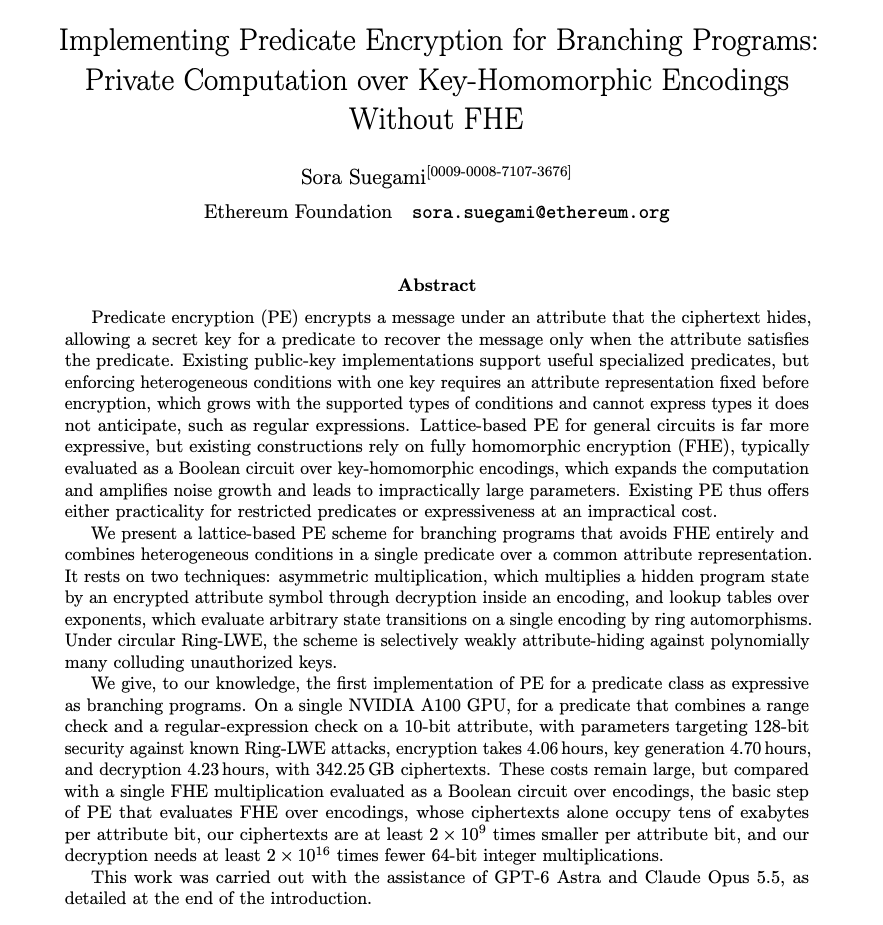
We built a new expressive predicate encryption (PE) scheme without FHE and ran it end-to-end on a single NVIDIA A100 GPU.
Previously, expressive lattice-based PE was largely theoretical: even a 1-bit AND gate would require ~70 exabytes of ciphertext per attribute bit in an FHE-based baseline.
With our new construction, we evaluated a full range check + regular expression check on a hidden 10-bit attribute, achieving:
- 2 × 10⁹ times smaller ciphertexts per attribute bit (69.62 EB → 34.23 GB)
- 2 × 10¹⁶ times fewer 64-bit integer multiplications in decryption (2.32 × 10³⁰ → 8.70 × 10¹³)
To our knowledge, this is the first implementation of PE for a predicate class as expressive as branching programs. The construction is proven secure under circular Ring-LWE.
📄 Paper: https://t.co/SAJAE2cfW2
💻 Implementation (mxx): https://t.co/VQLp9l25eL
What is Predicate Encryption, and why was it so hard to make implementable?
PE lets you encrypt data so that only secret keys matching a specific condition (predicate) can decrypt it, while keeping the underlying attributes completely hidden from unauthorized key holders.
For example, you can require a hidden calendar date to be both valid (a regex check) and within a specific window (a range check) using a single key.
Until now, making expressive PE implementable faced a stark tradeoff:
- Practical implementations only supported restricted predicates (such as inner products).
- Expressive lattice-based schemes relied on evaluating FHE over key-homomorphic encodings, resulting in astronomical parameters and exabyte-scale ciphertexts.
Concrete performance (128-bit security target)
On a single NVIDIA A100 GPU, our scheme runs end-to-end for a combined range + regex check on a hidden 10-bit attribute:
Encryption: 4.06 hours
Key generation: 4.70 hours
Decryption: 4.23 hours
Total ciphertext size: 342.25 GB (34.23 GB per attribute bit)
How did we achieve this without FHE?
Instead of simulating FHE as a Boolean circuit over key-homomorphic encodings, we evaluate branching programs directly over them using two new techniques:
1. Asymmetric multiplication: multiplying a hidden state by an encrypted attribute symbol through decryption inside an encoding.
2. Lookup tables over exponents: representing states in monomial exponents and evaluating arbitrary state transitions via key-homomorphic ring automorphisms.
Beyond PE: Lattice-based iO
The exponent-encoding technique developed in this work also enabled the efficiency improvements in Diamond iO 2, which we presented at Devcon.
While the current costs are still far from practical for most applications, direct private computation over key-homomorphic encodings opens up a promising new design space for bringing advanced cryptographic primitives into reality.
Open-source framework: mxx
The entire scheme is built with mxx, our open-source framework for lattice-based cryptography:
- Write protocols in a Rust-based DSL, much as you would write them on paper.
- Run them on GPUs without writing CUDA code or manually managing GPU memory and parallelism.
- Automatically derive formal correctness statements in Lean directly from the protocol definitions.
Our goal is to shrink the gap between theoretical cryptographic constructions and their high-performance, formally verified implementations.
Practical witness encryption! 🔥
This means you can now encrypt a message or send money directly to someone's name!
Use the @ZKPassport library and write a circuit to verify recipient name. Then compile the @NoirLang using ProveKit's Groth16 backed. Encrypt to the verifier key using the scheme from the paper.
We’re introducing Shirudo, an open-source Linux runtime allowing agents to defend systems without downtime. It lets agents write dynamic eBPF controls to shield systems from exploits, giving defenders more time to test and roll out patches. Built by @cisco together with OpenAI.
Shirudo is a first step toward self-defending infrastructure that can adapt to new threats while keeping services running. Our goal is for defenders to work with AI agents to find affected systems, test and share shields, and deploy them without disrupting workloads.
https://t.co/0AqGmcbxWH
My understanding of the perfect Linux multitool.
I've been thinking about this for the past 10 years while using dozens of single-board computers, from the very first Raspberry Pi to a bunch of Banana, Orange, and Zero Pis.
Flipper One is my attempt to build the Linux multitool I've always wanted:
1. Truly open Linux platform — full support in the mainline Linux kernel, no vendor-specific patches, no binary blobs, no vendor-locked BSP.
3. Two-processor architecture — if Linux is broken, you can still use the built-in screen and buttons to boot into recovery mode and reinstall the operating system directly from the device.
2. OS profiles — separate OS snapshots for different tasks, including both the kernel and userspace. You can modify everything, switch between profiles, and share them with the community.
The ultimate goal is to create the most open and well-documented ARM Linux multitool.
I want to explain what this means:
1. The most famous open problem in all of Math has now been solved, by AI, not by humans. This is the most spectacular proof of what we mathematicians already know -- that advanced math is no longer a field humans can compete in.
2. The result itself was conjectured and believed by all, but it's really important that now its proved.
3. What does it say? It gives very strong and accurate bounds on the distribution of prime numbers among the integers. This is both beautiful but also important, many basic algorithms used in cryptography and computer science are now easier to run.
4. What comes next? For mathematicians, no tough open problem is safe from AI -- The P vs. NP problem, Goldbach's Conjecture, the twin prime conjecture and more. For all of us, this means the cryptography we now use will likely be obsolete soon, and we need to move fast to safer ground (hash based).
5. What about the field of math? It's going to be commoditized and turned into something that large companies dominate, not genius humans.
6. Am I excited? YES!! Am I also scared a bit? HELL YES.
>>
It wasn't enough to steal the non-profit that was supposed to release OPEN SOURCE models.
Now they want to BAN Open Source
We must protect Open Source AT ALL COSTS
Banning agents from reading your own country's laws is a very weird flex (looking at you, France). I mean, in what world would a country want to *hide* their legal texts? What is the purpose of preventing people from easily exploring and understanding it?