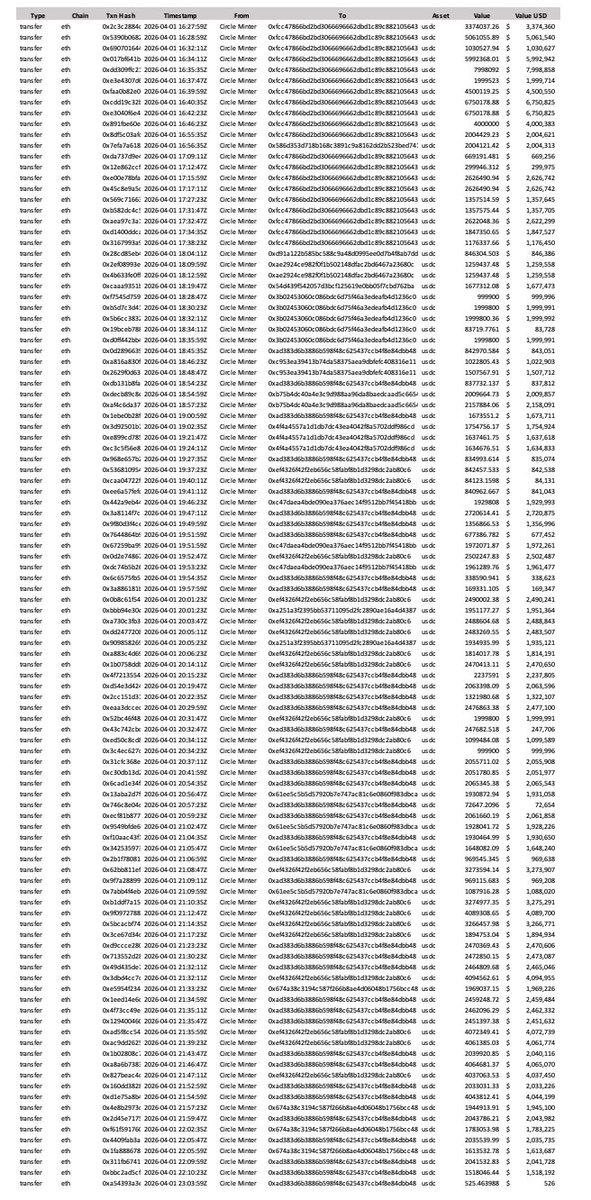
Update: $230M+ USDC bridged via CCTP from Solana to Ethereum across 100+ txns.
6 hours is how long Circle had to freeze stolen funds from the $280M+ Drift hack.
Circle is a centralized stablecoin issuer headquartered in New York and the attack began around 12 pm ET.
Why does our industry allow them to stay silent?
@jerallaire@circle@usdc
Photo from Shenzhen: huge crowd of Chinese people (lots of grannies!) lining up to get help installing OpenClaw.
One thing about tech diffusion in China that I feel is underdiscussed and that I’ll admit I don’t fully understand, is how open people of all ages are to jump into new tech. Feels very different from the AI suspicion/resistance you see in the U.S.
Similar with mobile payments and the shift to cashless. Street vendors in the lowest tier cities setting up WeChat Pay and Alipay QR codes almost overnight and Chinese grannies happily using payment apps with no problem at all. And yes that kind of grassroots adoption helped mobile payments scale extremely fast and allowed China to basically skip the credit card phase.
My conjecture is that if something similar happens with AI tools the speed of AI diffusion in China could look very different from what we see in other countries, which obviously would have major implications...
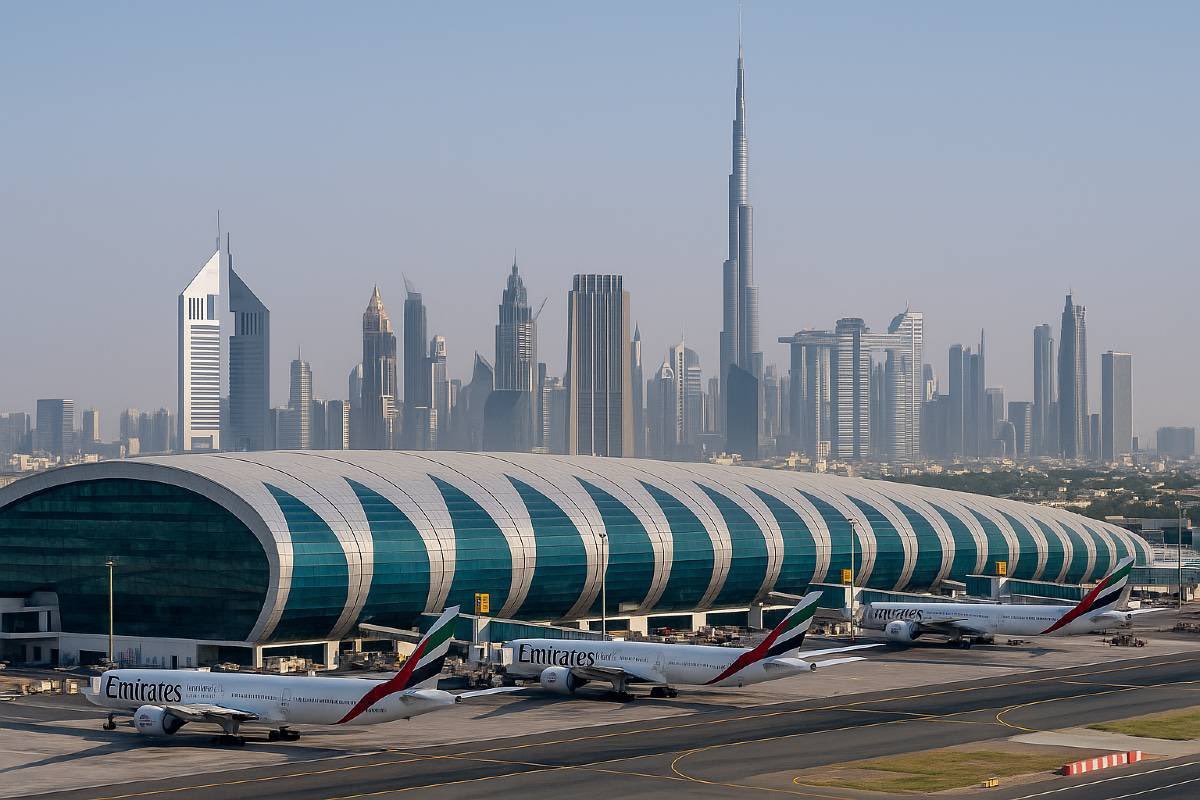
Dubai just shut down. The busiest international airport on earth. Closed. Indefinitely.
Dubai International and Al Maktoum International both suspended all operations on February 28 per official Dubai Airports statement. Over 280 flights canceled. 250 more delayed. The airspace that handles more international passengers than any hub on the planet went dark this morning because Iranian ballistic missiles were flying through it.
Now read the airline list and understand the scale of what just broke.
Emirates. Grounded. Etihad. Grounded. Qatar Airways. Suspended all flights to and from Doha after Qatari airspace closed. Air India. Every single flight to every destination in the entire Middle East. Suspended indefinitely. Turkish Airlines. Suspended flights to Bahrain, Iraq, Iran, Jordan, Kuwait, Lebanon, Oman, Syria, Qatar, and the UAE until at least March 2. Lufthansa. Dubai suspended. Air France. Tel Aviv and Beirut suspended. Wizz Air. Israel, Dubai, Abu Dhabi, and Amman suspended until March 7. British Airways. Affected. Virgin Atlantic. Affected. Japan Airlines. Affected. Norwegian Air, LOT Polish, Scandinavian Airlines, Aegean, Iberia, Air Arabia, PIA, Saudia, Air Algerie. All affected. All grounded or rerouting.
This is not a regional disruption. This is the global aviation network breaking at one of its most critical nodes.
Dubai is not just an airport. It is the single largest connecting hub between Asia, Europe, Africa, and the Middle East. Every flight from Mumbai to London, from Singapore to Frankfurt, from Nairobi to New York that routes through the Gulf is now either canceled, delayed, or burning extra fuel on thousand-mile detours around closed airspace. IndiGo just suspended flights to Almaty, Baku, Tashkent, and Tbilisi until March 28. Not March 2. March 28. A month of Central Asian connectivity erased because Iranian missiles crossed the flight paths.
The cost is compounding by the hour. Rerouted flights burn more fuel when oil is spiking past 100 dollars a barrel because the same conflict that closed the airspace is threatening the strait that moves 21 million barrels a day. Airlines are paying surge prices for fuel to fly longer routes around a war zone that did not exist yesterday morning. Every hour the airspace stays closed, the losses multiply across carriers already operating on thin margins.
And here is what nobody is calculating yet. Dubai’s economy runs on connectivity. Tourism. Trade. Finance. Logistics. All of it depends on DXB being open. The UAE just absorbed an act of war on its sovereign territory with a civilian killed in Abu Dhabi from missile debris. The country that built its entire economic model on being the safe, neutral, connected hub of the Middle East is now closed for business because the country it had no quarrel with fired missiles through its airspace.
Iran did not just attack military bases this morning. Iran shut down the economic engine of the Gulf.
That is a cost Tehran cannot afford to repay and the UAE will not forget.
Dubai intercepted an Iranian drone near the Burj Khalifa.
Read that sentence again and understand what almost happened.
The Burj Khalifa is 828 meters tall. It is the tallest structure ever built by human civilization. It contains 900 residences, a hotel, corporate offices, observation decks, and on any given day thousands of people from dozens of countries inside its walls. It is the architectural thesis statement of the entire Gulf development model: that human ambition can overcome geography, gravity, and the geopolitics of the neighborhood. Iran sent a drone toward it.
The UAE intercepted it. No injuries. No damage. No impact. The system worked. But the Burj Khalifa was evacuated. Thousands of residents and guests walked down emergency stairwells from the tallest building on earth because an Iranian suicide drone was flying toward their tower and nobody could guarantee the interception would succeed until it did.
One failure. One drone getting through. One Shahed-136 carrying a 40-kilogram warhead striking the glass facade of the tallest building on earth. The footage alone would have been the most consequential thirty seconds of video since September 11, 2001. Every government on earth knows this. Iran knows this. And Iran launched the drone anyway.
The interception succeeded by whatever margin interceptions succeed by. Meters. Seconds. The distance between the drone’s trajectory and the point where the defensive missile reached it. That margin is the distance between a contained geopolitical crisis and the single most devastating symbolic attack on civilian infrastructure since the Twin Towers fell. Iran gambled that margin against the most recognizable building on the planet.
It does not matter that the system worked. What matters is that it had to work. What matters is that 12,000 people who live and work inside that building now know that an Iranian drone was inbound toward their tower and their survival depended on a missile defense system performing flawlessly at the last possible second. That knowledge does not go away when the all-clear sounds. That knowledge follows them into every decision about whether to renew a lease, whether to keep an office, whether to raise children in a building that has now been a confirmed drone target.
The Burj Khalifa was built to be the tallest. Tonight it became the largest target. The tallest structure on earth is also the most visible object on radar for a thousand kilometers in every direction. It cannot hide. It cannot move. It cannot be hardened. It can only be defended. And tonight defense meant intercepting a 50,000 dollar drone seconds before it reached a building worth 1.5 billion dollars containing thousands of human lives.
Iran did not hit the Burj Khalifa. Iran did something that no amount of successful interceptions can undo.
Iran made the world picture it.
https://t.co/BrzGRrU3VW
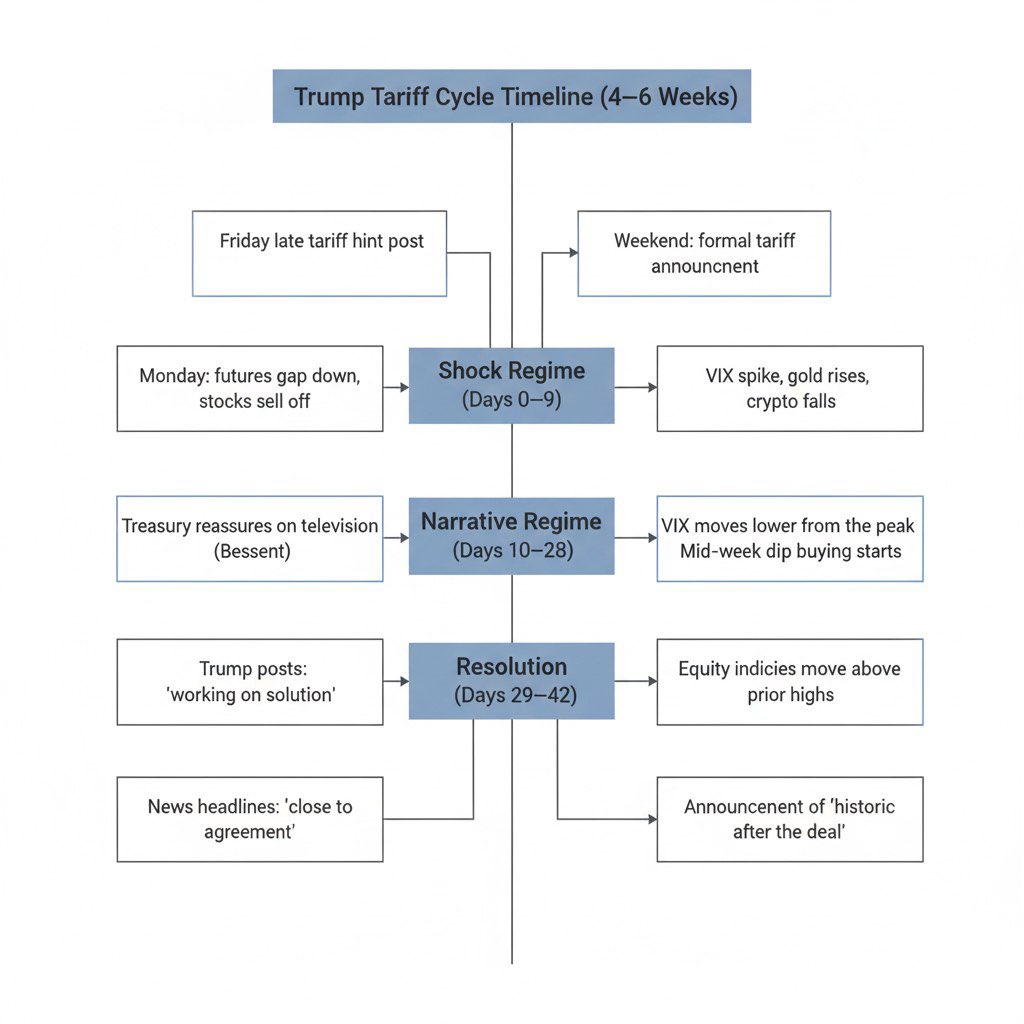
🚨PRESIDENT TRUMP USES THIS SAME TARIFF PLAYBOOK EVERYTIME TO GET WHAT HE WANTS.
Trump does not use tariffs as trade policy, He uses tariffs as a market control mechanism.
Every major tariff event under Trump follows the same structure. It has nothing to do with economics first. It has everything to do with pressure, timing, and market psychology.
The playbook always starts the same way:
1. Announcement timing is intentional
Trump almost always drops tariff news on late Friday or on weekends. This is done as US markets are closed so price cannot react instantly and the markets take some time to absorb the news.
2. Tariffs are structured with escalation windows
Trump never announces a single final tariff. He announces a first number and then a higher number later.
This happened last week too.
January 18, 2026: Trump announces tariffs on 8 European countries
10% tariffs effective February 1
25% tariffs scheduled for June 1 if no agreement is reached
That creates an immediate shock event but also keeps a negotiation window.
3. The first market reaction is always mechanical
Funds do not “think” during Phase 1. They execute risk protocols.
That means:
Prime brokers raise margin requirements
Volatility models force selling
Risk parity systems reduce exposure
Leverage collapses
Liquidity disappears
This is why moves are violent and fast. Not because fundamentals changed but Because capital structures are being forced to rebalance.
This is exactly what today looked like.
Large caps dropping 10–15% in minutes.
Small and mid caps dropping 30–40%.
4. Bitcoin always sells harder during Phase 1
Bitcoin is not treated as digital gold during tariff shocks.
It is treated as high beta risk.
Why:
24/7 market
High leverage
Perpetual futures
Thin liquidity during political shocks
So BTC becomes the pressure valve for global risk.
5. After the shock, the narrative phase begins
This is where Treasury officials appear.
This is where words like “Negotiations”, “Constructive talks”, “Temporary” and “Not catastrophic” start showing up.
Volatility stops to rise. Selling pressure slows and markets remember tariffs take weeks to implement.
6. Then comes the resolution phase
This is where Trump announces delay, reduction, framework, partial agreement or a “historic deal”.
Markets rally because uncertainty collapses.
This three-phase structure has repeated across:
China tariffs
Mexico tariffs
Canada tariffs
India tariffs
and will probably happen now too.
The Greenland situation follows the same template, but with higher geopolitical risk.
This is because:
Europe can retaliate symmetrically
It involves NATO allies
It includes territorial pressure
It overlaps with Supreme Court review of tariff authority
That makes this tariff more unstable, but not structurally different.
Now look at today’s crash.
Today was not about valuation. Not about earnings. Not about recession data.
It was Phase 1 of the tariff cycle: Shock.
Funds reduced exposure. Liquidity was pulled. Leverage was forced out. Crypto was hit harder because it always is during global risk resets.
So the playbook is simple:
1. Announce aggressively
2. Create fear while markets are closed
3. Let leverage unwind
4. Force negotiation pressure
5. Reframe later as diplomacy
6. Claim victory
7. Markets recover
We just faced the 3rd phase and now entering the 4th phase.
In a few weeks, everything will be back to normal and the markets will trade above their pre-dump levels.
We are revising our developer API policies:
We will no longer allow apps that reward users for posting on X (aka “infofi”). This has led to a tremendous amount of AI slop & reply spam on the platform.
We have revoked API access from these apps, so your X experience should start improving soon (once the bots realize they’re not getting paid anymore).
If your developer account was terminated, please reach out and we will assist in transitioning your business to Threads and Bluesky.
Just came across this old video of @brian_armstrong at Coinbase YC demo day back in 2012 and there's a few key takeaways I wanted to share:
1. Coachability > raw confidence
You can immediately see how Brian absorbs feedback from @paulg without defensiveness and adjusts his framing on the spot.
2. PG focuses on clarity
Paul Graham's feedback isn't about sneaking in buzzwords or vision statements but rather clarifying Coinbase's growth trajectory, Hence's the 20% a day.
3. Growth is the real pitch
Growth metrics do most of the talking. Coinbase growing 20% a day within 5 weeks of launch and doing 65k in BTC transaction volume.
“When your basic needs are met but your higher needs are blocked, money stops being about security and starts being about access- to experiences. to freedom. to the life you can see but can't reach
After all, lottery tickets sell better in poorer neighborhoods “
I've never felt this much behind as a programmer. The profession is being dramatically refactored as the bits contributed by the programmer are increasingly sparse and between. I have a sense that I could be 10X more powerful if I just properly string together what has become available over the last ~year and a failure to claim the boost feels decidedly like skill issue. There's a new programmable layer of abstraction to master (in addition to the usual layers below) involving agents, subagents, their prompts, contexts, memory, modes, permissions, tools, plugins, skills, hooks, MCP, LSP, slash commands, workflows, IDE integrations, and a need to build an all-encompassing mental model for strengths and pitfalls of fundamentally stochastic, fallible, unintelligible and changing entities suddenly intermingled with what used to be good old fashioned engineering. Clearly some powerful alien tool was handed around except it comes with no manual and everyone has to figure out how to hold it and operate it, while the resulting magnitude 9 earthquake is rocking the profession. Roll up your sleeves to not fall behind.