RAG vs. Graph RAG vs. Agentic RAG, clearly explained!
Standard RAG embeds documents into vectors and retrieves the most similar chunks via similarity search. For direct factual lookups, this works well.
But it breaks down when a query needs to connect facts spread across multiple documents. Similarity search retrieves individual chunks, not the relationships between them.
Graph RAG adds a knowledge graph layer on top.
→ During indexing, an LLM extracts entities and relationships from the documents.
→ During retrieval, the system traverses these connections instead of relying on embedding similarity alone.
This is what enables multi-hop queries.
Say a vector DB stores three facts about internal services:
↳ "The checkout service uses payments API."
↳ "The payments API runs on cluster-3."
↳ "Cluster-3 is scheduled for maintenance on Friday."
Someone asks: "Will the checkout service be affected by Friday's maintenance?"
Vector search can likely retrieve facts 1 and 3 because the query mentions "checkout service" and "Friday maintenance."
But it will miss fact 2, which connects the payments API to cluster-3.
That middle fact sits too far from the query in embedding space. It mentions neither "checkout" nor "maintenance," so it never makes it into the retrieved context.
A knowledge graph connects these as linked entities, and graph traversal finds the full path in one query.
Agentic RAG takes a different approach entirely.
Instead of a fixed retrieval pipeline, an LLM agent decides at query time which tools to invoke, which sources to query, and in what order.
Check the visual below to understand the three architectures thoroughly.
One thing to note here is that these three aren't levels of sophistication that you need to graduate through.
Instead, they solve different query types.
↳ Single-hop factual lookups → standard RAG
↳ Multi-hop relationship queries → Graph RAG
↳ Dynamic multi-source tasks with tool use → Agentic RAG
Once the right architecture is in place, the next leverage point is efficiency.
Most RAG architectures rely heavily on vector search, and that layer can be made 32x more memory efficient using binary quantization.
I covered the full implementation in the article below.
👉 Over to you: Which RAG architecture are you running in production?
People build AI tools. Users try them. The market filters out 99% of bad ideas.
Then model companies watch. If a workflow becomes common enough, eventually it gets built into the model itself.
Are startups creating products, or discovering features for the next generation of models? 😋
I'm experimenting with Codex to build an MVP called AI Observer.
For those who regularly use Codex, Cursor, Claude Code, or other AI coding tools:
Would you give this as one large prompt?
Or would you break it into multiple smaller tasks?🫶
I'm currently unemployed, spending most of my day in front of a computer — reading AI news, watching videos, collecting resources, talking to AI, exploring ideas. Yet at the end of many days, it's surprisingly difficult to answer a simple question: where did my attention actually go today?
I started thinking about a tool that acts like an observer. In the beginning, it would simply run in the background, understand how I spend my time, and generate daily reflections. Not just activity logs, but patterns. What I was learning, what I was avoiding, when I was focused, and when I was trapped in endless information consumption. Almost like having a second brain quietly watching from the outside.
But the more I thought about it, the more I realized the daily report is probably just V1. The real goal isn't tracking behavior—it's understanding a person. After weeks or months of observing you, it could start recognizing your habits, moods, and struggles. Instead of waiting until the end of the day to summarize everything, it could check in at the right moment. Encourage you when you're stuck, notice when you're drifting into another loop of endless searching, or simply ask if you're doing okay.
Eventually, I don't even imagine it as software. I imagine a small cat sitting on my desk. It can speak, show simple expressions, make simple movements, and quietly grow alongside me. Not an assistant that helps me get things done, but a companion that understands how I spend my days.
"When you read biographies of people who've done great work, it's remarkable how much luck is involved. They discover what to work on as a result of a chance meeting, or by reading a book they happen to pick up."
"You need to make yourself a big target for luck, and the way to do that is to be curious. Try lots of things, meet lots of people, read lots of books, ask lots of questions."
— Paul Graham, How to Do Great Work
https://t.co/AyIk5fnKZL
posting on x is one long public interview.
every post is a signal about how you think, what you notice, what you value, & whether anyone should pay attention to you.
linkedin is the exact inverse.
it’s one long public performance where everyone is trying to sound like the employee they wish they were instead of the person they actually are.
i don't think founders should be spending more than 2h/day inside codex anymore
the real leverage gaps in 2026 are actually simple:
- catch shifts before they become market trends
- develop taste that survives infinite AI slop
- talk about your project more on reddit, X, LI
everyone has tools now
very few people have signal.
30+ Startups Hiring Right Now 👇
@photonhealth — a prescription marketplace with real price transparency (NYC)
@nectarsocialai — running communities with AI (SF/remote)
Augustus — one API for payments worldwide (Berlin/Munich/remote)
@ConsensusNLP — search built for academic research (remote)
@trycasaai — membership for managing home life (SF)
SPREAD AI — pulling engineering data into one place (Berlin/Munich)
@belo_app — a wallet for moving money across borders (remote)
@OpturaAI — AI orchestration for big healthcare orgs (SF/Nashville)
Living Carbon — biotech for reforestation and carbon capture (SF/remote)
@turnkeyhq — wallet infra you don't have to custody (NYC/remote)
Outmarket AI — AI built for insurers (SF/India/remote)
@VoriHQ — the OS grocery wholesalers run on (SF)
Nace AI — AI agents that handle accounting and audit (remote)
Quantum Art — quantum computing that actually scales (Israel/US)
@CopilotKit — open-source framework for AI copilots (SF)
Happl — employee benefits across borders (London/remote)
Dandelion Health — AI built on real patient data (NYC/remote)
@multisig — infra rails for stablecoin finance (NYC/remote)
@pitdotcom — a plug-in AI product team for enterprises (Stockholm)
@enzo_health — AI charting for home health teams (Lehi/remote)
Lithosquare — finding minerals with AI (Paris/remote)
@useactively — outbound sales on autopilot (NYC/SF)
Novella — buying commercial insurance, simplified (NYC/TLV)
@xbow — AI that runs offensive security on its own (remote)
@gaiia_software — the billing stack for ISPs (Montreal/remote)
Nova Intelligence — modernizing SAP with AI (NY)
@WindmillDev — orchestration that starts with your code (remote)
9amHealth — care for heart and metabolic health (remote/San Diego)
@judgmentlabs — watching what your AI agents actually do (SF)
Adfin — automating invoices and getting paid (London)
BranchLab — AI for getting pharma to market (NYC/Boulder)
Dome Systems — mission control for enterprise AI agents (remote)
@PatronusAI — simulating workflows with world models (SF)
Ethos — an expert network for market intel (SF/remote)
@CircuitHub — assembling circuit boards (remote/MA)
The historical examples all rely on the same escape route: when one layer of work was automated, humans moved into higher-value cognitive work. AI attacks that refuge directly.
https://t.co/a2Bwq9gyMa
AI quality should be measurable, transparent, and continuously improving, Rather than relying on vague claims about accuracy or intelligence.
https://t.co/VpQJ4UKbJo
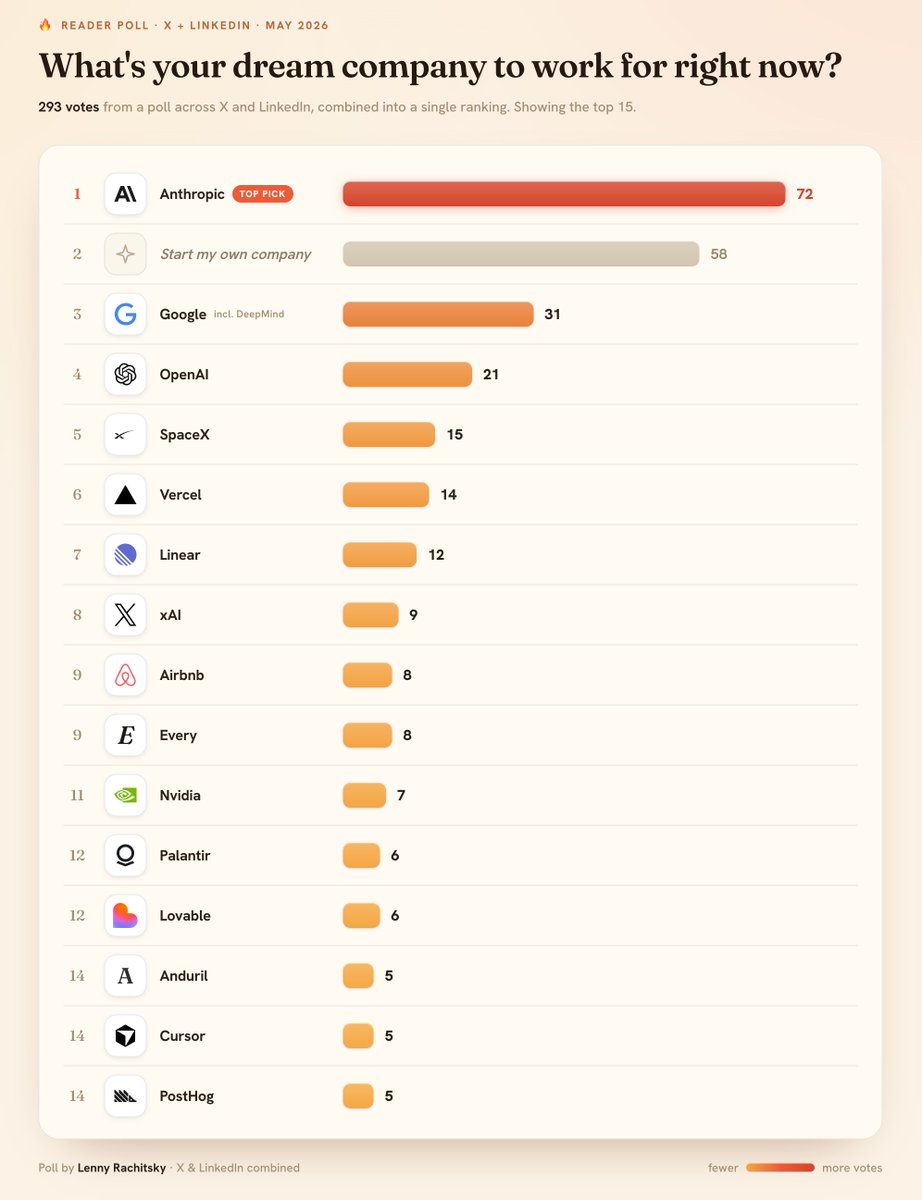
Fascinating results
+ Anthropic running away with it right now
+ So many people want to start their own company
+ Google over OpenAI
+ Vercel, Linear, Every, PostHog overperforming
A great list if you're trying to figure out where to go work 👇
Repeat after me:
1. Corporations are slave farms.
2. Tech CEO's are not your friends.
3. Big corporations are NOT stable workplaces.
4. There is no logic, reason or plan. Those CEO's have no idea what they're doing. Flailing at random.
5. You are just a cell in an excel sheet to them. A number. Like during the slave trades so they don't feel anything towards you. Makes it easier to mass fire.
Go work for smaller companies or start your own business. Don't lift a finger for the bottom line of big orgs.
Sharing here the message I just sent to the whole Wix team:
Today is a sad day for me. We have made a very hard decision.
We are reducing the Wix team size by roughly 20%. It is one of the hardest decisions I have had to make, but I am confident it is the right one, and I will explain why.
Before I go into anything else, let me say - this is a very hard decision because I will be saying goodbye to many people who have worked with me for years, many whom I call friends, people I trust and respect, friends who poured their energy and talent into Wix. Team members I know personally, and team members I never had the chance to meet, but whose commitment and contribution I have witnessed.
So thank you. Thank you for the effort, for the talent, for the passion, and for the friendship.
We are doing this as a company-wide change, a decision that will impact the entire organization, driven by how we need to operate going forward.
Why are we doing this?
The first reason is the Shekel/Dollar rates. In the past few quarters the exchange rate between the Shekel and the US dollar has shifted significantly as the Israeli Shekel strengthens against the US Dollar almost every day. As the majority of our teams are Israel-based, a very meaningful portion of our costs are shekel-denominated, while our revenue is largely dollar-denominated. This creates a structural pressure on our ability to operate at our current scale. It is a reality that directly shapes what is sustainable for our company.
The second stems from the fast evolution of AI capabilities. We have witnessed the most significant shift in how companies are built since the invention of modern programming languages in the 1970s. This is not just about adopting new tools - it is about rewiring how companies are built, how they think, how they manage and how they operate. Companies that embrace this change will not only build faster; they will build things the previous generation literally could not have imagined.
We are already taking concrete steps in this direction. As you know, we've recently introduced new roles like Xengineer and Creators, designed from the ground up around AI-native ways of working, a meaningful step towards the kind of company we are becoming.
It also means we need to become a faster, leaner, and flatter organization. We are moving to a structure with fewer levels between any member of our leadership and the most junior person on the team. Fewer layers means faster decisions, clearer ownership, and less distance between the people setting direction and the people building the product - but it also means a smaller number of people.
It is clear to us that in this new era, companies need to make this change in order to lead and compete or risk falling behind.
We are choosing to compete.
It is a painful change, a change that touches the lives of many, but I truly believe we have no other choice - we must evolve.
To those of you who are being let go
I want to once more say: Thank you.
Those who are affected will be contacted in person, directly, and we will do everything in our power to handle each conversation with sensitivity, respect, and the care you deserve, you will also be granted personally curated separation packages.
Many of you have given years to this company and built things we are genuinely proud of. I am personally grateful for what you've created, for the culture you've shaped, and for the trust you placed in us. More than anything, this decision was about the shape of the company we need to become. We own that - and we own the responsibility of supporting all of you through what comes next.
To those of you who are staying
What happens in the next few days matters. The people leaving this company are your colleagues, your friends, people you've built things with. They deserve to walk out of here with their heads held high, knowing that their work was real and that we recognize it. Please treat them with the respect they've earned. How we say goodbye says as much about who we are, as anything we've ever built together.
Our broader commitment
Before anything else, our commitment is to our users - to make the hard decisions so Wix continues to be the company that helps them succeed. We work for our users.
Millions of people run their businesses on Wix. Their world is also changing, also uncertain, also shaped by the current shifts. They rely on us - our reliability, our innovation, and our commitment to their success.
The responsibility does not stop with our users - behind every Wix shareholder is a real person whose savings, pension, or investment is tied to how we perform. We take this responsibility very seriously.
If we do not make this change, we will be failing our responsibility to our users, our shareholders, and our employees. In the long run, what is best for our users is best for our employees and best for our shareholders.
Today's decision was made to ensure we are here for our users and our shareholders, you among them, stronger and more capable, for years to come. We are doing this today because we are committed to building a company that is healthy, durable, and positioned to lead.
We will come out of this faster, stronger and better equipped for this new era.
Avishai
Every CEO layoff letter in 2026 follows the same template.
"Hardest decision I've ever made. AI changed everything. New roles designed for AI-native work. We owe it to our customers. We're choosing to compete."
I feel like I'm reading the same letter with different logos