Rent GPUs or buy verifiable inference?
@lightspeedvp led @ComputeDesk’s $45M seed to price and hedge GPU rentals.
On @Tensorcash, buyers can verify which model ran. Providers can earn fees and use the same proof to compete for block rewards. @inferenceFI is building the public order book.
@ttunguz Sir,you’ve compared GPU rental rates with inference revenue. If buyers could verify which model actually ran, would that make it easier to compare prices and switch between inference providers?
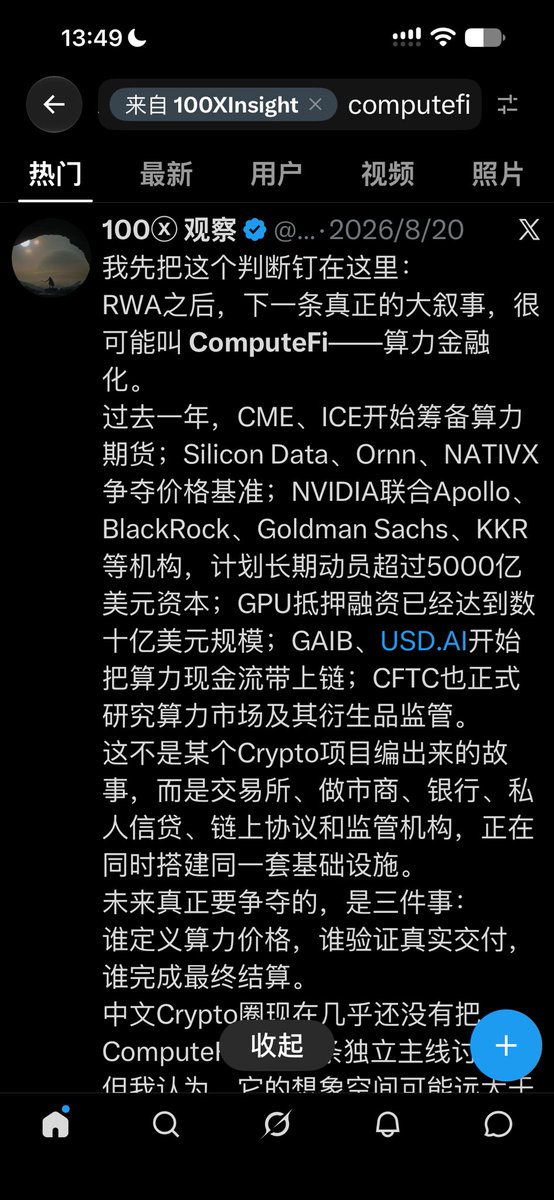
#ComputeFi #InferenceFi
Compute is becoming a financial asset.
@ComputeDesk co-founder and CEO @andrawesbahou joins Lightspeed partners @jmover and @katkzhang on The Investment Memo to discuss how that market is taking shape.
Andy argues that reliable delivery of compute brings buyers and sellers into the market. Their transactions help establish the price benchmark others can use to trade and manage risk.
Tune in to the full conversation below.
0:00 How Compute Became A Financial Asset
3:08 Historical Parallels to Oil
5:57 What Compute Desk Builds
7:37 Why Capital Markets Have Not Coalesced Around Compute
9:07 Who Could Benefit From The Financialization of Compute?
11:44 How Compute Volume Can Grow
14:46 The Three Products: Compute Signal, Trader And Clear
19:25 Why The Reference Rate Is "The Ultimate Prize"
20:49 Building A Team With Dual DNA
27:53 Why Physical Settlement Matters
34:18 The Paper Versus Physical Market
37:54 The Paradox Of Market Efficiency
39:29 The Fundraising Process And The Ten Year Vision
Truly an amazing read. We wrote about the GPU index side of this a while back, and this fills in the credit side perfectly.
In short: it’s not that demand is greater than supply, the problem is the financing.
In the current situation, there’s no big exchange where GPU-hours can be sold at scale, and no forward price to lock in what they’ll earn, meaning there’s no good way to hedge it either. So lenders can’t count on the income from them, with the outcome being that it’s more stable to lend against a known customer who pays no matter what, which is why GPUs are sold on multi-year take-or-pay contracts.
This brings a lot of issues, one of them being that GPUs basically always work in their own sandbox. A customer can’t simply get out of its contract: the lender has to approve any new buyer, and the customer stays on the hook if that buyer doesn’t pay. Meaning plenty of GPUs sit idle between training runs, at night, on weekends.
The cause of all this is that there’s no efficient market. And the cause of that? Compute is being priced through GPUs, which doesn’t work, because there’s no way to value the asset. Chips age, every cluster is different, and the price depends on who’s renting it.
All while most buyers don’t even want a GPU-hour. They want what comes out of it: inference.
If there were a market where compute could be valued on its own, lenders would get a forward price to lock in and always a buyer if a customer walks. Compute could be traded at scale, and all that idle supply would finally find a buyer.
As Jonah puts it:
“Trusting the asset takes two things: a known future price, the way oil has a forward price, and a market of buyers ready to pay it.”
So the compute market should be built on tokens, priced on the output itself, per token and per model, by supply and demand. A verified token shows exactly what it’s worth: no cheaper model or lower precision hiding behind the name, just one industry standard per model. Meaning people can buy exactly what they want, the inference itself, verified, instead of paying for it indirectly through GPUs. Without a tenant, lender, or sublease attached.
And with one standard product, a forward price can form, so anyone producing or buying compute will be able to hedge against it.
That’s what we’re building at @inferenceFI, on @Tensorcash.
There’s something people often get wrong about proving inference, and it’s probably the most important part.
Most think a proof is just there to guarantee the quality of an answer. But it goes a lot deeper than that...
Once quality is set, the only way to stay competitive is to offer the lowest price. So suppliers have to get more efficient, and as they do, the market grows and the price comes down.
That’s what @Tensorcash makes possible, and why we’re building @inferenceFI on it.
Proof of useful work isn’t proof of useful work when most of the GPU’s time isn’t part of it.
Simplified explanation: inference has two phases. Prefill reads the prompt in one big pass, and takes roughly 10% of the GPU’s time. Decode writes the answer, token by token, and takes roughly 90%.
If you want the mining to be useful and the work to be provable, decode is the only real pick. It’s where most of the GPU’s time goes, it’s the part buyers pay the most for, since output tokens are priced higher than input tokens, and it’s where a proof can be made: at every token the model scores the possible next words, and those scores differ per model. So on @Tensorcash, decode is the part that mines.
This means the time spent on the block reward is literally the time spent creating inference. Two outputs from one unit of electricity. There’s no trade-off and no game theory between serving inference and mining, because it’s the same work.
And because the vast majority of the work is useful, the network creates real value outside the block reward. Miners also earn from the inference they sell, so the block reward isn’t the only thing paying for the power, meaning miners have several sources of income.
Good piece but i think the fix is to stop trading GPU hours and trade the output.
A GPU hour drags a lease, a lender and a tenant behind it so token of an open model drags nothing. If every answer comes with a proof of which model made it, buyer does not need to know the seller it is same like your barrel of oil.
This is what @Tensorcash does. The proof is the mining a GPU with no customer still earns block reward, and when a customer comes the same work serves him and mines. Idle hours have a buyer by design.
@inferenceFI is the order book for those tokens on top with a daily price fixing and contracts settled on chain. Order book is not live yet but the proof is.
It does not fix how 100K GPU training clusters get financed but for inference i think the market starts with tokens, not with GPU hours.
$TSC