Introducing Gemini 4 Neon! Pushing the frontier across domains and punching above its model class in a meaningful way. To me, Neon feels like the right balance of intelligence, speed, and usability. Available now across @GoogleAIStudio, the API, and more!
Introducing Gemini 4 Neon! Pushing the frontier across domains and punching above its model class in a meaningful way. To me, Neon feels like the right balance of intelligence, speed, and usability. Available now across @GoogleAIStudio, the API, and more!
Another funny thing happening around Parano1d.
Nobody wants to talk about Solana potentially being the first major blockchain to be completely compromised. Or has it already happened?
It's simple. Your Solana wallet address is your Ed25519 public key, exposed from day one. A multibillion-dollar network built on this.
I started pointing this out, and suddenly CT was flooded with FUD about Parano1d.
And who's behind most of it? Pumpfun memecoin "developers" who think a GPT Pro subscription makes them qualified to audit cryptography, without even understanding what they're auditing.
Relax, guys. Your memecoins will die without anyone hacking them. That's pretty much the only roadmap pumpfun projects have.
I love this space🤣
A market for inference needs two ingredients.
Proof, so buyers can trust sellers they have never heard of.
And an open market, where spare capacity meets the buyers who need it, at open prices.
Welcome to inferenceFI.
Post-Quantum Signatureless Authorization v2
Quantum chosen-request security in the ideal-permutation model. Fixed-capacity Merkle nodes. Recursive verification.
46-47 ms verification on an i7 laptop. Full proofs. Reproducible code. Explicit assumptions.
https://t.co/A1ZPrFh05v
Useful computation produces proof, and proof produces value.
Without proof, the quality of an answer can’t be checked, so its value is uncertain.
A miner on TensorCash runs AI inference and records a proof of the model it used. With that proof, the inference can be sold as verified, and every eligible window is a chance at the block reward.
Most of this industry is in deep trouble.
Solana my "number one". Your wallet address IS your public key. Exposed from day one. Yet everyone's busy chasing privacy, liquidity, tps and the next bald trend. How about fixing the foundation first?
Ethereum: Once you've sent a transaction, your public key is exposed. At least Vitalik is taking the problem seriously and working on solutions.
Bitcoin: Some unspent outputs remain protected by hashes. Taproot exposes public keys immediately. Can Bitcoin Core make decisions faster than once a decade? Or is it time for a new Core?
Sooner or later, you'll have to rethink authorization itself.
No signatures. Proof-native authorization. Think you can break it? Do it.
https://t.co/3wU8sQKgOK
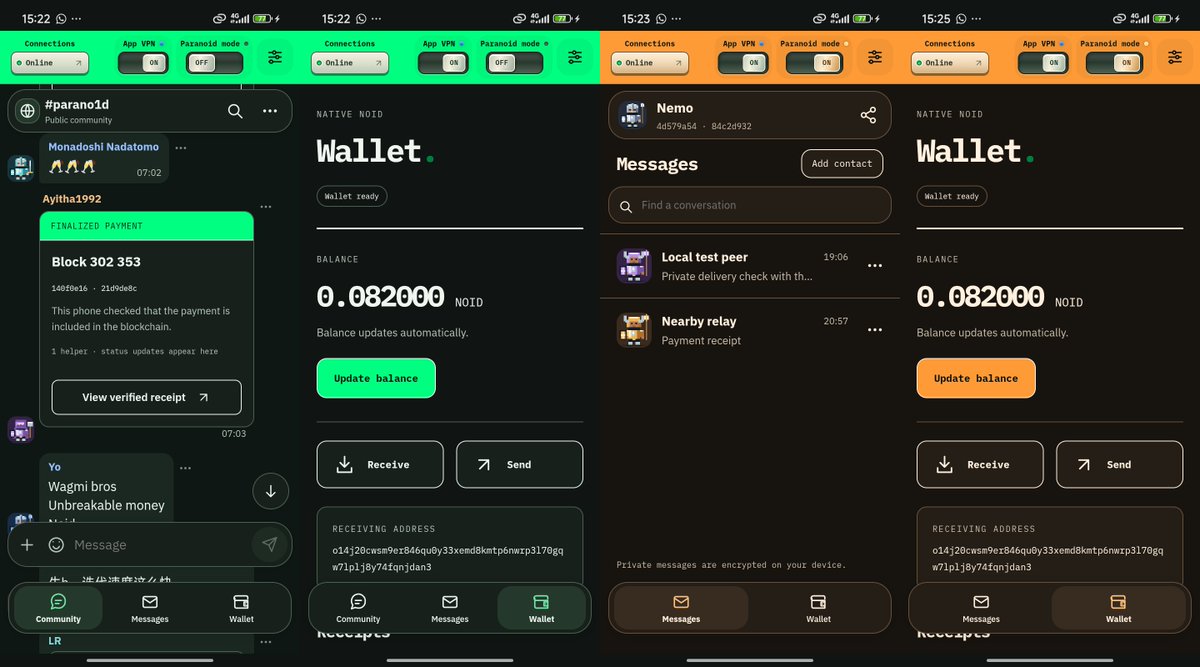
Mobile Parano1d v1.0 official release.
Full post-quantum blockchain node in your pocket. Runs on a $100 Android phone.
🟢 Normal Mode
Fast RPC access with independent cryptographic verification of blockchain State.
🟠 Paranoid Mode
Pure mainnet P2P. Zero wallet RPC. Your own node handles wallet recovery, payment broadcasting and receipt verification.
Real mainnet results on Redmi 15C with 4 GB RAM:
⚡ 23.54s Full blockchain State verification, including headers and fork origins.
⚡ 2.50s Complete recursive State proof re-verification.
⚡ 7.15s Native recursive State proof verification.
⚡ 0.82–1.50s P2P wallet checks.
And now Bluetooth mesh lets phones exchange encrypted messages and relay offline-authorized payments without internet.
Signatureless post-quantum payment authorization. Native parano1d:native wallet. Encrypted messenger. Built-in App VPN.
No replaying blockchain history. No trusted wallet servers in Paranoid Mode. No expensive hardware.
This is what happens when you replace the old blockchain architecture instead of optimizing it.
https://t.co/CkdEaEJvcG
Cheap verification doesn’t mean cheap proving. That’s what stands out to me here.
Sampled ZK audits help by proving only a small share of requests. Those selected computations still get cryptographic proofs; the rest don’t get individual coverage.
That’s also why I’m watching @Tensorcash . It’s trying a different way to keep overhead down: retain native floating-point inference, record sampling transcripts, then use parallel model replay and statistical checks. In its mining design, the verifier checks a submitted window without repeating the miner’s entire search.
The trade-off matters. Full replay needs access to the model and compute, and statistical acceptance doesn’t give you the same guarantees or weight privacy as ZK.
I want to see how far this route can bring costs down while still catching model swaps and other shortcuts in practice.
For anyone interested in the technical details, here’s TSC’s verification whitepaper:
https://t.co/F15KjZEIY0
Curious to hear from @sweis and @arasuarun—where do you see sampled ZK audits and statistical model replay each making the most sense?
@Bankless covered fingerprints, TEEs and cryptographic proofs—but missed a live path: @Tensorcash’s Proof-of-Inference.
tensorcash:native makes AI inference part of PoW consensus, using replayable traces and sampled checks.
https://t.co/eLClDDhoMi Not ZK. Not TEE. Worth a look, @davewardonline@TrustlessState.