AI-driven investment is making a historic contribution to US economic growth:
The contribution of computers and peripheral equipment to real Q4 2025 GDP surged to +0.57 percentage points, the highest in history.
This marks the 4th consecutive quarter of above +0.30 percentage point addition to the economic growth.
This is also TRIPLE the contribution seen in 2024.
Spending on information-processing equipment surged +36.1% last quarte.
Meanwhile, the combined CapEx of Amazon, $AMZN, Alphabet, $GOOGL, Meta, $META, and Microsoft, $MSFT, is expected to surge +70% YoY, to a record $610 billion in 2026.
The AI boom is accelerating.
🇺🇸 S&P 500
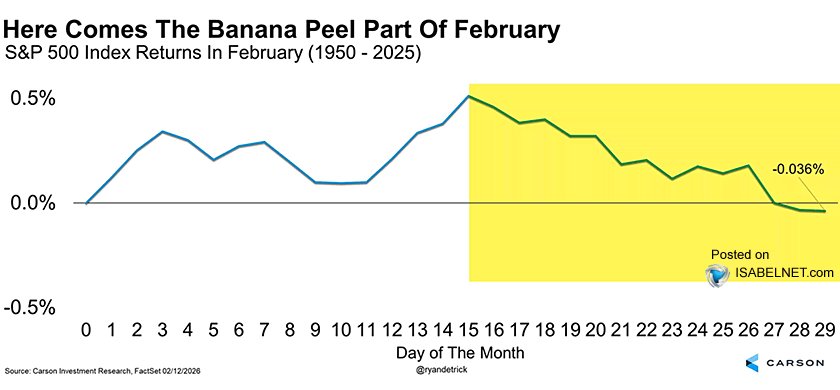
The S&P 500 tends to lose a bit of steam as February winds down, with the final days often trending softer. Nobody likes it, but few are really surprised
👉 https://t.co/yIk7SZYp6p
h/t @RyanDetrick $spx #spx
Retail traders—often referred to as “dumb money”—are clearly not betting on the downside for equities.
They usually trade leveraged ETFs on both sides, and in the last 4 instances when the “short” allocation was this low, they were wrong 3 times, with the SPX subsequently facing significant downside risk.
In case you don't realize what just happened:
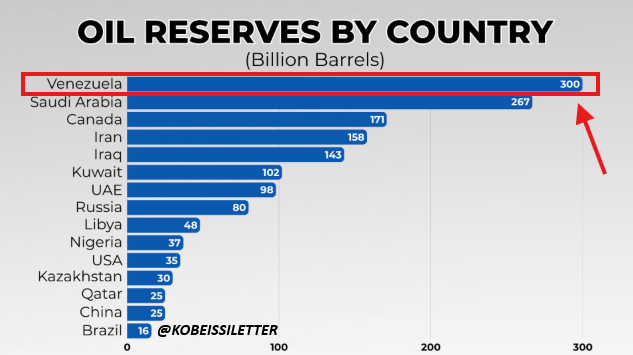
Venezuela holds the LARGEST oil reserves in the world, at 300 billion barrels.
The US is now "running" Venezuela with large US oil companies moving in, according to Trump.
The US now controls the largest oil reserve in the world.
Global money supply is out of control:
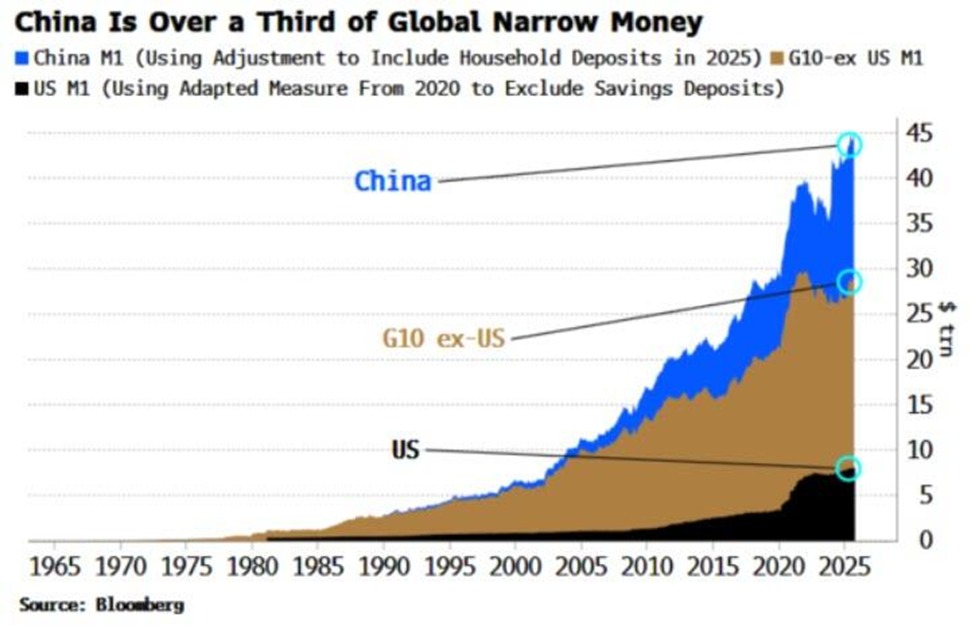
Global money supply is now up to a record $45 trillion.
This comes as China's M1 money supply has risen to $16.5 trillion, an all-time high.
China has driven the majority of global money supply growth this year.
China is currently the largest producer of narrow money in the world, accounting for ~37% of the total.
Meanwhile, the US M1 money supply, excluding savings deposits, is up to a record $8 trillion, representing ~18% of the world's total.
Global liquidity is expanding.
@saltydocEM great analysis, your comments the options are fantastic, one question the blue box on the left is the short call? orange is put and blue is call? Thanks
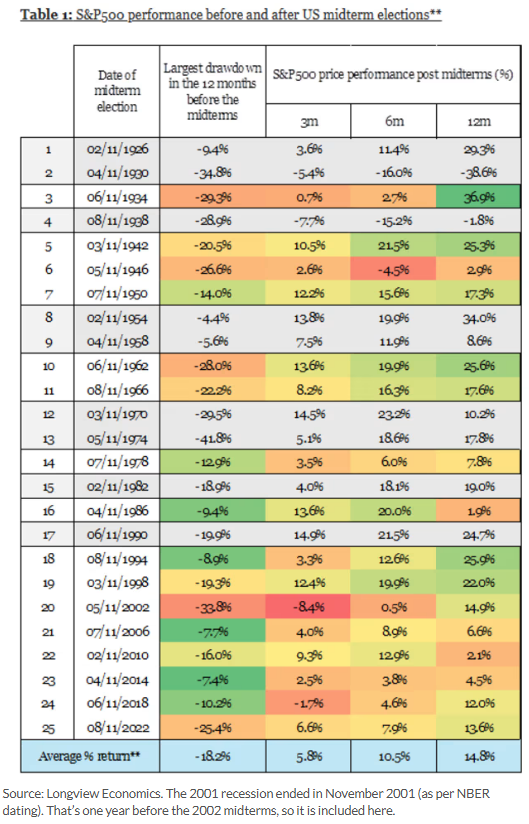
2026 Warning 🚨: Going back to 1926, the S&P 500 has seen an average drawdown of 18.2% in the 12 months before midterm elections 📉 Going back 60 years, the smallest drawdown has been 7.4% while the largest was 41.8% 🤯 After the midterms, all is well, but before? 🤔👀
Perhaps unsurprisingly, I haven’t seen many media outlets report accurately on the “deal” reached between Trump and Xi today, most forgetting to mention crucial aspects of it and almost all failing to contextualize the “47%” tariff figure quoted by Trump.
Let me try to detail the deal as accurately as I can, drawing from sources from both sides (on the Chinese side I mostly used a China Ministry of Commerce statement issued today at 3pm Beijing time, so roughly 1 hour and a half after the “deal” was concluded: https://t.co/IJ6YInXxt9 and on the U.S. side I used statements by Trump himself and others present in the meeting).
The key terms:
1. The U.S. will remove the so-called “50% rule” that it implemented in September for one year, in exchange of which China will suspend its rare earths export controls for one year
The removal of the “50% rule” is absolutely key, yet almost no media reported it, only mentioning that China had agreed to suspend its rare earths export controls for one year. Worth mentioning that the removal of the “50% rule” has been confirmed by Bessent himself as of a couple of hours ago (https://t.co/2zBqf8Mfbz)
As a reminder the “50% rule” was THE main reason why China retaliated with the rare earths export controls. It was a huge escalation by the U.S. as it effectively increased the number of Chinese companies on the "Entity List" by 14 times (!), from 1,400 companies to 20,000 (https://t.co/p8McpXELjb). Meaning 14 times more Chinese companies cut off from the Western financial system, forbidden to use USD, etc.
It was also the key trigger for the Nexperia debacle that’s currently occurring in Europe. The “50% rule” would have put Nexperia on the Entity List, and the U.S. told the Dutch that the only way Nexperia could escape U.S. sanctions was to get rid the Chinese ownership in the company (https://t.co/fNsHGUzpOh), hence the Dutch’s move to seize the company away from its Chinese ownership almost simultaneously with the introduction of the “50% rule”. Unclear what will happen in this case now that the 50% rule has been dropped but logic would dictate that the company be given back to its rightful owners. Although, admittedly, expecting European legislators to act based upon logic is a tall order…
2. The US will drop its OVERALL tariffs on China to 47%, meaning that China now benefits from 16% tariffs as part of the "Liberation Day" tariff policy
Of course Trump would mention the OVERALL number to make it sound like he didn’t cave on his liberation day tariffs but when one looks into the details, China actually negotiated him down to approximately 16% on his "Liberation Day" tariffs (down from the initial 34% and WAY down from the 125% peak), AND they got the so-called “fentanyl tariff” cut by half on top of that.
How so? First of all, before Trump 2.0 even got inaugurated, tariffs on Chinese goods were already standing at a weighted average of 20.7% (source: https://t.co/G6J4IIk65x). Soon after taking office, in February and March (so before “Liberation Day”), Trump added 20% on top of that in the form of his so-called “fentanyl tariff.” So BEFORE “Liberation Day” the OVERALL tariffs on China were already 40.7%.
Then on Liberation Day Trump added a 34% reciprocal tariff on top of that (so 74.7% overall tariffs), which he again escalated to 125% by April 10th after China retaliated. This brought the peak to 145% just from Liberation Day and fentanyl tariffs alone (or 165.7% including the pre-existing tariffs).
The fact that the OVERALL rate is now down to 47%, given the fact that the deal includes a 50% reduction on the fentanyl tariff (from 20% down to 10%), means that China has now negotiated the Liberation Day down from 125% to about 16% since 20.7% + 10% fentanyl + 16% Liberation Day is approximately equal to 47% overall tariffs (well, 46.7% to be exactly precise).
This means that when it comes to Liberation Day tariffs, China will stand roughly on par with the EU (who are at 15%: https://t.co/43B2WlUXPJ) or South Korea (who also will likely be around 15%: https://t.co/MQPcvfJ1kQ ).
3. The US will suspend its hostile actions on China’s ships and shipbuilding industry, in exchange of which China will also suspend its retaliatory measures
The US has agreed to suspend implementation of its so-called “301 investigation” measures against China's maritime, logistics and shipbuilding industry for one year, which was going to lead to massive port fees in the U.S. for Chinese-built and Chinese-operated vessels.
In exchange China will also correspondingly suspend implementation of countermeasures against the US for one year: they had announced that, as retaliation, they too would start charging U.S. ships for docking at Chinese ports (https://t.co/wacAemwEON )
4. Other parts of the deal
TikTok: China mentions they agreed to "properly resolve" the TikTok issue which is probably diplomatic speak to say that it’s not resolved yet.
Soybeans: China mentioned that “both sides reached consensus on expanding agricultural product trade” while Trump mentioned that China will buy 'tremendous' amount of soybeans, which all in all probably means that China agreed to resume buying U.S. soybeans (which they had stopped as retaliatory measures as leverage in the trade war).
Fentanyl: Both sides agree on "anti-drug cooperation" regarding fentanyl - which is language that’s pretty boilerplate in US-China discussions, so probably nothing new there.
“Handling of individual enterprise cases”: there is a pretty opaque language that suggests both sides discussed how to handle specific companies’ issues (Nvidia? Huawei? Nexperia?) and that they “reached consensus” on this.
Future Summitry: Trump commits to visiting China in April 2026, with mutual support pledged for China's 2026 APEC hosting and America's G20 summit. This signals both sides expect the relationship to stabilize enough for Xi and Trump to meet several times in person in 2026.
All in all, I would say that the key feature of this “deal” is the reciprocity and almost religious balance in every aspect: each concession matched by the other, each suspension mirrored. It shows we're now dealing with peer competitors who can effectively keep each other in check.
You can see how immensely things have changed if you contrast this deal with Trump's so-called “Phase 1” agreement from his first term (https://t.co/Mb44CMhVsA) with its unilateral Chinese commitments to buy American products and enact structural reforms to "rebalance" trade, with the U.S. warning it would “vigilantly monitor” Chinese compliance. All from an era when the US could still essentially dictate terms. None of that unequal framework survives here: instead of Washington trying to reform China based on its interests; all it can now do is learn to coexist with it.
It’s still early days though, for instance the deal doesn’t mention fundamental issues such as Taiwan. This is clearly not a grand strategic reset but rather both powers trying to figure out the rules of engagement of our new multipolar reality.
Xi Jinping mentioned in his introductory statement in the meeting that the U.S.-China relations was a “giant ship” going through “winds, waves and challenges” that needed to be “steadily sailed forward” by both leaders. That’s pretty much what this meeting was: the winds and waves are still there but at least both sides seem to acknowledge that they're now on the same ship.
A rare technical setup has triggered:
• The S&P 500 hit record highs
• Then saw its sharpest one-day drop in months
• VIX spiked >30%
Historical backtests show this combo often precedes a short-lived rebound followed by market inconsistency and defensive rotation.
A warning signal worth knowing: https://t.co/E6sMW5GhIr
$SPX $VIX #stocks #Volatility
This is unusual:
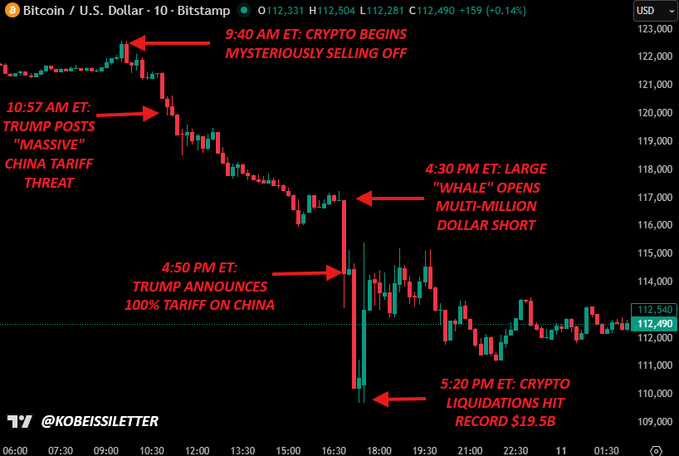
~30 minutes before President Trump's tariff announcement yesterday, a "whale" took a multi-million dollar SHORT in Bitcoin.
1 hour later, crypto saw its largest ever liquidation and this position was liquidated for +$192 MILLION in profit.
Did someone know?
DAX climatic spike reaching third standard deviations of VWAPs anchored in 2009, 2020 and Oct 22. German index has become a meme thanks to SAP.
SAP is in the 5th standard deviation of the VWAP anchored in 2008 and in the third standard deviation of the VWAP anchored in Oct 22.
@CarlosBuesa1 Esta muy bien, pero si quieres que suba la acción, compra acciones para que todos vean como un signo de confianza, vas a ganar y encima será el punto de inflexión de la acción.
@TailThatWagsDog the options in the last 30 minutes, it's a good indication of how it's going to open the next day from what I've seen, the positions on Wednesday and Thursday have indicated the movement well👍