Final print version of my rejoinder to comments on "Divergence vs. decision P-values" is at
https://t.co/Z5K7ReW5vw
All commentators agreed the main distinction is important, but raised key issues, esp. the need to be alert to insensitivities of a diagnostic to model violations.
@rlmcelreath When asked what they thought of the Royal Statistical Society naming its magazine "Significance", someone said it's like naming a chemistry magazine "Phlogiston", an astronomy magazine "Astrology", or a psychiatry magazine "Lobotomy", with the latter capturing statistics best.
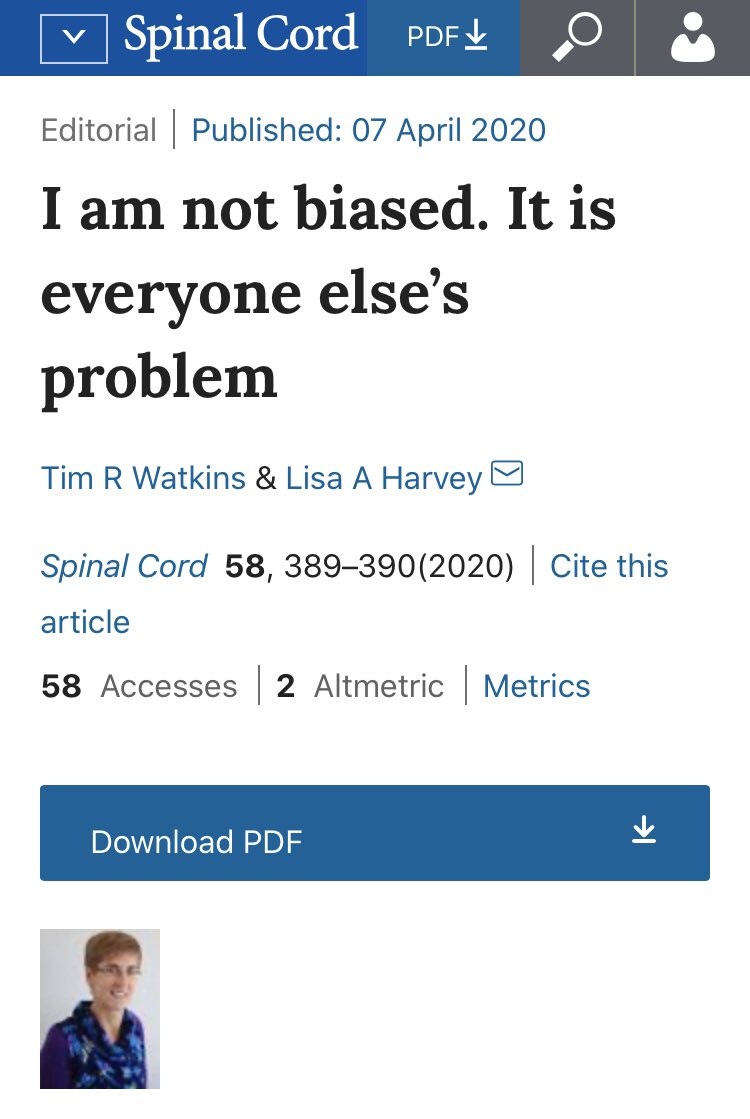
There are hundreds of cognitive biases, but most of them stem from a failure to recognize that our beliefs are subject to biases.
Defending our views stalls learning. Questioning them stimulates growth.
The only belief worth cherishing is the belief that you might be wrong.
@AndersHuitfeldt I was reading one of your papers only last night. Not the best news. Health research and science needs good contrarians to question when others don't. But the human nature of academics with a reputation to protect gets in the way (though perhaps subconsciously).
@joftius@dailyzad How about:
"All models are wrong, but while human nature makes us assume they explain how things happen, some can be useful if we build models carefully and respect uncertainty."
@EpiEllie@PWGTennant@AndersHuitfeldt "potential confounder"? - a variable that might cause confounding regarding a specific research question, depending on the actual data generating process at the time. I'm guessing that people naturally think in terms of causes (confounding) having an 'agent' (confounder).
@EpiEllie At least you are thinking carefully about what you will teach instead of just using material a previous lecturer developed, as many early career lecturers do for lack of time.
It helps explain why many biostatistics courses are still taught as they were decades ago.
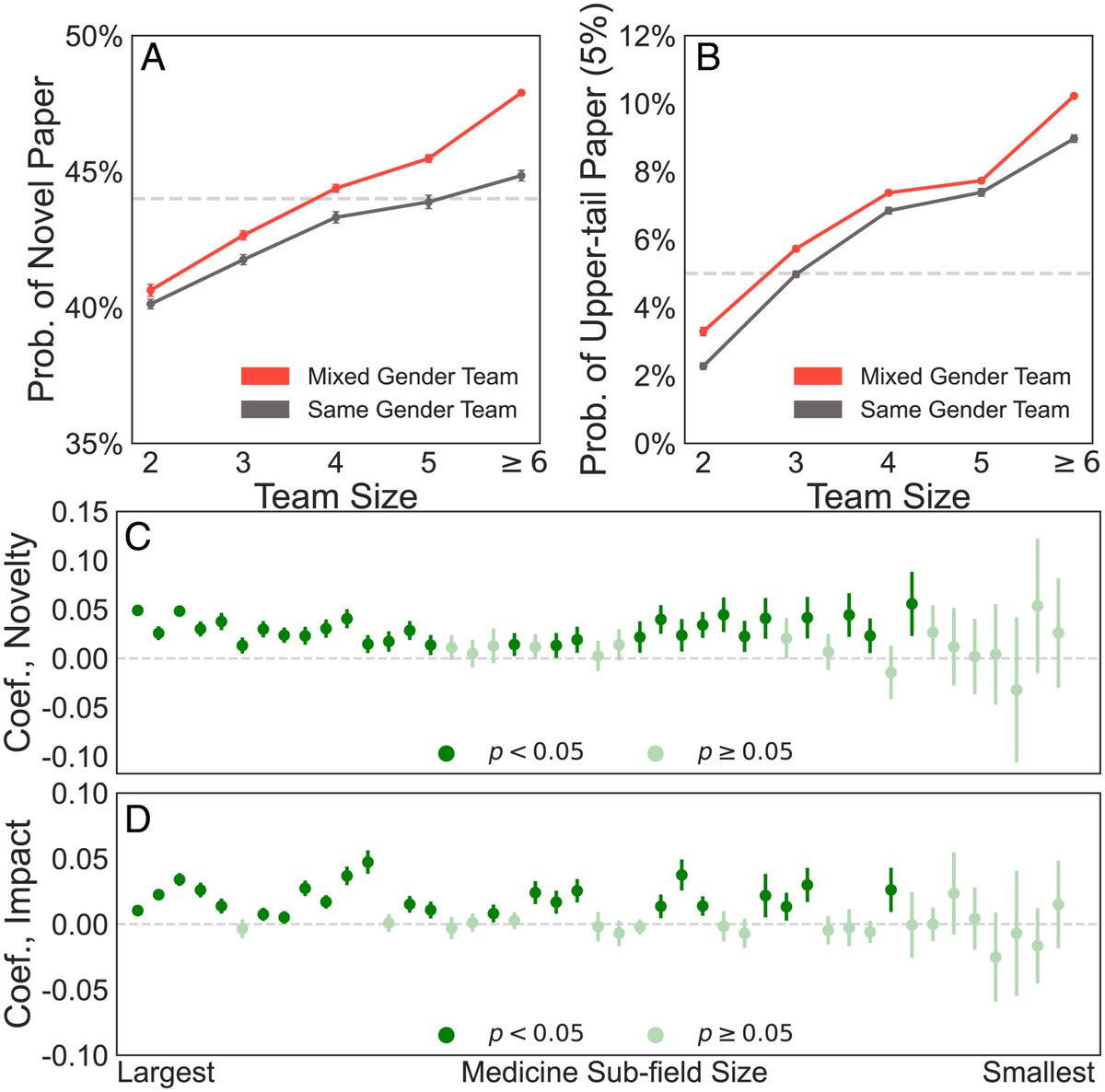
Diversity is smarter than homogeneity.
New data on 6.6 million science papers in all 45 subfields of medicine: mixed-gender teams generate more novel and influential work than same-gender teams.
Similarity breeds groupthink. Variety fuels deeper reflection and broader learning.
30 pharmacoepidemiology must-reads ! 💪💊
The list has been compiled following massive input from #epitwitter (see link below!). Here, we present the full list, all nicely wrapped up into one methods package for all your pharmacoepi methods needs!
https://t.co/ZNTsXvmjo5
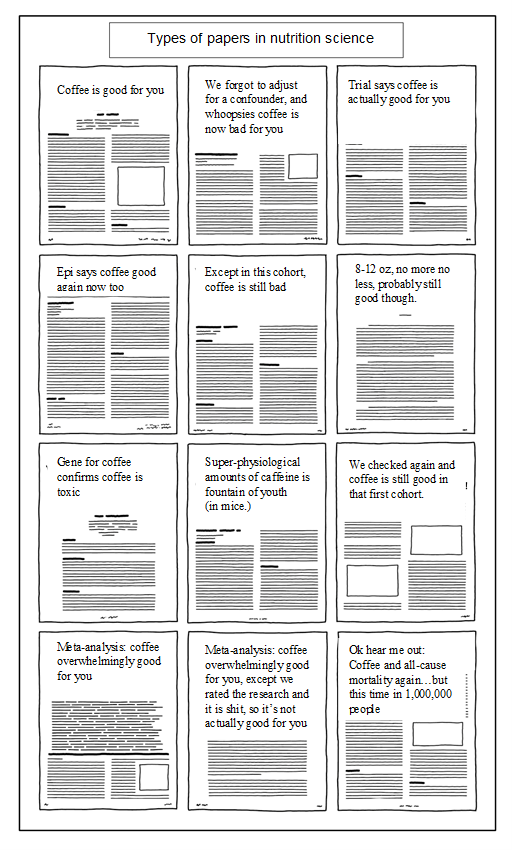
I wonder if coffee causes (some) researchers to rush doing their research plan/analysis/writing tasks instead of thinking more before they do them??
Need another publication, need to meet that deadline, need to get more grant funding so I have an income ...
@stevesphd@stephensenn@mendel_random A good argument for relabelling our profession as something other than 'statistician', which too many (including many statisticians) seem to associate only with the calculation of statistics. Perhaps 'data scientist' better describes our role after all?
@statsmethods@Danielle_Newby@PWGTennant Thanks @statsmethods. Appreciate your summary. Sounds like we're both in the same camp regarding statistical philosophy, at least broadly speaking, but I'm glad you do a better job than I do at communicating these principles to a wide audience.
@Danielle_Newby@statsmethods@PWGTennant At a guess, overadjustment bias and the (related) Table 2 fallacy are two of the concerns. But there are likely others as well, and it would be useful to know more specifically what @statsmethods was thinking of.
Beyond fighting the semantic abuse and inferential confusion caused by "statistical significance" and "confidence": As Judea has argued for decades, integration of causality into teaching and interpretation of probability and statistics is long overdue - https://t.co/VeTyEtUXqg
@PWGTennant@MaartenvSmeden@nature@edwardsjk@EpidByDesign Indeed, an association can only be interpreted in terms of causes - either from causal mechanisms, confounding, or some sort of selection/collider bias. And the causal explanation is usually the easiest that comes to mind, hence ...
@EGranger90 Indeed, welcome to the club of those who persevered and endured through to the end! (I strongly suspect with reasonably low uncertainty) that it's an achievement you'll always feel proud of.
@imrankhan I laughed - perhaps because it's unexpectedly human-like. Exactly how I imagine I would try and do it if I liked to hang around upside down.