This map goes a long way in explaining why Italy and Spain are beloved holiday destinations for Germans and Brits. Throw in good food and a beach and you’ve got a tourism jackpot.
118 years ago today, an asteroid exploded over Siberia, flattening an estimated 80 million trees.
On June 30, 1908, an asteroid or comet roughly 30 meters (100 feet) across, entered Earth’s atmosphere and exploded high above the remote Tunguska region of Siberia. The blast leveled approximately 80 million trees across 2,150 square kilometers (830 square miles).
The explosion is estimated to have released energy roughly 1,000 times greater than the atomic bomb dropped on Hiroshima. Had it occurred over a major metropolitan area, an entire city could have been devastated. Fortunately, it happened in one of the most remote regions on Earth, and no confirmed fatalities are known.
Every year on June 30, the global space community marks Asteroid Day, commemorating the Tunguska event and reminding us that near-Earth objects (NEOs) pose a real, natural hazard. Detecting, tracking, and characterizing these objects is one of the best ways to protect our planet.
That’s why The Planetary Society funds astronomers searching for NEOs. Investing in planetary defense today helps safeguard our world for future generations. 🌎
Ariana addresses the rescheduling of several upcoming tour dates
“we are so sorry for these unfortunate scheduling changes. this was our best and safest option as these challenges with production have come to our attention.
the utmost important thing to us all is safety, first and foremost, and also making sure you all see the show how it is intended to run.
thank you so much for your understanding and i cannot wait to see you”
🚨 A turnê da Ariana Grande passou por ajustes em Chicago, Boston e Nova York, com mudanças em horários e datas de alguns shows, incluindo o adiamento da apresentação de NY para 14/07.
A cantora pediu desculpas e explicou que as alterações foram feitas por motivos de produção e segurança, destacando que o mais importante é garantir que o show seja entregue como planejado.
Would you rather drink one beer every evening for a year, or drink 365 beers in one evening?
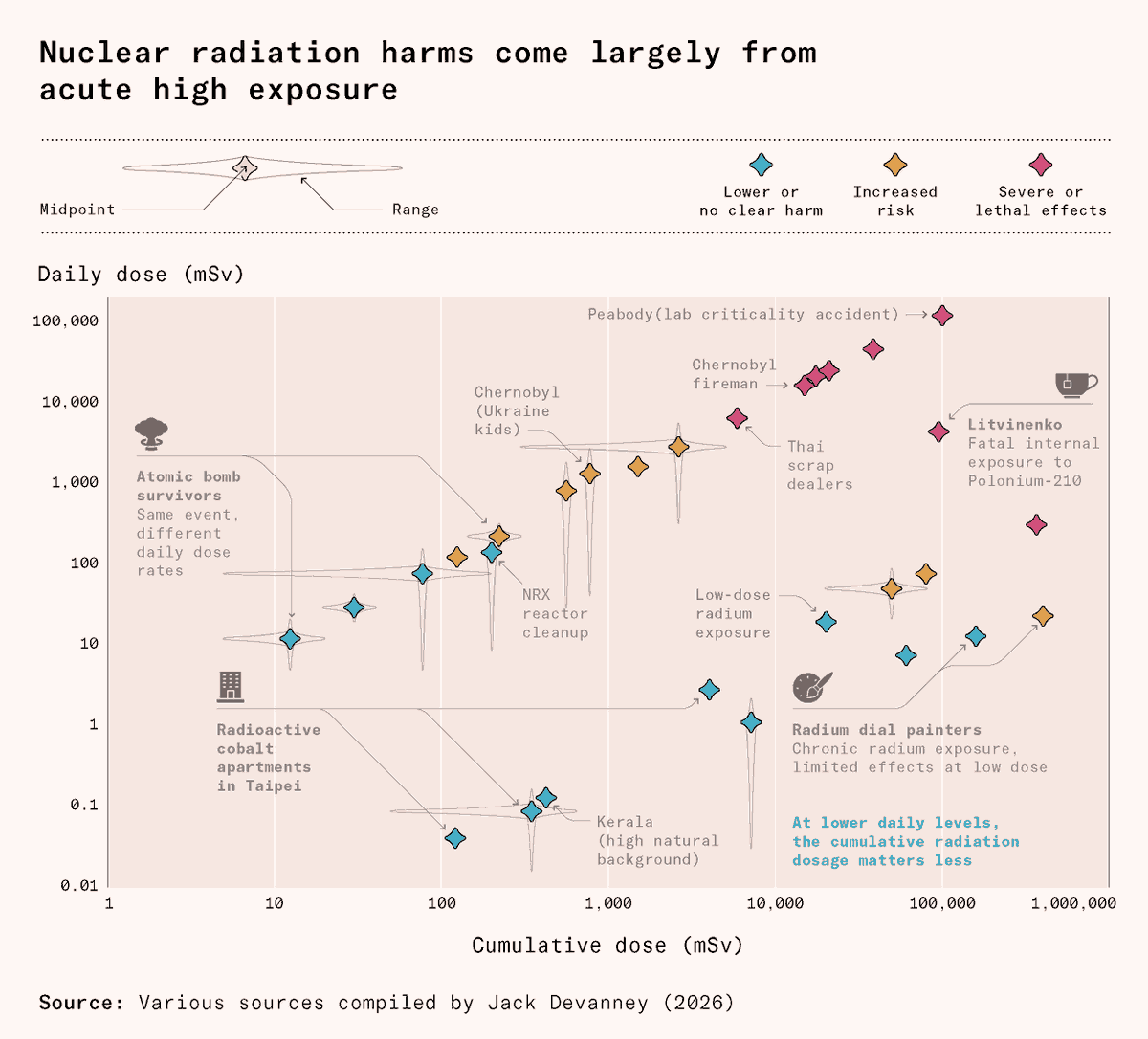
All of nuclear power 'safety' regulation is built on the idea that, when the same question comes to radiation, there's no difference. But the empirical evidence is overwhelming that the body repairs small amounts of damage caused by ionising radiation in the same way it repairs damage from other small harms.
If this is correct it would mean that the "unsafe at any dose" philosophy that has underpinned the regulation of nuclear energy since the 1970s is wrong. It is premature to conclude that yet: we need more evidence.
But if that further research does confirm what the existing evidence suggests, then nuclear power is much, much more expensive than it needs to be, even in places like South Korea that build cheaply, and nuclear power could be cheaper than any other form of electricity.
We could go much further than, say, the Fingleton Review or the mainstream proposals for reform that are on the table in the United States. We could have a new atomic age in which the "too cheap to meter" dream was realised.
Would you rather be exposed to the radiation of 1,000 CT scans all in one go, or be hit with the same cumulative amount of radiation, but over the course of a lifetime?
https://t.co/krJx47qKAh
Hopefully you will not have to take that decision, but if you do, make sure it's spread out over your lifetime.
There is now overwhelming evidence that low-dose-rate ionizing radiation is not that harmful. Even Chernobyl, by far the world's worst nuclear disaster, exposed millions yet has likely killed 60 or so people. A total of 200 may die early. The other bad civil nuclear disasters – Windscale, Fukushima, and Three Mile Island – likely killed nobody at all.
The evidence is rolling in:
---> Many residents of Kerala are exposed to seven full-body CT scans' worth of ionizing radiation every year. But multiple studies find no effect on their health.
---> Taiwanese apartment dwellers were unwittingly exposed to up 100 CT scans per year because their apartments were made with radioactive cobalt rebar. But dwellers suffered much lower cancer rates than other age-comparable Taiwanese.
---> Between 1915 and 1950, women in factories painted radium onto watch dials to make them glow in the dark. Those licking the brushes sometimes suffered severe cancers. But non-lickers had lifetime doses equivalent to nearly 1,000 CT scans with no effect.
---> At 58 in 1945, Albert Stevens was injected with an enormous amount of plutonium, exposing him to a radiation dose equivalent to 300 CT scans every year. He lived to be 79.
These and many other studies show that ionizing radiation's harms are primarily about concentrated acute doses, not low doses over a long time. Yet nuclear regulatory systems are based around the principle that any radiation exposure is totally intolerable. This leads to rules like 'ALARA' – as low as reasonably achievable – which continually ratchet up regulatory requirements, making nuclear power slow and expensive.
Read my new piece with @chalmermagne for @WorksinProgMag.